| U.S.S. BISMARCK
NCC-1108B
ARMORY - DECK 03 |
 |
| U.S.S. BISMARCK
NCC-1108B
ARMORY - DECK 03 |
|
A
NOTE FROM THE MASTER-AT-ARMS
 |
|
|
- PO3
Azhaar de Monde
Master-at-Arms
U.S.S. BISMARK NCC-1108B
THE PHASER
Phaser energy is released by the rapid nadion effect. Rapid nadions are short lived subatomic particles which can liberate and transfer strong nuclear forces within a class of crystals called fushigi-no-umi.
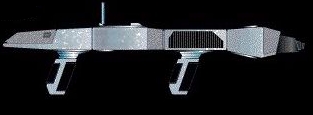
Phasers have three distinct effects on the target. At low power settings - setting 1 to 3 on a hand phaser - the impact of phaser energy is almost wholly limited to simple electromagnetic and mild thermal effects. These are concentrated on the nervous system of the target, causing pain and/or unconsciousness in most beings. At higher levels the thermal effect becomes prevalent, and the phaser will begin to cause physical damage to the target resulting in moderate or severe injuries. By the time the power level is at setting 7 the energy is distributed equally between thermal and nuclear disruption energy. Disruption effects become widespread, resulting in immediate death to most Humanoid life forms.
At levels higher than 7 the majority of phaser energy is in the form of nuclear disruption. A large portion of the target is simultaneously vaporized and transitioned out of the continuum, a process which is instantly fatal. The higher power settings available with Type 3 phasers (setting 9+) cause severe damage over a wide area. These settings are rarely used because of the relatively high power consumption; a single setting 10 discharge uses more than twenty five times as much energy as a setting 7 discharge, while a setting 16 discharge uses over three hundred and fifteen times as much.
TYPE
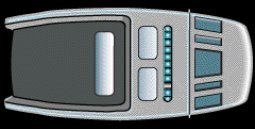
1 PHASER
 |
TYPE
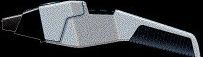
2 PHASER
 |
TYPE
3 PHASER
 |
COMPRESSION
PHASER
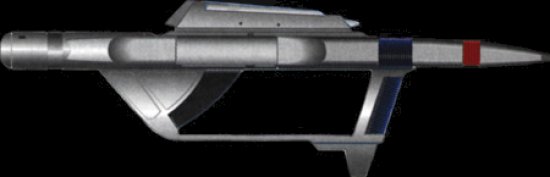 The Compression rifle concentrated on simplicity. The LiCu 521 discharge crystal was doped with arsenic atoms and trisilinate molecules in order to restrict the phaser energy discharge. The doping materials diverted a small part of the discharging energy to re-establish the charge barrier between the discharge crystal and the Sarium kelleride power crystal, limiting or compressing the beam to a maximum of 200 picoseconds of firing. This would fire the entire energy discharge in a beam of only 6 centimetres length, greatly increasing the intensity of the energy and so enhancing the effect on the target. Although it was by far the simpler of the two weapons, great difficulties were encountered during the development of the compression rifle. Most of these centred around thermal damage to the discharge crystal resulting from the very high energy intensities flowing through it. Average firing lifetime of an emitter crystal in the first model developed was only 9.6 nanoseconds - 48 discharges - a far from acceptable figure. Redesign of the shape of the emitter boosted this figure to 28 nanoseconds, still not sufficient for a field weapon. The solution arrived at was to install two high capacity cooling systems, one mounted on either side of the rifle. This boosted the emitter crystals lifetime to 600 nanoseconds, or 3,000 discharges. Starfleet deemed this just about acceptable and rushed the compression rifle into limited service. |
TYPE
3A PHASER (Mk. I & Mk. II)
|
||||
| The Type 3A Phaser, known
also as the Pulse Rifle and the Heavy Phaser Rifle, is a much larger, more
sophisticated weapon than other Phaser Rifle variants. It is capable of
firing phaser energy in either beams or pulses of variable length, therefore
giving it better armour penetration abilities or improved multiple foe
combat abilities.
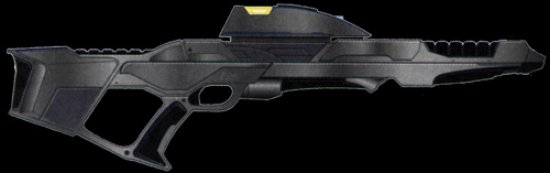
When the Starfleet desgin team began work on the Type 3a variant, they decided rather than tamper with the materials that made up the discharge crystal, they built in a small isolinear artificial intelligence unit into the Type 3a which had complete control over energy discharge of the weapon. The desigin team encountered considerable success in it's testing program that was surprisingly free of difficulties. The use of a computer control system also allows the beam characteristics to be modified much more easily than in previous phaser rifles, which is clearly important when dealing with adaptable foes such as the Borg. The Type 3a also includes a much more effective and elaborate targeting system, a more powerful gyrostabilizer, and a larger energy reserve, giving the Type 3a excellent assult and defense characteristics, making for an allround excellent sidearm. The Type 3a is capable of firing on a maximum of setting of 18. The targeting unit is now being retro-fitted into earlier models of phaser rifle. The first model of heavy phaser rifle (Mk. I - T3a) had a duranium alloy metal stiffening to the barrel, but in service this has proved to be unnecessary and a subsequent model was issued (Mk. II - T3a) without this feature. The USS Bismark employs both variant types of the Type 3a, but is phasing out most of the Mk. I variants, opting instead toward the lighter Mk. II variant. |
TR-116 RIFLE
 |