|
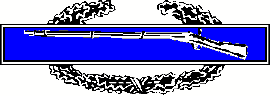
| The
Combat Infantryman Badge was established by the War Department on
October 27, 1943. It remains as one of the most revered badges in
the U.S. military. To be awarded the CIB, a soldier must be an
infantryman satisfactorily performing infantry duties, must be
assigned to an infantry unit when the unit is engaged in ground
combat, and must actively participate in the ground combat.
Personnel assigned special forces specialty codes are also
authorized the CIB under the same conditions. Separate awards of the
CIB have been authorized for World War II, the Korean War, and the
Vietnam War. Only one award is authorized for service in Vietnam,
Laos, the Dominican Republic, Korea (after July 27, 1954), Grenada,
Panama, and the Persian Gulf War regardless of whether an individual
has served one or more tours in one or more of these areas. Second
and third awards of the CIB are indicated by superimposing 1 and 2
stars, respectively, centered at the top of the badge between the
points of the oak wreath. |
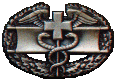
| Originally established as the Medical Badge, the Combat
Medical Badge (CMB) was created by the War Department on March 1,
1945. It could be awarded to officers, warrant officers, and
enlisted men of the Medical Department assigned or attached to the
medical detachment of infantry regiments, infantry battalions, and
elements thereof designated as infantry in tables of organization or
tables of organization and equipment. Its evolution stemmed from a
requirement to recognize medical aidmen who shared the same hazards
and hardships of ground combat on a daily basis with the infantry
soldier. Second and third awards of the CMB are indicated by
superimposing 1 and 2 stars respectively, centered at the top and
bottom of the badge. The soldier must have been personally present
and under hostile fire while assigned as specified. (Edited and
paraphrased from the Military Code)
| |