|
|
||||||||||
|
|
||||||||||
Seaplanes |
||||||||||
|
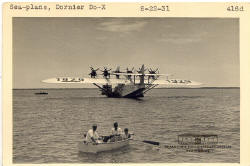
Seaplane, Dornier Do-X Men in Rowboat |
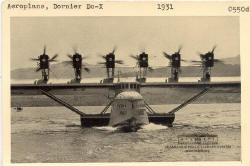
Miami's climate and the calm waters of Biscayne Bay have made it an ideal location for seaplanes to be used. This was a major factor in Pan American Airways' decision to locate their Flying Boat operations at Dinner Key. Many other seaplane services have based their operations in South Florida. This photograph taken on August 22, 1931 shows the Dornier Do-X seaplane on Biscayne Bay. |
|||||||||
|
The Dornier Do-X seaplane was an experimental aircraft built by Claude Dornier, a German engineer who had gained experience working in the Zeppelin airship factory. In 1911, he designed the first all-metal airplane. Impressed by his skills, Zeppelin allowed him to open a new division of the company. This division manufactured fighter planes for Germany during World War I. After the War, Dornier set his sights on developing a long-range seaplane for overseas passenger routes. |
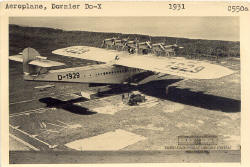
Aeroplane, Dornier Do-X, 1931 |
|||||||||
|
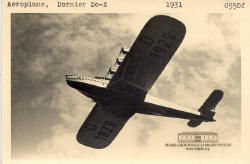
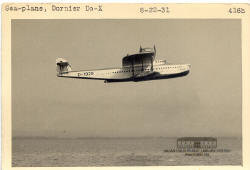
Aeroplanes: Side View in Air Additional Title: Sea Plane, Dornier Do-X, 8-22-31 |
The resulting aircraft was the Dornier Do-X, shown flying over Biscayne Bay on August 22, 1931. Completed in 1929, the Do-X was the world's largest aircraft. Total length of the aircraft was 131 feet, with a wingspan of 157 feet. Powered by twelve 640-hp Curtiss Conqueror V-12 piston engines, the Do-X had a maximum speed of 130 mph and a range of 1,367 miles. The aircraft was intended to carry 100 passengers on three deck levels. Individual sleeping cabins were provided and the amenities were designed to be comparable to those of ocean liners. |
|||||||||
|
The Do-X had its first successful flight on October 21,1929. It carried 169 passengers on a one hour flight. Dornier expected to attract great interest from prospective buyers. However, the 1929 Wall Street crash and the resulting Great Depression hindered Dornier's attempts to market this aircraft. In order to create interest in his airplane and perhaps find buyers, Dornier decided to embark on an around the world flight. It was on this flight that the Do-X visited Miami and was photographed by Romer. |
On Shore of Swiss Lake, Do-X Flying Boat, N.D. |
|||||||||
Do-X Flying Boat, Taxiing from Lake on Take Off |
By all accounts, the around the world flight was a disaster. The flight was troubled by several mechanical problems and accidents. Dornier eventually completed the flight, but it took ten months to do so. Although the Do-X was an impressive looking aircraft and an engineering marvel, prospective buyers were hard to find. Eventually an Italian airline company ordered two of these aircraft, but they were never used for passenger service. | |||||||||
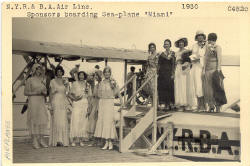
| This photograph shows a New York, Rio, & Buenos Aires Air Lines seaplane boarding passengers in Miami. NYR&BA provided service down the east coast of South America from New York with stopovers in Miami. It was an early competitor of Pan American, but suffered when its rival secured the highly coveted air mail contracts. Many have suggested that Pan American used political connections to secure the contracts. Eventually, Pan American purchased NYR&BA and took over its aircraft and routes. |
N.Y., Rio & Buenos Aires Air Line. 1930 |
|||||||||
N.Y.R. & B.A. Air Line. Plane "Miami" as Seen from Dinner Key Dock. 1930 |
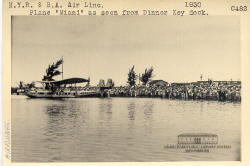
Shown at Dinner Key in 1930 is a NYR&BA Consolidated Commodore seaplane. These planes could carry 22 passengers at a speed of 108 mph and were used to carry mail and passengers on the route down the east coast of South America with a final destination of Buenos Aires. The Commodores went into service on November 10, 1929. They flew for NYR&BA only until September 15, 1930 when Pan American took over the company. These aircraft were then switched to Caribbean routes allowing the Pan American Sikorsky Clipper Ships to service South America. | |||||||||
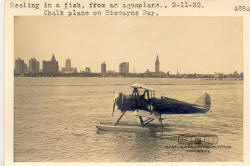
| Another seaplane service to thrive in Miami was Chalk's Flying Service. Founded in 1919 by Arthur "Pappy" Chalk, the airline has operated from Watson Island since 1926. Service is mostly to the Bahamas. The airline has a colorful history and has carried many celebrated figures. During prohibition, Al Capone, bootleggers, and federal agents all flew on Chalk's. Ernest Hemingway was also a regular passenger for fishing excursions to the Bahamas. Today the company operates as Chalk's Ocean Airways and serves the casinos of Paradise Island, as well as the out islands of the Bahamas. |
Fishing from Aquaplane with Skyline Behind |
|||||||||