|
|
||||||||||
|
|
||||||||||
Pan American Airways |
||||||||||
|
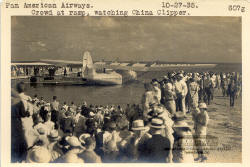
Pan American Airways. Crowd at Ramp, Watching China Clipper. 10-27-35 |
A large crowd is shown at Dinner Key in Coconut Grove to see the arrival of the China Clipper. This Martin 130 was delivered to Pan American on September 10, 1935 at a cost of $417,000. The China Clipper won fame for inaugurating trans-Pacific airline service in November, 1935 with a flight from San Francisco to Manila with stops in Honolulu, Midway, Wake, and Guam. This aircraft could carry 52 passengers and had a range of 3,200 statute miles. The China Clipper served most of its career in the Pacific, with occasional service out of Miami. This particular aircraft sank on January 8, 1945 in Port of Spain, Trinidad. |
|||||||||
|
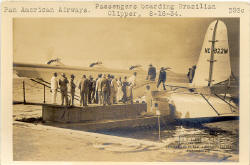
Most early Pan American flights out of Miami served the Caribbean and Latin America from the Seaplane Terminal at Dinner Key. Passengers are shown boarding the Brazilian Clipper for its maiden flight to Rio de Janeiro on August 16, 1934. The inaugural flight carried 19 passengers and a crew of 8. On arrival in Rio, the plane was christened by the wife of the Brazilian President, Getulio Vargas. |
Pan American Airways. Passengers Boarding Brazilian Clipper, 8-16-34. |
|||||||||
|
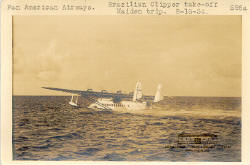
Pan American Airways. Brazilian Clipper Take-Off maiden Trip. 8-16-34 |
Shown taking off from Miami on its first flight to Brazil, the Brazilian Clipper was a Sikorsky S-42 manufactured in Connecticut by Russian immigrant Igor Sikorsky at a cost of $242,000. This particular aircraft could carry a maximum of 32 passengers, had a cruising speed of 150 mph, and a range of 1,200 statute miles. This aircraft was replaced on the Rio de Janeiro route by a newer version S-42A in 1937 and renamed the Colombia Clipper. It served on routes to Colombia and the Caribbean until it was retired in July, 1946. |
|||||||||
|
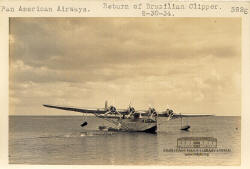
The Brazilian Clipper is shown upon its return to Miami after its inaugural flight to Rio. The date of this photograph is August 30, 1934. The roundtrip flight took two weeks to complete. On the way to and from Brazil, overnight stops were made in San Juan, Port of Spain, Georgetown, Belem, Fortaleza, and Salvador. Intermediate stops were made for refueling. |
Return of Clipper Ship at Sunset. 1934 |
|||||||||
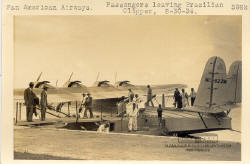
Pan American Airways. Passengers Leaving Brazilian Clipper, 8-30-34 |
Passengers are shown leaving the Brazilian Clipper on its return to Miami from Rio de Janeiro. In 1936, a 12 day aerial cruise to Rio de Janeiro was advertised by Pan American for the price of $865. A 19 day trip including a 10 day stay in Rio cost $895. Passengers were tempted with the opportunity to visit 10 countries along the way. | |||||||||
| The Brazilian Clipper heads to its dock after returning to Miami from Rio. After allowing passengers to disembark, Pan American seaplanes came up a ramp and were stored on dry land between flights. This facilitated maintenance and refueling. Ramp facilities were available at most of the seaplane stops along the way to and from Brazil. One of the reasons that Pan American chose to use seaplanes was the lack of well developed airports in many of the countries that were served. The cost of creating seaplane bases was relatively inexpensive and preferable to using inadequate airports. |
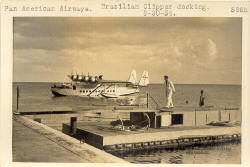
Pan American Airways. Brazilian Clipper Docking. 8-30-34 |
|||||||||
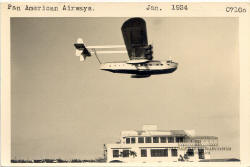
Pan American Airways. Jan. 1934 |
A Pan Am Clipper is shown landing at the Pan American Seaplane Terminal at Dinner Key. The Terminal Building shown in the background was taken over by the City of Miami when Pan American eliminated Flying Boats and now serves as City Hall. The plane landing is an S-40, which was a pioneer on the Latin American and Caribbean routes. Pan American owned three of these aircraft and they were known as the American Clipper, the Caribbean Clipper, and the Southern Clipper. | |||||||||
| Pictured third from the left is Charles Lindbergh, the first man to fly solo across the Atlantic. He is pictured with his crew for the maiden flight of the American Clipper. Pan American hired Lindbergh as a technical advisor with a salary of $10,000 per year. He often flew proving flights over new routes. His presence was guaranteed to attract favorable publicity for the airline since he was one of the world's great celebrities at the time. News reports claim 50,000 spectators came to Dinner Key to see Lindbergh take off on the inaugural flight of the American Clipper. |
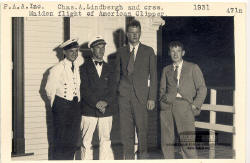
Pan American Airways: Crew Group |
|||||||||
|
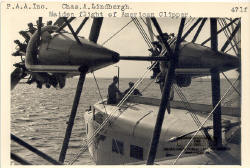
Pan American Airways: Lindbergh between Two Motors |
Lindbergh is shown standing in the cockpit of the American Clipper on November 19, 1931 before the take-off on its maiden flight bound for the Panama Canal Zone. This flight made overnight stops in Kingston, Jamaica; Baranquilla, Colombia; and finally Cristobal in the Canal Zone. The flight arrived on November 22, 1931 after three days of flying. There were 32 passengers aboard this S-40 including the plane's designer Igor Sikorsky. A large celebration was organized by the Postmaster in the Canal Zone heralding the arrival of the first air mail to Panama.. |
|||||||||