|
|
|
|
|
|
|
Military Aircraft |
|
|
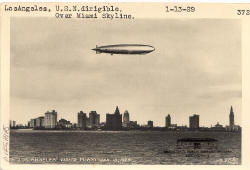
"Los Angeles", U.S.N. Dirigible. Over Miami Skyline. 1-13-29 |
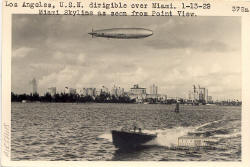
This photograph shows the U.S. Navy dirigible "Los Angeles" flying over Biscayne Bay with downtown Miami in the background. The "Los Angeles" made several trips to Miami and is pictured here while attending the Miami All American Air Races of 1933. This airship was manufactured in Germany and delivered to the U.S. government as part of war reparations following World War I. It was originally intended to be a commercial ship similar to the Hindenburg and Graf Zeppelin. |
|
Pictured from the south with the Miami skyline in the background, the "Los Angeles" was the largest aircraft in the world when first flown in 1924. She arrived in the United States on October 14, 1924 after a 82 hour, 5,000 mile flight from Germany. This was a new record for the longest airship flight and the "Los Angeles" was only the fourth aircraft to cross the Atlantic. She was commissioned by Mrs. Calvin Coolidge on November 25, 1924 and began service for the Navy shortly thereafter. |
"Los Angeles", U.S.N. Dirigible over Miami. Miami Skyline as Seen from Point View.1-13-29 |
|
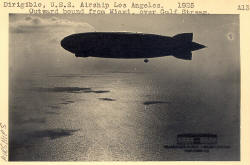
Dirigible, U.S.S. Airship Los Angeles. Outward Bound from Miami, Over Gulf Stream. 1925 |
This photograph shows the "Los Angeles" leaving Miami in 1935. This airship was 658 feet long and was powered by five 400 HP engines. During her career the "Los Angeles" pioneered several new techniques including the launching and recovery of fixed wing aircraft while in flight and sea landings and rendezvous with aircraft carriers. She was decommissioned from the Navy in 1932 after eight years of service, but continued to fly in a non-military capacity. Presumably, her visits to the Miami Air Meets were in this function. The "Los Angeles" was dismantled at Lakehurst, N.J. in 1939 for budgetary reasons. |
|
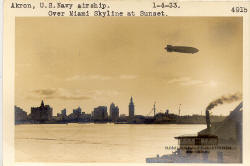
Another Navy dirigible, the "Akron", is pictured over the Miami skyline in January, 1933. The "Akron" was built by the Goodyear-Zeppelin Company and christened by the First Lady, Mrs. Herbert Hoover, on August 8, 1931. This airship set a record in 1931 when it carried 207 people on a 10 hour flight. The "Akron" was capable of storing internally and launching 4 scout planes for reconnaissance purposes. Shortly after this photograph was taken, the "Akron" departed Miami for a short trip to Cuba. In March, the "Akron" visited Panama. Opa-Locka was the departure base for both of these missions. On the evening of April 3, the "Akron" was lost in a crash off New Jersey caused by high winds. Only three of 76 crewmen aboard survived. |
Akron, U.S.N. Airship over Miami Skyline. 1933 |
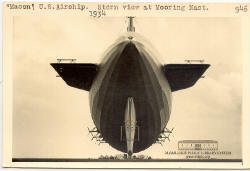
"Macon." U.S. Airship. Stern View at Mooring Mast. 1934 |
Pictured at the mooring mast at Opa-Locka is the Navy dirigible "Macon". This photograph shows a stern view of the airship. The "Macon" was the sister ship of the "Akron", but was slightly larger at 785 feet long. The intended purpose of this airship was to perform scouting missions. After the crash of the "Akron", Navy officials were under great pressure to prove the value of airships. Although the "Macon" was in need of repairs for "minor structural deficiencies", Naval leadership sent the "Macon" out to participate in fleet operations in the Pacific. On February 12, 1935, the "Macon" went down off the coast of California. All but two of the crew of 83 survived, but this forced the Navy to abandon the use of rigid airships. |
| Pictured here from the Miami All American Air Races of January, 1933 is Boeing Bomber Number 100. This aircraft was christened "The City of Miami" in a ceremony at the air meet. This bomber was produced in the period between the two World Wars. Although the original photograph does not include the bomber's model number, it appears to be a Boeing B-9 bomber first manufactured in 1931. This aircraft carried a crew of five in an open cockpit, had two machine guns, and carried a 2,400 pound bomb load. The relatively fast top speed of 186 mph caused other manufacturers to develop a new generation of bombers. |
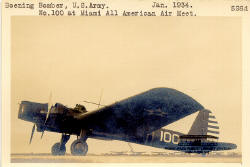
Boeing Bomber, U.S. Army. No. 100 at Miami All American Air Meet. Jan. 1934 |
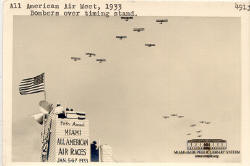
All American Air Meet: Bombers over Timing Stand. 1933. |
A group of bombers performs a flyover at the 1933 Miami All American Air Races. The U.S. Army Air Corps was anxious to emphasize the importance of military aviation to the public. They took every opportunity to provide demonstrations of their flying prowess and were annual visitors to the air show. The annual visit to Florida also allowed pilots to train and fly in good weather. |