|
|
||||||||||
|
|
||||||||||
Graf Zeppelin |
||||||||||
|
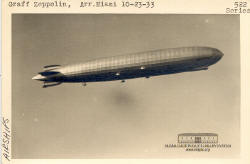
Graf Zeppelin, Arrive Miami, 10-23-33 |
The German airship Graf Zeppelin and its sister ship the Hindenburg were the most famous airships in the history of aviation. The Graf Zeppelin visited Miami in October, 1933 on its way from Rio de Janeiro to Chicago for the "Century of Progress" World's Fair. This photograph shows the Graf Zeppelin over Miami on October 23, 1933. |
|||||||||
|
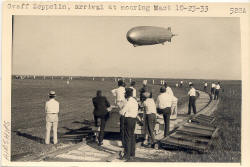
Shown approaching the Opa Locka Naval Air Base on October 23, 1933, the Graf Zeppelin had departed from Rio de Janeiro on October 19. The flight had taken the Zeppelin to the Brazilian cities of Recife and Natal, the Amazon jungle, Cayenne in French Guiana, Devil's Island, Trinidad, Grenada, St. Vincent, Puerto Rico, and finally Miami. |
Graf Zeppelin: Arrival at Opa-Locka Field. 1933 |
|||||||||
|
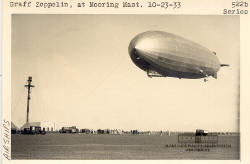
Graf Zeppelin. Contact with Mooring Mast |
Shown approaching the mooring mast, the Graf Zeppelin was piloted by Dr. Hugo Eckner; one of the developers of the Zeppelins. Built in 1925, the Graf Zeppelin was 776 feet long and had a maximum diameter of 100 feet. This airship carried 20 passengers in ten staterooms and had 45 to 50 crewmembers. The maximum speed was 71.5 mph and the Zeppelin could cruise for 118 hours before needing to land for refueling. |
|||||||||
|
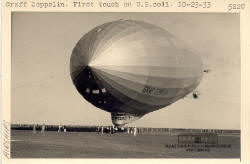
This photograph shows the first touchdown of the Graf Zeppelin on U.S. soil on its way to Chicago. Hitler had come to power in Germany in January 1933 and the arrival of the Graf Zeppelin was somewhat controversial. Especially troubling were the Nazi Swastika's ordered to be painted on the port side of the tail fin and rudder by Hitler. Captain Eckner had strongly disapproved of this. |
Graf Zeppelin. First Touch on U.S. Soil. 10-23-33 |
|||||||||
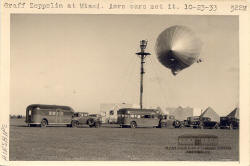
Graf Zeppelin at Miami. Aero Cars Met It. 10-23-33 |
A large crowd numbering in the thousands was reported to be on hand to view the Graf Zeppelin's arrival. There are reports that the public was allowed no closer than one half mile to the Zeppelin. Those allowed on the field were reportedly searched for weapons by police. Florida Governor David Scholtz had been informed of possible anti-German demonstrations and sent a telegram to the County Sheriff advising him to protect the Graf Zeppelin and its crew during their stay in Miami. Nevertheless, Miami newspapers photographed and commented on the Swastikas in their reports. | |||||||||
| Shown taking on fuel at its mooring mast, the Graf Zeppelin is generally considered to be the most successful airship in history. She was retired after the spectacular explosion of her sister ship, the Hindenburg, at Lakehurst, N.J. on May 6, 1937. In all, the Graf Zeppelin completed 590 flights; successfully carrying more than 13,100 passengers. She made the first round the world flight in 1929 and provided regularly scheduled passenger service between Germany and South America from 1933 through 1937. |
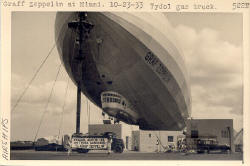
Graf Zeppelin at Miami. Tydol Gas Truck. 10-23-33 |
|||||||||