|
|
||||||||||
|
|
||||||||||
Airports |
||||||||||
|
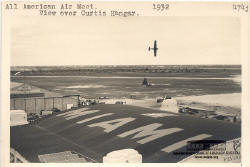
All American Air Meet. View over Curtiss Hangar. 1932 |
Municipal Airport was Miami's major airport in the early days of aviation. It was located close to the site of the present-day Opa-Locka Airport. The annual Miami All American Air Races were held at Municipal Airport beginning in 1929. Opa-Locka was the last departure point in the United States for Amelia Earhart on her attempted around the world flight. At one point in the 1960s, Opa-Locka was the world's busiest airport - recording more takeoffs and landings than any airport in the world. |
|||||||||
|
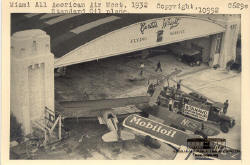
This photograph shows a view of the Curtiss Wright Hangar at Municipal Airport. Glenn Curtiss was an early aviation pioneer and along with the Wright brothers held many important aviation patents. Curtiss Wright Flying Service had a presence at many airports across the country. Curtiss moved to Miami and became involved in real estate. He is the founder of the Miami suburb of Miami Springs. The architecture favored by Curtiss was "Pueblo"-style. This style is visible in the architecture used for the hangar. |
All American Air Meet, 1932 Standard Oil Plane |
|||||||||
|
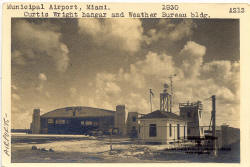
Municipal Airport, Miami. Curtiss Wright Hangar and Weather Bureau Building. 1930 |
Another view of the Curtiss Wright hangar and the U.S. Weather Service building at Municipal Airport. Today, Opa-Locka Airport houses a Coast Guard Air Rescue station. Emergency helicopter flights provide rescue services in the Miami area and extend into the Bahamas when necessary. |
|||||||||
|
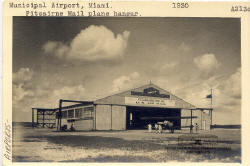
Curtiss did not have a monopoly at Municipal Airport. Other flying services and airlines were present. Pictured here is the hangar of Pitcairn Aviation. Pitcairn, which later became Eastern Airlines, provided U.S. Air Mail service to Miami. Today, Opa-Locka is a major civil aviation and cargo airport providing services to the Caribbean Islands. |
Municipal Airport, Miami. Pitcairn Mail Plane Hangar. 1930 |
|||||||||
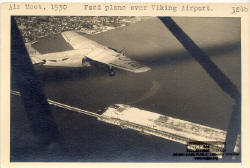
Air Meet, 1930 Ford Plane over Viking Airport |
Viking Airport was located on Biscayne Island on the Venetian Causeway. This location was within minutes of downtown Miami. However, as waterfront property became valuable for development purposes, it was converted into residential real estate. Today, Biscayne Island is the home to high-rise condominiums and apartment buildings. | |||||||||
| This photograph from December, 1931 looks southwest over Viking Airport on Biscayne Island. The County Causeway connecting South Beach with downtown Miami can be seen in the distance. |
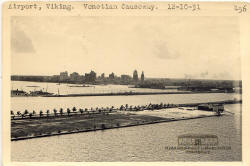
Airport, Viking. Venetian Causeway. 12-10-31 |
|||||||||
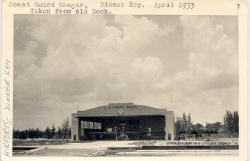
Coast Guard Hangar, Dinner Key. Taken from Old Dock. April 1933. |
This 1933 photograph shows the Coast Guard hangar at Dinner Key in Coconut Grove. Pan American Airlines also used Dinner Key as the Terminal for their Clipper Ship Flying Boats. Service was provided to Latin America and the Caribbean from this location. | |||||||||
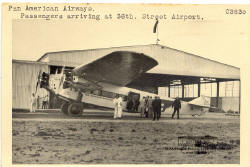
| Before switching over to the Flying Boats, Pan American operated out of the 36th Street Airport. This terminal continued to serve passengers using conventional aircraft. The 36th Street Airport eventually became Miami International Airport and is one of the world's busiest international hubs. It is a major gateway to Europe, Latin America, and the Caribbean. |
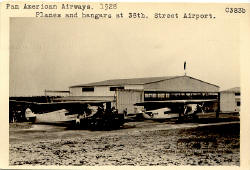
Pan American Airways. Planes and hangars at 36th Street Airport. 1928 |
|||||||||
|
Pan Am Fokker Tri-Motor, 36th St. Depot. 1928 |
Pictured here at the 36th Street Airport is Pan American NC9700, a Fokker F-10A. This airplane carried 12 passengers at a speed of 118 mph. Pan American took delivery of this plane on December 31, 1928. It was put into service on the route between Miami and Puerto Rico via Santo Domingo and Cuba. This particular aircraft, christened the "Christopher Columbus", was lost in a crash in Santiago de Cuba on June 13, 1929. |
|||||||||