

Modern World History: The Scientific Revolution
At the time of the Middle Ages, many mathematicians, astronomers, and scientists took an interest in the world around them. They were known though not to make observations of the natural world. These philosophical people relied on the few ancient believers--especially Aristotle--for their scientific understanding.These number of changes were believed to have happened around the fifteenth and sixteenth centuries.
The Renaissance humanists had taught themselves Greek as well as Latin and thus gave them access to newly discovered works by Ptolemy, Archimedes, and Plato. These writings made it obvious that not all of the ancient thinkers agreed with Aristotle and other accepted persons of the Middle Ages.
Some other developements also encouraged new ways of thinking. Techinical issues that needed dutiful observations and accurate measurements, such as calculating the amount of weight that a scale must hold, served to arrouse scientific activity. Also, too, the invention of new instruments, like the telescope and microscope, made fresh scientific discoveries available. Above all, the priniting press paved the way to spread new ideas quickly and easily.
Arithematic played a very important role in the scientific accomplishments of the sixteenth and seventeenth centuries. The study of mathematics was encouraged during the Renaissance by the rediscovery of the works of ancient arithematic studiers. Nicholas Copernicus, Johannes Kepler, Galileo Galilei, and Isaac Newton were all great mathematicians who thought that the secrets of nature were written in the language of math. After studying and somtimes, disposing of the ideas of the acient mathematicians, these enlightened thinkers developed new theories that became the support system of the Scientific Revolution.
A Revolution in Astronomy
Especially significant in the scientific revolution wre the discoveries in astronomy. These discoveries would overturn the conception of the universe held by westerners in the Middle Ages.
The Ptolemaic System
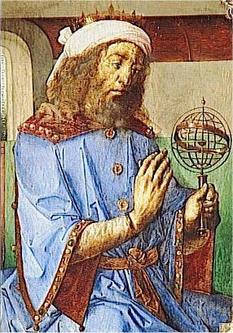
Ptolemy, who lived in the second century A.D., was the greatest astronomer of antiquity. Using his ideas, as well as those of Aristotle and of Christianity, the philosophers of the Middle Ages had constructed a model of the universe known later as the Ptolemaic system. This system is called geocentric because it places earch at the center of the universe.
In the Ptolemaic system, the universe is a series of concentric spheres--spherese one inside the other. Earth is fixed, or motionless, at the center of these spheres. The spheres are made of a crystal-like, transparent substance, in which the heavenly bodies--pure orbs of light --are embedded. For example, the moon is embedded in the first sphere, Mercury in the second, Venus in the third, and the Sun in the fourth. The rotation of the spheres makes these heavenly bodies rotate about the earth and move in relation to one another.
The tenth sphere in the Ptolemaic system was the "prime mover," which moved itself and gave motion to the other spheres. Beyond the tenth sphere was Heaven, where God and all the saved souls resided. God was at one end of the universe, then, and humans were at the center. Humans had been given power over the earth, but their real purpose was to achieve salvation.
Copernicus and Kepler
In May 1543, Nicholas Copernicus, a native to Poland, published his famous book, ON the Revolutions of the Heavenly Spheres. Copernicus, a mathematician, felt that the geocentric system was too complicated. He believed that his heliocentric, or sun centered, conception of the universe offered a more accurate explanation than did the Ptolemaic system.
Copernicus argued that the Sun, not Earth, was at the center of the universe. The planets revolved around the sun. The Moon, however, revolved around Earth. Moreover, according to Copernicus, the apparent movement of the Sun around Earth was really caused by daily rotation of Earth on its axis and the journey of Earth around the Sun each year.
The next step in destroying the Ptolemaic system was taken by the German mathematician Johannes Kepler. Kepler used detailed astronomical data to arrive at his laws of planetary motion. His observations confirmed that the Sun was at the center of the universe and also added new information. In his first law, Kepler showed that the orbits of the planets around the Sun were not circular, as Copernicus had though. Rather, the orbits were elliptical (egg-shaped), with the Sun toward the end of the ellipse instead of at the center. This finding, known as Kepler's First Law, contradicted the circular orbits and crystal-like spheres that were central to the Ptolemaic system.
Galileo
Scientists could now think in terms of planets revolving around the Sun in elliptical orbits. IMportant questions remained unanswered, how ever. What are the planets mad eof? How does one explain motion in the universe? An Italian scientist answered the first question. Galileo Galilei taught mathematics. he was the first European to make regular observations of the heavenes using a telescope. With this tool, Galileo made a remarkable series of discoveries: mountains on the Moon, four moons revolving around Jupiter, and sunspots. Galileo's observations seemed to destory yet another aspect of the Ptolemaic system. Heavenly bodies had been sen as pure orbs of light. Instead, it appeared tha tthey were composed of material substance, just as Earth was.
Galileo's discovereis, published in the starry messenger in 1610, did more to make Europeans aware of th enew view of the universe than did the works of Copernicus and Kepler. In the midst of his newfound fame, owever, Galileo foudn himself under suspicion by the authorities of the Catholic Church.
for the rest of the article go to www.glencoe.edu
The Renaissance humanists had taught themselves Greek as well as Latin and thus gave them access to newly discovered works by Ptolemy, Archimedes, and Plato. These writings made it obvious that not all of the ancient thinkers agreed with Aristotle and other accepted persons of the Middle Ages.
Some other developements also encouraged new ways of thinking. Techinical issues that needed dutiful observations and accurate measurements, such as calculating the amount of weight that a scale must hold, served to arrouse scientific activity. Also, too, the invention of new instruments, like the telescope and microscope, made fresh scientific discoveries available. Above all, the priniting press paved the way to spread new ideas quickly and easily.
Arithematic played a very important role in the scientific accomplishments of the sixteenth and seventeenth centuries. The study of mathematics was encouraged during the Renaissance by the rediscovery of the works of ancient arithematic studiers. Nicholas Copernicus, Johannes Kepler, Galileo Galilei, and Isaac Newton were all great mathematicians who thought that the secrets of nature were written in the language of math. After studying and somtimes, disposing of the ideas of the acient mathematicians, these enlightened thinkers developed new theories that became the support system of the Scientific Revolution.
A Revolution in Astronomy
Especially significant in the scientific revolution wre the discoveries in astronomy. These discoveries would overturn the conception of the universe held by westerners in the Middle Ages.
The Ptolemaic System
Ptolemy, who lived in the second century A.D., was the greatest astronomer of antiquity. Using his ideas, as well as those of Aristotle and of Christianity, the philosophers of the Middle Ages had constructed a model of the universe known later as the Ptolemaic system. This system is called geocentric because it places earch at the center of the universe.
In the Ptolemaic system, the universe is a series of concentric spheres--spherese one inside the other. Earth is fixed, or motionless, at the center of these spheres. The spheres are made of a crystal-like, transparent substance, in which the heavenly bodies--pure orbs of light --are embedded. For example, the moon is embedded in the first sphere, Mercury in the second, Venus in the third, and the Sun in the fourth. The rotation of the spheres makes these heavenly bodies rotate about the earth and move in relation to one another.
The tenth sphere in the Ptolemaic system was the "prime mover," which moved itself and gave motion to the other spheres. Beyond the tenth sphere was Heaven, where God and all the saved souls resided. God was at one end of the universe, then, and humans were at the center. Humans had been given power over the earth, but their real purpose was to achieve salvation.
Copernicus and Kepler
In May 1543, Nicholas Copernicus, a native to Poland, published his famous book, ON the Revolutions of the Heavenly Spheres. Copernicus, a mathematician, felt that the geocentric system was too complicated. He believed that his heliocentric, or sun centered, conception of the universe offered a more accurate explanation than did the Ptolemaic system.
Copernicus argued that the Sun, not Earth, was at the center of the universe. The planets revolved around the sun. The Moon, however, revolved around Earth. Moreover, according to Copernicus, the apparent movement of the Sun around Earth was really caused by daily rotation of Earth on its axis and the journey of Earth around the Sun each year.
The next step in destroying the Ptolemaic system was taken by the German mathematician Johannes Kepler. Kepler used detailed astronomical data to arrive at his laws of planetary motion. His observations confirmed that the Sun was at the center of the universe and also added new information. In his first law, Kepler showed that the orbits of the planets around the Sun were not circular, as Copernicus had though. Rather, the orbits were elliptical (egg-shaped), with the Sun toward the end of the ellipse instead of at the center. This finding, known as Kepler's First Law, contradicted the circular orbits and crystal-like spheres that were central to the Ptolemaic system.
Galileo
Scientists could now think in terms of planets revolving around the Sun in elliptical orbits. IMportant questions remained unanswered, how ever. What are the planets mad eof? How does one explain motion in the universe? An Italian scientist answered the first question. Galileo Galilei taught mathematics. he was the first European to make regular observations of the heavenes using a telescope. With this tool, Galileo made a remarkable series of discoveries: mountains on the Moon, four moons revolving around Jupiter, and sunspots. Galileo's observations seemed to destory yet another aspect of the Ptolemaic system. Heavenly bodies had been sen as pure orbs of light. Instead, it appeared tha tthey were composed of material substance, just as Earth was.
Galileo's discovereis, published in the starry messenger in 1610, did more to make Europeans aware of th enew view of the universe than did the works of Copernicus and Kepler. In the midst of his newfound fame, owever, Galileo foudn himself under suspicion by the authorities of the Catholic Church.
for the rest of the article go to www.glencoe.edu
2007-09-09 22:10:22 GMT