INTERFAITH EVENING
ABOUT QUAKERS
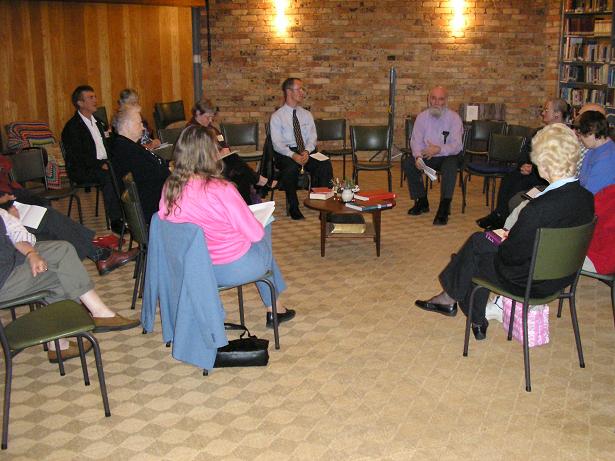
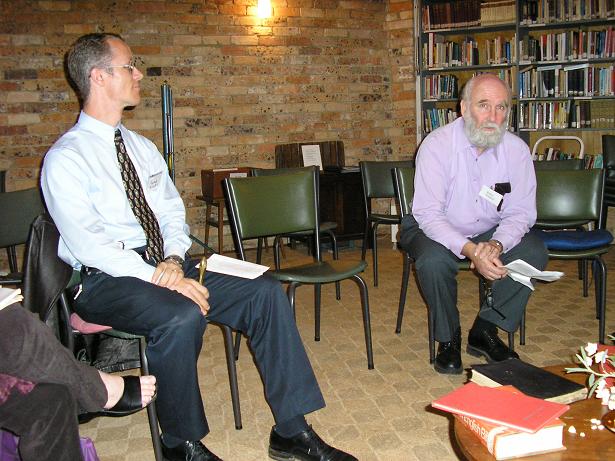
On May 5th the Wahroonga Quaker interfaith team, in keeping with its tradition
of asking little-known faith groups to talk about themselves, hosted an evening
about we Quakers ourselves. The audience (mostly Quakers, but drawn also from
Baha'i, Christian and Scientology traditions) was treated to a truly wonderful
presentation, by a panel of learned, thought-provoking and witty Friends. They
fielded some extremely stretching questions from the floor leaving everyone,
Friends and friends alike, going home with a lot to mull over.
Particular thanks are extended to Cyrus Brooks, from the Scientology tradition,
who agreed at very short notice to be our M.C. and who did the impossible:
herded a bunch of Quakers into a state of order and kept everyone wonderfully to
time.
HISTORY
Robin Walpole opened with an outline of Quaker history, explaining how Quakers
emerged from the turmoil of religious, social and political thought in 17th
Century England. He explained that they survived the persecutions of the
Restoration, probably because, unlike other movements, Quakers had no leadership
to destroy. Nevertheless 13,000 Quakers were imprisoned for refusal to swear
oaths of allegiance or pay tithes for the established church, 338 died in prison
and more than 100 were transported to America before the Act of Tolerance in
1689 gave them some protection. Quakers nevertheless could not attend university
until the 19th Century because of the necessity to swear allegiance. Rob also
told us about Sydney Parkinson, the first Quaker to set foot in Australia (an
artist on Cook's 1770 expedition in the Endeavour), and about the commission of
Backhouse and Walker to investigate the condition of convicts and indigenous
people in the colony in the 1830s.
TESTIMONIES
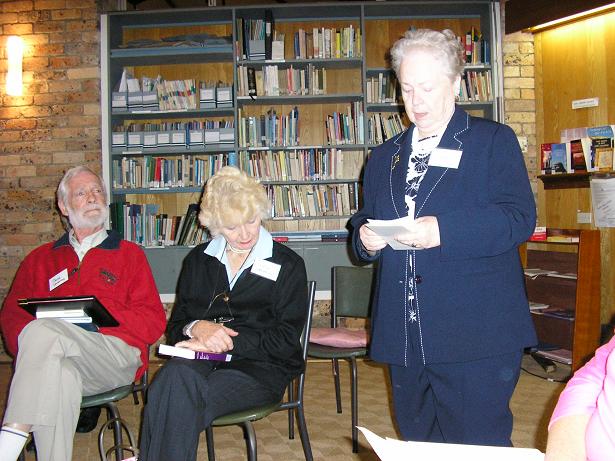
Elaine Polglase outlined the testimonies of integrity, equality. simplicity and
peace, emphasising that the testimonies are ideals to strive for, not a creed.
She spoke of the Quaker position that there is that which is of God in all
people and explained how the group of U.S. prison inmates who developed
Alternatives to Violence program requested Quakers to take up and expand the
movement in the spirit of the peace testimony. Elaine also shared regarding the
Advices and Queries.
WORSHIP
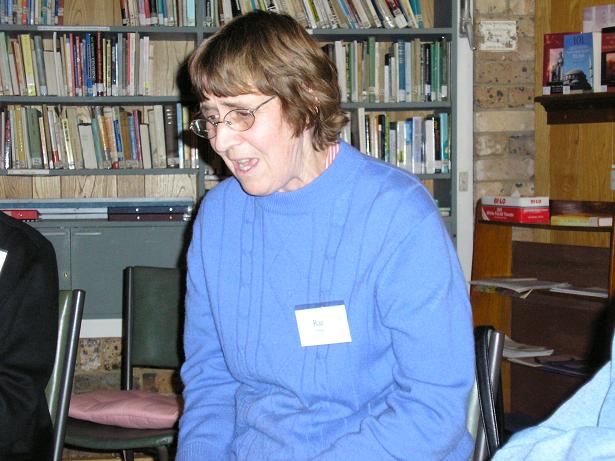
Rae Litting outlined Quaker silent worship, an opportunity to listen not to
speak, a provision of space in which God can act. She contrasted this
perspective to anthropomorphic styles of worship which can centre on praising
God as if God needed it, telling God how to go about running creation, and
petitioning God as if God had favorites and we deserved the privilege. Rae
pointed out that in silent worship there is opportunity for awe and wonder, for
a leading to right action, for strength in times of difficulty and a leading to
sensitivity to the needs of others and the environment. We discussed the Light
as a concept for thinking about God, and Rae finished with the quote from
Caroline Fox: "Live up to the light that one hast and more will be granted
thee".
QUAKER PROCEDURES
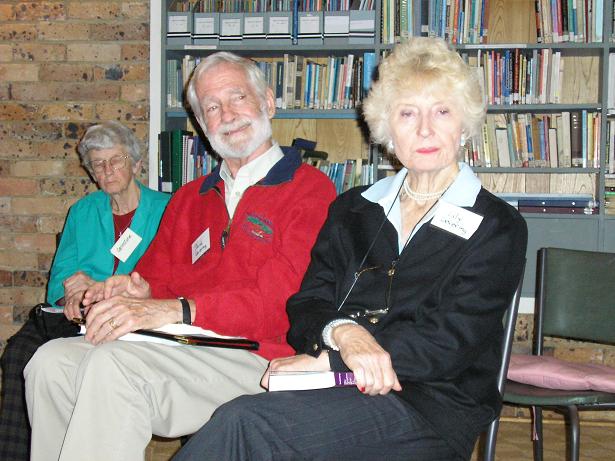
David Levering outlined Quaker processes and decision making, explaining that
they rest on three assumptions: 1 there is that of God in everyone, 2 Each of us
can experience that of God and 3 Devine guidance will lead to realisation of a
single shared truth. So decision making is not a matter of consensus but of
unity in spirit. He emphasised the importance of the role of clerk and the skill
required to encapsulate the will of the meeting in the resulting minute. This is
not necessarily a fast process: David told us of a minute that took 150 years to
write! I took it to be a decisiion that took 150 years to reach unity on. David
also outlined the Meeting for Clearness in which a persistent and perplexing
problem can be addressed. We also discussed options available to persons who
dissent from a decision, i.e. one can stand aside, request that one's name be
recorded as standing aside, or if strongly opposed one might decide to leave.
It was a very good evening for learning and reflecting.
Our next Interfaith evening, June 23, will be a panel discussing "After Death?".
Speakers are invited from Buddhist, Sikh, Muslim and Catholic communities.