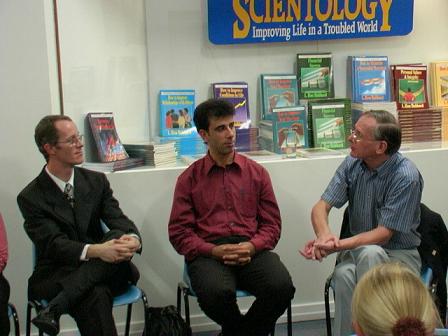
INTERFAITH AFTERNOON TEA
ON RELIGIOUS TOLERANCE, FREEDOM & MULTICULTURALISM
3 APRIL 2004
HELD
AT THE CHURCH OF SCIENTOLOGY OF
SYDNEY, 201 CASTLEREAGH STREET, SYDNEY, NSW 2000 AUSTRALIA
Cyrus Brooks (Scientology), Mehmet Ozalp (AFI, Islam), Peter Masefield (Buddhism)
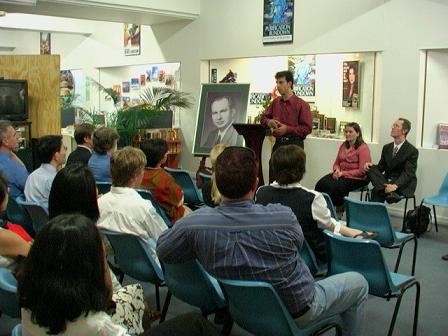
Mehmet gives his talk on tolerance and Islam.
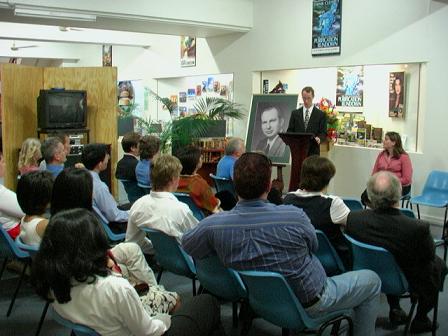
Cyrus gives his talk in relation to Scientology and freedom and tolerance.
SPEECH
ON RELIGIOUS TOLERANCE, FREEDOM & MULTICULTURALISM, 3 APRIL 2004
Hello,
my name is Cyrus Brooks. I am the Community & Interfaith Relations Director
of the Church of Scientology Asia Pacific. I work in Glebe, 10 minutes from
here. My colleague Tara Fitzpatrick is my counterpart here in this Church.
Scientology
is a relatively new religion. It is 50 years old this year. It came to Australia
in the 1950’s. And here It received national recognition in 1983 by the High
Court. And within that case was scribed the definition of religion that the
federal government now uses in the Department of Immigration and the Tax
Office—which is interesting as many people see the obvious differences in
religion: the clothes we wear, the way we worship, the ceremonies and even words
we use. Yet the Federal government found that religions shared commonality in
things of an ultimate nature.
There
are some very interesting commonalties:
L.
Ron Hubbard, the founder of Scientology, said
“All
religions seek truth. Freedom of the spirit is only to be found on the road to
Truth.”
When
we speak of truth, we relate this to
wisdom. By definition wisdom is
understanding what is true, right, lasting; common sense, good judgment and
scholarly learning.
How
about philosophy? – by definition,
it is the love or pursuit of wisdom.
And
the Holy Bible says:
“By
wisdom a house is built and by understanding it is established; by knowledge the
rooms are filled with all precious and pleasant riches. Wise warriors are
mightier than strong ones, and those who have knowledge than those who have
strength;”
Proverbs
24:1-5
“My
child, eat honey, for it is good, and the drippings of the honeycomb are sweet
to your taste. Know that wisdom is such to your soul; if you find it, you will
find a future, and your hope will not be cut off.”
Proverbs
24:13-14
How
about religion?
It comes from Latin re- meaning back and ligare meaning to bind. We are bound together in our religions in common beliefs and practices, aims and goals.
L. Ron Hubbard said the aims of the Scientology religion are “a world without insanity, without criminals and without war; where the able can prosper, and honest beings have rights, and man is free to rise to greater heights.”
I think all religions would agreed with these aims.
In Baha’i it is said: “Religion is the greatest of all means for the establishment of order in the world and the peaceful contentment of all that dwell therein.” Baha’u’llah, founder of BAHA’I.
Indeed
Buddhism spread through and civilized
three-quarters of Asia in a very short period.
And
again of Scientology, in 1963 Mr. Hubbard said:
“we
study and process the human spirit to free it from the effects of the physical
universe.
“Our
forte is the human spirit and its relationship to the physical universe.
“Two
‘great nations are liable to wreck the playing field with overwhelming nuclear
force, their rage against each other born out of their inability to handle their
own affairs.
“Our
first job is to salvage as many as we can from the possible debacle.
“Our
hope is that we can halt the progress of destruction by processing and
applications of Scientology, before Armageddon.”
There
you have a bit about religion, truth and
wisdom. How about freedom
& tolerance and how does Scientology fit into this picture? Well to
answer that, I want to read the Creed of the Church of Scientology. A Creed is a
STATEMENT OF THE GROUP’S BASIC BELIEFS. Here is ours:
We
of the Church believe:
that
all men of whatever race, color or creed were created with equal rights;
that
all men have inalienable rights to their own religious practices and their
performance;
that
all men have inalienable rights to their own lives;
that
all men have inalienable rights to their own sanity;
that
all men have inalienable rights to their own defense;
that
all men have inalienable rights to conceive, choose, assist or support their own
organizations, churches and governments;
that
all men have inalienable rights to think freely, to talk freely, to write freely
their own opinions and to counter or utter or write upon the opinions of others;
that
all men have inalienable rights to the creation of their own kind;
that
the souls of men have the rights of men;
that
the study of the mind and the healing of mentally caused ills should not be
alienated from religion or condoned in nonreligious fields;
and
that no agency less that God has the power to suspend or set aside these rights,
overtly or covertly.
And
we of the Church believe:
that
man is basically good;
that
he is seeking to survive;
that
his survival depends upon himself and upon his fellows and his attainment of
brotherhood with the universe.
And
we of the Church believe that the laws of God forbid man:
to
destroy his own kind;
to
destroy the sanity of another;
to
destroy or enslave another's soul;
to
destroy or reduce the survival of one's companions or one's group.
And
we of the Church believe that the spirit can be saved and that the spirit alone
may save or heal the body.
1954,
L. Ron Hubbard, Founder
Note
that key is freedom to believe and practice and an inalienable right to do so.
But
why does Scientology believe that this freedom is so important? (and note it is
a freedom for all mankind, not limited to our personal faith)…
Well
Mr. Hubbard said in the book, The Way To Happiness the following about RESPECTING
OTHERS RELIGIOUS BELIEFS.
“Tolerance
is a good cornerstone on which to build human relationships. When one views the
slaughter and suffering caused by religious intolerance throughout all the
history of man and into modern times, one can see that intolerance is a very
nonsurvival activity.
Religious
tolerance does not mean one cannot express his own beliefs. It does mean that
seeking to undermine or attack the religious faith and beliefs of another has
always been a short road to trouble.
Philosophers
since the time of ancient Greece have disputed with one another about the nature
of God, man and the universe. The opinions of authorities ebb and flow. Just now
the philosophies of “mechanism” (the view that all life is only matter in
motion and can be totally explained by physical laws) and
“materialism”—dating as far back as Egypt and Greece—are the fad: they
seek to assert that all is MATTER and overlook that, neat as their explanations
of evolution may be, they still do not rule out additional
factors that might be at work, that might be merely using such things as
evolution. They are, today, the “official” philosophies and are even taught
in schools. They have their own zealots who attack the beliefs and religions of
others: the result can be intolerance and contention.
If
all the brightest minds since the fifth century BC or before have never been
able to agree on the subject of religion or antireligion, it is an arena of
combat between people that one would do well to stay out of.
In
this sea of contention, one bright principle has emerged: the
right to believe as one chooses.
‘Faith’
and ‘belief’ do not necessarily surrender to logic: they cannot even be
declared to be illogical. They can be things quite apart.
Any
advice one might give another on this subject is safest when it simply asserts
the right to believe as one chooses. One is at liberty to hold up his own
beliefs for acceptance. One is at risk when he seeks to assault the beliefs of
others, much more so when he attacks and seeks to harm others because of their
religious convictions.
Man,
since the dawn of the species, has taken great consolation and joy in his
religions. Even the ‘mechanist’ and ‘materialist’ of today sound much
like the priests of old as they spread their dogma.
Men
without faith are a pretty sorry lot. They can even be given something to have
faith in. But
when they have religious beliefs, respect them.
The
way to happiness can
become contentious when one fails to respect the religious beliefs of others.”
That
is something I believe all of us would like to impart to others. And through
respect and tolerance, we can even start to learn more about each other. And
thus through knowledge, truth and understanding,
the world will be a more peaceful, friendly and happier place.
Thank
you.