Shattered World - A Worse World War : Part 49.3
December 16th 1948 to January 16th 1949
Captain Daniel Richards piloted his 'Silent Star'
reconnaissance plane with smooth precision, his eyes carefully monitoring all
the cockpit's readouts as the high altitude aircraft cut through the thin air
at 44,000 feet. He was approaching his target, a massive prisoner of war camp
the Japanese had constructed on Okinawa the previous year.
Mounted in the belly of the sleek black jet was an
array of some of the most sophisticated cameras yet devised by man. The
unblinking eyes of precision cameras zoomed in on pre-set targets, snapping
picture after picture in a carefully designed grid pattern to capture every
square foot of the Japanese facility. Clearly visible under the unfeeling gaze
of the camera were row after row of freshly dug trenches and heavy equipment in
the process of digging more trenches...
The chatter of machine gun fire cut the air in
sudden, sharp, bursts. Hagane Ishikawa
watched grimly as American, British, and Australian prisoners fell under the
hail of bullets and tumbled limply to join their comrades in the trench they
had helped dig. The trench, filling steadily with more and more bodies, was
almost ready to be covered with dirt; having fulfilled its grim purpose. More
gaunt, listless, Anglo soldiers stumbled towards the trench under the cold
glare of camp guards. Surely knowing what awaited them, the men seemed resigned
to their fate.
Guards lining the opposite side of the trench were
busily reloading their machine guns with fresh ammunition, preparing for their
next batch of death. Hagane remembered the first such slaughters, when
prisoners had been herded into trenches alive and exposed to chemical weapons.
Their deaths had been slow and agonizing and the Commandant had soon ordered a
halt to that method. Not out of any mercy, but out of a simple efficiency.
Machine gun ammunition was cheaper and more abundant than the precious chemical
weapons stocks.
The slaughter had begun two days after the atomic
bombing of Tokyo and Osaka and had continued ever since. Half the camp's 30,000
prisoners were already dead, buried in carefully arranged rows of deep trenches
outside the camp itself. They'd made no efforts to hide the massacre, indeed
the government in Tokyo wanted the
American leadership to know what was happening.
Japan had other POW camps and not all of them were killing their
prisoners...yet.
Hagane’s own feelings on the awful site before him
were mixed. His sense of honor screamed that what they were doing was
wrong...but his own family was in Tokyo and based on the rumors flying around
the island he had little doubt that they were all dead. The countless murdered
civilians in Tokyo and Osaka cried out for vengeance and Hagane couldn't help but
hear their call. When his turn came to man one of the machine guns he would
fulfill his duty and cut down the skeletal prisoners.
December 16th 1948
The Soviet thrust towards
Kiev, conducted by the powerful Ukrainian Front with its 350,000 men and 1500
tanks, has now developed into two bulges extending across the Dnieper well into
German lines north and south of the Ukrainian capitol. Field Marshall Manstein,
overall commander of German Army Group South, advocates a withdrawal from the
city but Hitler refuses - demanding that the Ukrainian capitol “…be held at any
cost”. There are political considerations.
The best part of the Ukrainian army, some 250,000 men in 25
infantry divisions, are digging deep into several concentric rings of defense
around the capitol.
December 17th
1948
In a stroke of monumental
luck a German ballistic missile, one of several dozen lobbed towards London in
the largest such attack in several weeks, hits the Parliament building. The
powerful warhead destroys the parliament building outright and severely damages
the famous ‘Big Ben’ tower as well, nearly toppling it. Luckily for the
British, Parliament was not in session at the time.
In an act of symbolic revenge the British will launch a hail of
their own ballistic missiles towards Hamburg over the course of several days,
causing widespread but relatively insignificant damage to the city. With
neither side able to sustain a real bombing campaign against the other’s
heartland the slow bleeding of the missile exchange across the Channel
continues.
December 18th 1948
In direct violation of
Hitler’s orders, Manstein orders the commanders of the powerful but depleted 4th
and 5th panzer armies to begin breaking contact with Soviet forces
near Kiev for a withdrawal to the west. The Soviet pincers around Kiev are now
probing north and south to link up and encircle the city.
In the central Ukraine, Soviet forces are now across the Dnieper
on a broad front and are charging southwest across the open Ukranian plains.
The remnants of the 1st SS Panzer Army as well as various other
German, Italian, and Romanian divisions are in headlong retreat towards the
Dnister River on the border with Romania. The Romanian Home Army, including
Romania’s best armored and mechanized infantry forces, is already digging into
positions on the east bank of the river along a broad front, as are forces from
Bulgaria.
The German High Command, aware of the serious situation in
central Ukraine, has begun the process of assembling reserve divisions to bolster
the Romanian forces assembling along the Dnister. In addition, the 2nd
Panzer Army(presently resting and refitting in Eastern Poland), is to be sent
south as fast as possible.
December 20th 1948
Kiev, now surrounded by
Soviet forces, is home to 250,000 trapped Ukrainian soldiers as well as 4
German infantry divisions assigned to turn the city into a fortress. 4th
and 5th panzer armies, having withdrawn in good order under the
cover of the now swarming Luftwaffe, are moving quickly west towards Rivne
where a new line of defense is to be established in the western Ukraine.
Hitler, in a fit of rage, removes Manstein from command of Army Group South,
cursing him as a “weak defeatist”.
In southern Ukraine, Donestsk falls after a week of house to house
fighting. Axis forces in southern Ukraine, including German, Italian, Romanian,
and Bulgarian divisions, are maintaining a slow fighting withdraw to the
southwest.
Further south and east, in the rugged
northern foothills of the Caucuses Mountains, the Soviet offensive in that
theatre at last grinds to a halt after Beria finally concedes that the Red Army
can not defeat General Winter and the Mountains at the same time. Several sharp
and sustained Soviet thrusts towards the mountain passes have all broke like
shattered glass against the steely mountains; utterly repulsed with heavy
losses by Axis forces dug into every mountain nook and crevice.
December 22nd 1948
Italian
bombers use guided glide-bombs to sink a British cruiser in the waters north of
Malta. The steadily increasing capability of Axis air power in the central
Mediterranean has severely curtailed Royal Navy operations there. This,
combined with Italian and German submarines, has largely isolated the
island-fortress of Malta. The island is only receiving supplies via air
transports escorted by fighters operating out of northeastern Libya and Egypt.
Meanwhile, the flow of Axis supplies from
Italy to Tripoli and Tunis via Sicily is now largely uninterrupted aside from
isolated British air and submarine attacks.
December 25th 1948
On Christmas day Romanian
and Bulgarian forces, with the aid of the Luftwaffe as well as their own air
forces, halt the Red Army along the line of the Dnister River near the Romanian
frontier. The Soviets, with their supply lines across the Ukraine fragile and
beset by numerous partisans, bring their exhausted forces to a halt – having
completed the “liberation” of the entire central Ukraine.
However, to the north the German 4th and 5th
panzer armies remain in tact and Germany still controls a swath of territory in
the northwest Ukraine. To the south German and minor Axis forces have been
driven back to the base of the Crimean peninsula but are now hunkered down in a
strong defensive line built after the Eurasian War and reinforced over the past
several months.
January 2nd
1949
On Formosa Japanese forces
have been pushed back into a pocket in the northwest part of the island. With
most of the island now secured the U.S. is now flying B-31 bombers out of newly
acquired air bases on massive conventional and incendiary bombing raids over
Okinawa and Kyushu. Escorted by long-ranged propeller fighters equipped with
drop tanks for extreme operational range, the bombers take stiff but
“acceptable” losses to Japanese air defenses and fighters.
January 5th
1949
After over two weeks of
stubborn defense, surrounded on all sides and under constant chemical and
conventional bombardment, Axis forces in Kiev surrender. 30,000 German and some
240,000 Ukranian soldiers are taken prisoner. The best part of the Ukranian
Army has been destroyed.
January 8th
1949
Across the Ukraine the
weather has cleared and both sides surge aircraft into the air. As usual Soviet
advantage in numbers balances out against German aircraft and pilot superiority
but the tactical jet bombers of the Luftwaffe give Axis forces a critical edge
in the air, sliding through Soviet air defenses and prop fighters to bomb and
strafe anything that moves on the open plains.
January 11th
1949
A series of desperate
Soviet attacks in the southern and northwestern Ukraine over the past few days
falter and come to a bloody halt after stiff German counter-attacks and
constant Luftwaffe and partisan harassment of Soviet columns combine to breakup
the Soviet thrusts before they can really develop. The front lines have come
grinding and groaning to a halt, both sides still exchanging artillery,
rockets, and local probes. Both sides are exhausted, critically short of
chemical weapons stocks, and reeling from massive casualties and tank losses.
January 13th
1949
With the situation on the
Eastern front stabilizing, Hitler turns his attention to an Axis Summit meeting
held in Budapest. In back rooms away from the bright lights and video cameras
of the propaganda ministry, Mussolini is advocating bold action in the
Mediterranean theatre, a bid to knock the British out of the war by “cutting
their life veins” as the Italian dictator puts it. Hitler, impressed by the
opportunity to achieve victory in the west with a relatively small commitment
of forces, agrees to the plan and over the next few days the German and Italian
general staffs will begin to turn Mussolini’s envisioned campaign into concrete
operational plans.
January 15th
1949
A massive 600 bomber
incendiary night raid on Nagasaki destroys much of the city’s industrial heart
and kills some 40,000 civilians. In the aftermath of the recent Atomic attacks
the devastating raid barely registers in the minds of the reeling Japanese
leadership.
January 16th
1949
The Soviet Komet jet
fighter, a copy of an early model British Meteor, makes it first appearance in
combat over the skies of Moscow. The jet does well against German Ural bombers,
inflicting much higher than average losses against a 300 bomber German raid on
the city. This first Komet squadron is based near Moscow and dedicated to a
pure interceptor role but more squadrons will join the ranks of the Red Air
Force over the next few months.
The German 2nd panzer army, combined with various
other units to form the new Army Group Dnister, takes up position alongside
Romanian, Bulgarian, and Italian forces to bolster Axis defenses along the
Romanian frontier.
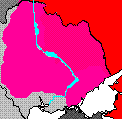
Soviet gains in the Ukraine as of January 16th 1949
January 15th
1949
30 miles Northwest of
Macau, China
It was as if he had never existed. One second Sergeant Taylor
had been yelling at his squad to get under cover and the next second he was a
splatter of raw meat and gore. The shell had landed right at his feet. At
least, corporal Smith thought, sarge wouldn’t have felt anything. Jesus, let me go that way if I have to go.
More shells were falling and not all of them exploded with
the characteristic violence of high explosives. Some of them popped with a mute gurgle and spewed forth the new
Mustard-Phosgene mixture that the Japs had started using lately. The new gas
combined the most lethal aspects of the two into a deadly cocktail. Luckily the
American forces grinding towards Macau were well equipped for chemical warfare.
The latest gas masks were hot and uncomfortable and limited your vision…but
they did what they were supposed to do better than the earlier versions.
Corporal Robert Smith, suddenly in command of a platoon after
the deaths of sarge and Lt. Anderson, forced his hands to stop shaking and,
with sheer force of will, poked his helmeted head out over the mound of dirt in
front of his fox hole. Sure enough, Japanese infantry were swarming ahead with
their bayonets fixed in yet another reckless charge. The bastard in charge of
the Jap battalion ahead of them was a fanatic even by knip standards. This was
the fifth charge since sunrise and the previous four had been absolutely torn
to shreds.
“Here they come” Robert shouted to make himself heard over
the bombardment. As the Japs had done earlier in the morning they were keeping
up the shelling even as their own men rushed into the target area. Crazy bastards. Lifting the field radio and
cupping a hand over his mouth and the microphone to make sure he was
understood, he called for artillery support on the exact same coordinates he’d
given three times already.
Even before the first shells started impacting in the open
field machine gun positions to Robert’s left and right began stitching death
back and forth across the field in terrible arcs. Japanese soldiers fell but
most ran on, hunched over in a low crouch and screaming at the top of their
lungs. By the time division’s artillery began plastering the field the first
wave of Japs was right on his line and the sound of bolt action rifles and
assault rifles filled the air with a constant poppoppop like a hailstorm from
hell.
For
a terrible moment he thought the platoon would be overwhelmed and Jap soldiers
were in among the line, bayonets gashing savagely. But the Americans had
bayonets as well and relatively few Japanese soldiers had reached the line. Robert
found himself confronted by a snarling Jap and he gutted the short man as he’d
been taught back in basic. Blood splattered and smeared his face. The front of
the Japanese attack was broken in a wave of blood as the platoon held. The Japs
still out in the open field were being savaged by air-bursting artillery shells
from which they had no protection.
As
the last Jap soldiers fell or fled back to their line 400 yards to the east,
Robert took advantage of the lull to light a smoke. He was far from the only
man to do so. It helped calm his nerves as the medics came to carry away the
screaming wounded. He’d barely even noticed that the Japanese bombardment had
slacked off and then stopped altogether. The swarms of bombers overhead and
thunderous rippling explosions to the east and south probably had something to
do with that. The Jap artillery battery was either destroyed or moving to a new
position. Either way, it was out of action. He was not surprised when division
sent down the orders to launch a new attack.
January 19th
1949
25 miles Northwest of
Macau, China
The four days of relatively rapid advancing had surprised
Robert. He’d even let himself start to believe that the Japanese position
outside of Macau had come apart. The ambush that had killed or wounded half his
platoon an hour before had dispelled any such notion. They’d ran headlong into
the outer edge of the Jap’s next line of defense. And, he thought gloomily, the platoon’s new sergeant had been the
first man killed and thus he found himself leading the men again.
Apparently the higher-ups didn’t want the Japs to be able to
settle into their new positions because they’d sent up tanks and ordered a
general offensive right into the Jap line without delay. Some of those tanks
were idling in the trees behind his platoon now, their big cannons pointing
southeast towards the enemy as they waited to attack.
The peninsula that the 2nd Army was moving down to
approach Macau did not offer a lot of good defensive terrain but the god damn
Japs had damn sure done their best. Their line took full advantage of what
little defensive cover was available, and they’d brought up a lot of forces to
make what must be their last major stand outside of Macau itself. Mortar and
artillery shells occasionally whined and screamed overhead but neither side
seemed ready to open up a sustained bombardment. It was simply a long ranged
game of cat and mouse as both sides moved their forces into position.
Corporal Robert Smith was cleaning his assault rifle when he
noticed a jeep bouncing down the muddy dirt road toward his position. It was
moving dangerously fast considering the slippery conditions, but moving slower
would have been more dangerous. Japanese snipers would be certain to take
interest if it gave them half a chance. A soldier manned a .50 caliber machine
gun mounted on the back of the jeep and the driver manhandled the steering
wheel with what was obviously an experienced hand.
The Jeep sloshed right
up to Smith’s position and, setting down this gun, he snapped off a smart
salute to the four star general who stepped out from the passenger seat.
The stories regarding General Patton were legend. But the legends about his immaculately
polished uniform and ivory pistols turned to be no mere myth. The general,
jogging over in an absolutely immaculate uniform, approached Robert and
returned his salute.
“At
ease Corporal” he said, his gaze shifting to look out over the front. A Jap
infantry battalion was well entrenched half a mile to the southeast but they
would be hard to spot even with binoculars.
“Where’s your battalion CO” the General asked, his gaze still
directed towards the front.
“Five hundred yards that way” Robert said, gesturing to the
south. Patton nodded, then turned his attention squarely on Robert.
“Son,
I don’t normally deliver news to Corporals like this straight to the front but
since I’m here anyway and since Colonel Cunningham spoke so highly of you…”.
The general reached into his jacket and his hand emerged with brand new
sergeant’s chevrons.
“Congratulations
Sergeant Smith” the general said. Robert accepted the insignia in shocked
silence. He had half expected to make Sergeant any day now…but to have his
promotion handed to him by General Patton himself!
“Thank
you, sir” was all he could say. Patton nodded as he began scanning the front
with his binoculars. A bursting shell a hundred yards to the south didn’t have
any visible impact on Patton. He was no “lead from the rear” officer and that
was for damn sure.
TO BE CONTINUED…