Shattered World - A Worse
World War : Part 49.2
November 29th 1948 to December 15th 1948
November 29th 1948
The area south of Benghazi
is the scene of confused and vicious fighting. The Italian and German force
moving north towards Benghazi has
run headlong into the teeth of British anti-tank forces and been utterly
repelled with crippling tank losses.
Army Group Africa’s
thrust out of Benghazi towards the
south has been more successful but it has not yet made its escape. Anticipating
a breakout attempt, the British had created a series of defensive lines south
of the besieged city, each manned by fresh British and Imperial troops. By the
end of this day Army Group Africa has crashed through two of those lines but
still faces one more British line of defense – and the trapped Axis Army Group
is running low on fuel.
November 30th
1948
Army Group Africa’s breakout attempt
has run out of steam in the face of the third British line of defense south of Benghazi
– just ten kilometers short of Axis forces which had been driving towards Benghazi
from the south. To make matters worse for the Axis, three powerful British
armored divisions fresh from their victory over Rommel to the east, are moving
rapidly to tear into Army Group Africa’s dangerously exposed northeast flank.
Rommel, facing the
destruction of Army Group Africa, takes command of his one remaining intact
panzer division and begins pushing directly west. Its men, exhausted and
bloodied from the fighting several days before, are near their limits of
endurance.
In the Ukraine,
Kharkiv and Sumy fall to the Red
Army as the Soviets grind ahead and German forces continue a fighting
withdrawal to the southwest.
December 2nd
1948
Rommel’s desperate panzer thrust has succeeded in flanking
the last British defensive line south of Benghazi,
opening a corridor through which Army Group Africa is now pouring south.
However, British armored divisions are already ripping into the Army’s rear
flank and Rommel has only one depleted panzer division to face three British
armored divisions. There is only one option –: Retreat, prompt and immediate.
In the Pacific the
U.S. launches
operation ‘Thunder Stroke’. After a series of large diversionary B-31 raids on Okinawa
and Kyushu (the first attacks on Japanese soil of the
war) two separate groups of B-34 bombers, flying fast at 42,000 feet, launch
atomic attacks on Tokyo and Osaka.
The small groups of B-34 bombers, flying above the ceiling of most Japanese air
defenses, are mistaken for new American reconnaissance aircraft by Japanese air
defense commanders and meet no resistance. In the single most devastating
attack in human history, three atomic bombs are dropped on Tokyo and two atomic
bombs are dropped on Osaka over a ten minute period around 9:00 AM local time.
The results are catastrophic for Japan.
In Tokyo
two atomic bombs hit the city directly; the 20 kiloton Mk. II devices each
detonating at 500 feet over the harbor and city center respectively. A third
atomic bomb, this one a 40 kiloton Mk III warhead, is detonated 200 feet above
the major Yokosuka naval base just
outside of Tokyo.
Much of Tokyo
is wiped from the face of the earth. An estimated 250,000 people die
immediately in the two nuclear explosions in the city itself, and another
700,000 will die or be wounded in the massive and unstoppable firestorms that
spread, merge, and burn down much of the flammable Japanese capitol. Hundreds
of thousands more will die or fall sick over time due to the effects of
radiation poisoning.
Equally devastating,
at least in terms of its effects on Japanese fighting strength, is the
destruction or crippling of no less than 8 major capitol ships in the atomic
attack on the Yokosuka naval base,
as well as the annihilation of all that base’s facilities and precious fuel
reserves. Among the capitol ships destroyed or crippled are a super-Yamato
class battleship, one lesser battleship, a precious fleet carrier, and multiple
cruisers of various types. Roughly a third of Japan’s
total remaining naval strength is destroyed in a single instant.
{* The Japanese had believed that the massive air
defenses around the Yokosuka naval base would prevent an atomic attack there since
the Americans would presumably not risk an atomic bomb where there was a
significant risk of the bomber being shot out of the sky. They hadn’t counted
on a bomber that is immune to their air defenses *}
In Osaka
the damage is smaller but still devastating. The Mk. II bomb dropped on Osaka’s
harbor misses its target by half a mile, detonating off-shore with the force of
23 kilotons and throwing up a radioactive cloud of mist that will contaminate
the harbor and the shoreline for miles up and down the coast. Most of the ships
in the harbor survive with only light damage and varying levels of radioactivity.
Further inland, the second Mk II atomic bomb detonates over an industrial
sector of the city, killing 80,000 people in the initial blast and igniting a
firestorm that sweeps through the city’s industrial core killing and wounding
another 200,000.
Ten
kilometers outside Tokyo,
in an
underground bunker complex completed only a month before, Emperor Hirohito
rushed up the last flight of stairs that would take him to the grass field
above. He did so against the strong advice of the doctor and military advisors
that trailed behind him. He simply had to see for himself.
The bunker, buried one hundred
feet under the ground and insulated in thick concentric shells of reinforced
concrete, had allowed him to sleep through the attack. It was a junior officer
who had awoken him minutes before to the news that Tokyo
was under assault. And what an assault it was. The young officer had spoke of as many as several of the infernal atomic
bombs. For the fourth time in half as many minutes he thanked his ancestors
that he’d accepted the requests that he stay in the new hardened bunker rather
than remaining in the city for the night.
At last his head reached the surface and then he was
out in the crisp cold air, and his eyes were drawn by shocked reflex to the
terrible sight before him. He didn’t need to look at the pointing and shouting
guards to know where to look. In the direction of Tokyo
three monstrous pillars of smoke and cloud towered into the air, their tops
capped in boiling cauldrons of wicked orange flame and dark oily smoke; like
the poisonous head of a demon-spawned mushroom from hell. Even as he looked the
manmade cloud pillars
soared higher into the air and their awesome boiling caps
expanded and roiled like the breath of some titanic dragon of the gods.
So this, the Emperor thought to himself,
is how the world ends. Not destroyed by the
hand of God but smote by the scientific hand of man. Long minutes passed
before the horrible clouds stopped growing, and they persisted for quite some
time before winds began to sheer and distort the mushroom visages. He’d seen
detailed reports of what an atomic bomb had done to a smaller city in China.
All of Japan
would weep soon. The Emperor himself did not shed a tear until he was handed a
telegraph message that read simply : ATOMIC ATTACK REPORTED IN OSAKA,
NUMBER OF DEVICES ATLEAST TWO.
December 3rd
1948
With the fires still raging in Tokyo
and Osaka, the Emperor of Japan
goes on the air to speak to the Japanese people for the first time ever. In a
short and concise speech he thanks the Japanese people for their sacrifice and
implores America
to cease further atomic attacks on Japan’s
cities while Japanese diplomats begin to seek terms for an armistice. Later in
the day U.S. president Dewey responds with a stern radio address in which he
demands the unconditional surrender of the Japanese Empire “…lest it face
continuing devastation the likes of which no nation could possibly hope to
survive”.
December 5th
1948
The last of Army Group Africa has managed to slip away to
the west but not without a heavy cost. The 8th panzer army, serving
as a desperate rear guard for the escape, has been smashed flat. Rommel himself
only narrowly escapes as his own armored command car runs the gauntlet of bombs
and artillery fire with British mechanized forces in hot pursuit. Somehow,
against all odds, Axis forces in North Africa have
managed to disengage and are now streaming west towards strong defensive lines
in the small coastal town of Surt.
{* The Italians have built several sets of defensive
lines to the east of Tripoli in anticipation of the attritional war shifting
deeper into Libya *}
December 7th
1948
Talks between the U.S.
and Japan break
down after Japanese diplomats refuse to back down on their one remaining demand : Keeping their Emperor.
December 8th
1948
Outside of the still smoldering ruins of Tokyo,
a quiet coup takes place that will have grave consequences for the people of Japan.
A radical clique within the Japanese high command, after hearing of the Emperors
intention to surrender unconditionally, places the Emperor under ‘special
guard’ and sequesters him to his bunker outside of Tokyo.
Many in the military and civilian leadership who oppose continuing the war will
‘disappear’ over the next several days. Admiral Yamamoto, after learning of the coup, commits suicide
rather than face the dishonor of the Emperor’s imprisonment and Japan’s national suicide.
The fanatical new Japanese leadership has
one glimmering hope – If Japan can simply stay in the war long enough then
there is a chance, they believe, that a German victory in the west could force
the Americans to grant them reasonable terms for an Armistice. And so, the
madness of war will go on indefinitely, against all rationality.
December 10th 1948
Now into its second week, the Soviet winter offensive in
the Ukraine has
shrugged aside the initially stubborn German defense and has now reached the Dnieper
River in central Ukraine
and is 30 kilometers east of Kiev
in the north. Progress in the south has been slower where the Germans are
determined to hold the Crimea and the southern stretch
of the Dnieper River.
The Soviets already have bridgeheads across the Dnieper
in central Ukraine
and are preparing to thrust southwest towards Romania.
The Crimea, they decide, can be dealt with later.
Continuing poor weather has mostly kept both sides out of the air.
The German high
command for its part has focused on the defense of Kiev
in the north and Donestsk in the south. The central Ukraine
will have to be traded away to buy time. Romania,
now under direct threat for the first time since the Eurasian War, begins to
fully mobilize its forces to defend the northeastern frontier. Across the Ukraine,
Ukrainian soldiers are fighting gallantly on the defense - partly out of
nationalist fervor and partly out of sheer fear of the vengeance that Beria
will surely wreak upon their homeland.
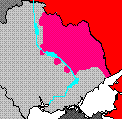
Soviet advance into the Ukraine as of December 10th 1948
December 15th 1948
Army Group Africa and the tattered
remnants of the 8th Panzer Army reach defensive lines at Surt where
100,000 fresh Italian troops are already in defensive positions. These troops, recruits from Italy
and some veterans transferred from Algeria,
have been digging in for ten days and are well equipped with anti-tank rockets
and artillery support.
The British, with
their supply lines now stretching all the way back to Gazala due to Army Group
Africa’s thorough demolition of Benghazi’s harbor(not to mention Italian patrol
boats, submarines and aircraft prowling in the waters off the coast), decide to
halt their advance short of the Italian defensive line. Having advanced deep
into Libya, the
British must now consolidate their supply lines and rotate in whatever fresh
forces they can muster.
TO BE CONTINUED IN PART 49.3…