Shattered
World - A Worse World War : Segment 46.1
July 12th 1948 to July 26th
1948
War rages on the titanic
Eastern Front as the two greatest armies of all time clash from the plains of
the Baltic Coast to the mountains of the Caucasus. The more numerous, and
more cumbersome, Soviet armies push forward slowly in the north and in the far
South while the great central portion of the front remains a confused picture of
thrust and counter-thrust. The War hangs in the balance and the fate of the
world remains uncertain and elusive. The only thing that is certain is that the
end is not near, the only thing that matters is feeding
the engines of destruction.
The War does not limit itself to the plains of the Soviet Union. It rages from the English Channel to the
South China Sea, from the cold, dark, waters of the North Atlantic to the
contaminated rubble of Vladivostok. It comes in the form of ballistic
missiles raining upon London and as a silent submarine prowling beneath the
waves of the Mediterranean, as a panzer crashing through a thatch-roofed home in
a Ukrainian village and as a one thousand pound bomb whistling on its long fall
towards a factory in Hamburg. From the sands of Algeria and Libya to the Jungles of Vietnam, from the choppy seas of the South
Atlantic to the dust-filled sky of Manchuria �
The War rolls on unabated in all its ravenous fury.
July 12th 1948
Soviet forces have now secured the Baltic States and are
probing into German lines at the border with East Prussia. To the South Soviet forces are
pounding slowly, but steadily, west after the success of liberating Minsk. The Germans, after
initially putting up a fanatic defense in this sector, are trading land for time
here and the fighting has now become extremely fluid. Further to the south the
lines have stabilized as both sides have fought each other to exhaustion and are
taking an operational pause to rest and regroup. German forces in the Orel pocket have given up land and
consolidated into stronger defensive positions as the Luftwaffe tries in vain to
keep the pocket supplied. |
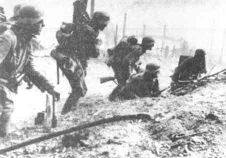
German Infantry near Orel |
July 13th 1948
The U.S.
5th fleet clashes with Japanese naval and air forces south of
Formosa in the Battle of the South China
Sea. The battle is initiated when U.S. B-31 bombers operating out of
the Philippines drop two
atomic bombs on Formosa shortly after a massive
series of conventional air strikes against targets all over the island. The
atomic bombs take out the two largest Japanese air bases on Formosa.
However, due to extreme luck on the part of the Japanese, a large strike force
of fighters and bombers had finished taking off from the bases just several
minutes before the simultaneous atomic strikes.
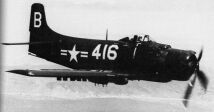
Douglas Skyraider |
The
Japanese strike force consists of nearly 200 land-based bombers and prop
fighters as well as several dozen Shinden jet fighter escorts. These jet escorts
clash with carrier jets from the U.S. aircraft carriers and thus the
first jet-on-jet naval action in history occurs. This fighter engagement favors
the U.S. although the Shinden
and U.S. carrier jets are closely matched
in terms of performance. Japan loses nearly 125 aircraft while the
U.S. loses only about 65. Some of the
Japanese bombers make it through and manage to moderately damage one U.S. Essex
Class Carrier. Another carrier is attacked with chemical weapons but the
chemicals are dispersed in the wind and prove not to be effective. |
The
second phase of the battle begins when the opposing fleets launch large strikes
on each other�s carriers at nearly the same time. The Japanese have four
carriers in the battle while the U.S. has six carriers and this numerical
advantage will prove to be a decisive advantage for the U.S. fleet. The
Japanese carrier-launched attack force has only limited fighter escort and
mostly fails to get by the 5th fleet�s fighter protection. Another of
the Essex Class carriers is moderately damaged when a torpedo bomber manages to
score a hit on it but other than that the U.S. carriers
come through largely untouched. The Japanese carriers would not be so lucky.
U.S. torpedo and dive bombers sink
three of the four Japanese carriers and damage the other one. In the span of
eight hours Japanese air power on Formosa and the carrier aviation wing
of the Japanese Navy have been virtually destroyed. |
USS Bunker Hill hit by 2000lb bomb |
The
Japanese lose nearly 300 aircraft in addition to the three carriers, while the
U.S. loses roughly 100 aircraft in all. |
|
July 15th 1948
Britain
sets July 28th as the launch date of their offensive in
Libya. The British have massed the
largest army ever seen in Africa, with some
550,000 British, Canadian, Indian, and Australian soldiers and nearly 1000 tanks
massed at the front. This has taken a considerable amount of time and effort
and may be the last such big offensive that the British will be able to afford
in the theatre for a long time. The pressure upon the British Army to break the
Axis in North Africa has become intense with some in Britain saying the continuation of the War
depends upon its success in Libya.
Guderian
has seen the build up proceeding and is preparing a strategy of his own. He is
out-numbered but confident he can hold his positions. He has stiffened Italian
infantry at the front of his lines with elite German infantry and anti-tank
forces while carefully massing his all-German mechanized and armored divisions
at key points behind the lines. Both sides will have plenty of artillery and air
power in support.
By
coincidence, Rommel has also set July 28th as the jump-off date for
his westward offensive in Algeria. |
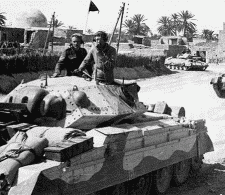
British tank in North Africa |
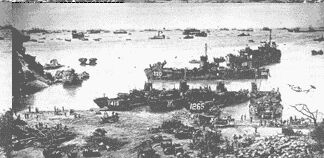
Formosa "Omaha Beach" |
July 16th 1948
Three divisions of U.S. marines come ashore on three different
Formosa beaches on the western part
of the island following massive air and off-shore bombardment. The marines
manage to establish beach heads despite strong Japanese resistance and suicidal
Japanese human-wave counter attacks. The U.S. commanders
have elected not to use atomic bombs on the beach head although they have two
available for use. Instead, they have decided to wait until after they are
pushing inland before using the nuclear weapons. This change in atomic doctrine
has come about as a result of the U.S. learning more about radiation
contamination. It is not a good idea to contaminate your staging area. |
July 21st 1948
Britain
begins shipping early-model Meteor jet airframes to the Soviet Union after over a year of requests from the
Soviets for them to do so. The U.S. will provide the jet engines
themselves. The U.S. and
Britain have decided to begin
supplying the Soviets with these aircraft since they are now relatively obsolete
and wouldn�t be a threat in any post-war situation. |
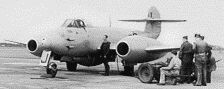
Meteor inspected by soviet engineers |
July 22nd 1948
British preparations for their coming bombing campaign
against the Baku oilfields have intensified and
the air war over eastern Turkey and the southern Caucasus is underway as the British have begun to probe
Axis air defenses in the region with small-scale raids and fighter sweeps.
July 23rd 1948
Persia
launches its invasion of fascist Iran with air support from the
British. The Persian infantry have been fairly well trained and equipped and
have British advisors at all levels. Iran has excellent small arms
provided by the Germans and Turks but they have virtually no air force and no
Axis air support at all. The Persian offensive begins with large artillery
barrages and several waves of RAF carpet bombing attacks on front line Iranian
positions. Many ill-trained Iranian infantry units crack under the stress and
the Persians make excellent initial progress into the Iranian lines.
July 26th 1948
U.S.
forces have nearly finished preparations to continue their offensive from
Indo-China and into China proper. Patton now has three
full armored divisions at his command. The Japanese have scraped together a
couple of armored divisions but intend to rely more on anti-tank weapons such as
an 88mm artillery piece modeled after the dreaded German �88�. They also have a
small number of bazookas and unguided anti-rank rockets which they have copied
from U.S. and German designs. The Japanese
force arrayed in southern China represents the last real
strength of the once-vaunted Imperial Japanese Army.
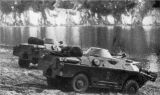
Soviet scout cars near Yalu River |
Further
North the Japanese have managed to establish moderately strong defensive
positions along the Yalu in northern Korea and along the
Manchurian-Chinese border. However, these defensive forces arrayed against the
Soviets lack any real strategic depth. The Chinese offensive in the north has
turned out to be more of a nuisance than anything else, sucking away Japanese
units that could otherwise be providing some depth for the forces facing the
Soviets. |
TO BE CONTINUED in Segment 46.2