Shattered
World - A Worse World War : Segment 46.3
August 16th 1948 to
August 25th 1948
August 16th 1948
In Arbil, northern Iraq, trains
have been arriving in unusually large numbers for the past two weeks. Hidden
safely under tarps on flat beds to avoid the prying eyes of high-flying German
recon jets, sit American-made Goddard V ballistic missiles and the equipment to
support them. Even the local Kurdish leadership doesn’t know what the surge of
trains is bringing. With a maximum range of some 450 miles the oil fields at
Baku are barely within range. And, from launching points in southeastern
Britain, northwestern Germany is also in range. Britain, with some help from the
U.S., is about to unleash a surprise for Germany.
August 17th
1948
After two weeks of headlong
retreat, the Free French are ready to make a stand. Having marshaled all
available remaining troops, some 100,000 in all, Charles De Gaulle has drawn a
line 30 kilometers east of Algiers. And Rommel’s streaking panzer and mechanized
divisions have arrived. The Free French have more artillery, more men, and much
shorter supply lines. The Germans have more armor, more mobility in general, and
air superiority. Perhaps more importantly, the Germans have the Desert Viper.
And the Viper strikes hard, sending his best panzer division directly into the
Free French center while panzergrenadier divisions sweep southwest to flank the
Free French lines. The Free French are ready for such an attack, and well
entrenched troops equipped with American bazookas and recoilless rifles slow
down the panzers while Free French artillery hammers at less protected German
infantry.
In the early
afternoon hours, just as the Free French seem poised to bring Rommel’s advance
to a halt, Rommel springs a trap that has been three years in the making. An
Italian paratrooper battalion, formed in 1945, has been training hard ever since
for a very special mission. A decapitation strike on Charles de Gaulle. Rommel
was informed of the battalion’s existence and its purpose only three weeks
before. The timing could not have been better. Rommel knows exactly how to use
this paratrooper battalion and quickly dismisses Mussolini’s elaborate plan to
use them to kidnap De Gaulle. Rommel has something more practical in
mind. |
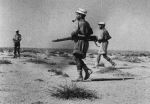 French Desert Patrol |
At precisely 2:30
PM, after an hour of heavy bombardment by German and Italian aircraft,
2000 elite Italian paratroopers armed with the best light weapons and
equipment in the Axis arsenal drop from Luftwaffe transport planes and land in
the Free French rear – west of Algiers. By 4:00 they have taken up strong
defensive positions, thoroughly blocking the coastal roads and rail lines
heading west towards Oran. Meanwhile, Rommel’s strong southwestern flanking
attack is now due south of Algiers. Charles De Gaulle and much of the Free
French government, the entire remaining Free French army, and the city of
Algiers, have nearly been pocketed. |
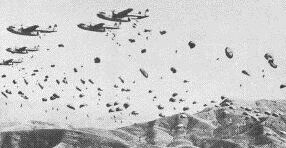 Italian Paradrop |
Far to the east,
the story is different. Guderian’s lines in Libya are beginning to buckle under
the tremendous weight of British firepower being thrown at him. With his lines
west of Gazala beginning to waver, Guderian decides to fall back to his
secondary line of defense. This line, anchored on Mekili in the south and Derna
along the coast to the north, is the last significant defensive line east of
Benghazi. As the air war rages on, the best German and Italian infantry
divisions in the theatre begin assuming strong screening positions as the rest
of the Axis army begins to move west. British bombing has disabled the Libyan
rail net between Benghazi and Derna to such an extent that the Axis forces are
moving purely by road.
August 19th
1948
With three bridgeheads now fully
secured on western Formosa and marines probing inland in all directions, the
U.S. high command has decided on a target for the second atomic bomb at their
immediate disposal. After a series of massive fighter sweeps clear the skies
over northern Formosa, a U.S. B-31 bomber drops a 20 kiloton atomic bomb
over a section of the Japanese defensive line west of Taipei. The Japanese,
expecting an atomic strike somewhere along the line, execute a new strategy of
“flexible defense”. The defense lines west of Taipei have great depth but are
relatively dispersed at any given point.
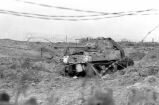 Blasted Sherman |
The atomic bomb missed the massive
concrete bunker it was aiming for and instead landed nearly a mile north amidst
widely dispersed Japanese trench lines. Immediately after the atomic explosion
the Japanese begin lobbing conventional and chemical artillery into the area
west of the atomic strike – catching the massing U.S. forces there by surprise.
Despite the Japanese bombardment the U.S. attack begins on time and tears
through the area devastated by the atomic blast. However, an hour after the
atomic strike Japanese infantry have already moved to bolster the remaining
lines of defense east of the blast zone. In the end, the atomic attack gains the
U.S. army and marines about four miles of easy advance before they once again
run into strong Japanese defenses. |
Charles De Gaulle
organizes a Free French counter-attack against the Italian paratroopers blocking
the roads and rails to the west of Algiers. The Free French have little
remaining mechanized capability and their air force has been destroyed over the
course of the last few weeks of heavy fighting over Algeria. The Italian
paratroopers west of Algiers hold their positions with the help of Italian and
Luftwaffe air support. Having exhausted his last offensive capabilities De
Gaulle settles in for a stubborn defense – the siege of Algiers has
begun. |
 De Gaulle finished? |
In London, the
British decide at last that they must commit precious resources to save the Free
French position in North Africa. Several divisions of ANZAC and Canadian
infantry are to be transferred to Northwest Africa. However, getting them there
will take time and the Free French position is unraveling rapidly. Churchill
calls his commanders in Libya to encourage them to press the offensive forward
with all possible vigor in the hopes that pressure there will bring Rommel’s
invasion of Algeria to a grinding halt. |
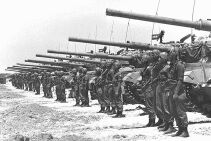 British Centurions |
August 20th
1948
After several weeks of delay Germany unleashes its titanic
retaliatory campaign against the Soviet Union in response to the Soviet’s use of
a crop-busting biological attack. The attack begins in the early morning hours
as 150 Ju-588 long range heavy bombers attack the Soviet city of Omsk, far to
the east of the Ural mountains. The bombers, the first operational Ju-588’s
fielded by the Luftwaffe, fly largely unmolested across Kazakhstan and drop a
mix of conventional, incendiary, nerve gas, and mustard gas munitions on the
city’s industrial districts and heavily populated residential neighborhoods. The
city’s tank and aircraft factories suffer moderate damage – the city’s civilian
population suffers much, much worse. Swollen with new factory workers and
largely lacking in civil defense procedures or air defenses, the city is
entirely unprepared for the German onslaught. Some 100,000 civilians are killed
in the nightmarish inferno of flames and chemical death; tens of thousands more
are wounded. This begins what will become a sustained conventional and chemical
bombing campaign against important trans-ural Soviet cities. Only eight of the
new German bombers are lost in the first attack. Losses will rise in the future
as the Soviets improve their air defenses in the trans-ural regions.
The second aspect
of the German retaliatory campaign is a rain of ballistic missiles, armed with
nerve gas warheads, upon many of the cities of European Russia. The latest
mass-produced model of the German A4 missile has a range of nearly 1600
kilometers and a 3500 pound warhead. Hundreds of these missiles hit Leningrad,
Moscow, Beriagrad, and other major Russian cities west of the Urals. Inaccuracy
of the missiles, winds, and excellent civil defense preparations in the European
Russian cities themselves(including chemical-rated bomb shelters, chemical
warfare masks for the general population, etc.), combine to limit the
deaths to a combined total of some twenty thousand killed and twice that number
wounded. Although the losses from the German chemical ballistic missiles are
relatively light(and will get lighter as civil defense procedures further
improve) – the constant threat of the German ‘gas missiles’ will none-the-less
exact a huge psychological toll upon the people of European Russia.
As German missiles
and bombers rain chemical and conventional death across the Soviet Union –
German radio and TV broadcasts boast of the powerful attacks, with Goebbels
publicly describing the campaign as “righteous vengeance against the sub-human
Bolshevik’s attempt to starve all of Europe”. Germany publicly acknowledges its
fight to prevent the spread of a virulent wheat blight in central and eastern
Europe and presents evidence through diplomatic back channels which strongly
implicates the Soviets in its emergence. The Soviets, of course, strongly deny
the German claims and rail against the “NAZI genocide upon the workers and
peasants of the Soviet Union”. |
 Joeseph Goebbels |
Germany, a
latecomer in the area of biological warfare, will soon redouble its efforts to
catch up in this field.
August 22nd
1948
The RAF mounts its first large
scale bombing raid on Turkey, with 500 British Lancaster and B-31 bombers
hitting the Turkish capitol of Ankara. A powerful force of escorting British
fighters sweeps aside the Turkish air force. The center of Ankara is devastated
and many of the city’s government buildings are destroyed , including
the
tomb of Mustafa Kemal Atatürk, the Turkish
parliament building, and many other government offices. 55,000 Turkish civilians
are killed in the bombing and its resulting firestorm. Britain urges Turkey to
leave the Axis Powers if it “wishes to avoid further rains of destruction”. In
Turkey there will soon be much resentment against the Germans due to the
Luftwaffe’s failure to aid in the air defenses over central Turkey. However,
this resentment pales against the anger directed at the British. |
 Target: Ankara! |
August 24th
1948
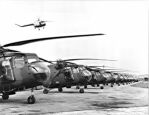 The german Armada |
In central Poland, over five
hundred hastily assembled German helicopters engage in the largest ever massed
helicopter training operation. Otto Skorzeny is training the men of the
1st SS paratrooper division for a very special mission. |
August 25th
1948
Germany launches operation ‘Pillar’, a complex combined-arms
operation designed to end the siege of Gibraltar once and for all. Ten massive
rail guns have been brought forward to shell Gibraltar on a sustained basis and
the Kriegsmarine has re-deployed many of its older submarines, supported by
additional Sea Ural long-range naval recon planes, to tighten the submarine net
around Gibraltar and prevent the occasional British re-supply attempts. In
addition, the fledgling Spanish air force and newly arrived Iberian squadrons of
the Luftwaffe will intensify bombing operations. The operation is designed to
culminate in a direct assault by conventional and special forces but this will
not take place until the new siege efforts have further degraded the Rock’s
defenses. |
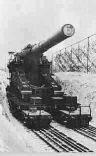 The "Beast" |
TO BE CONTINUED…

