 |
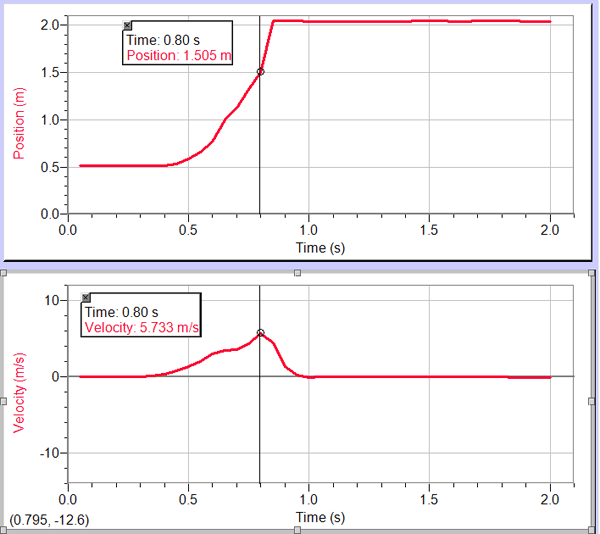 |
| When we started our Lander project, we realized that we were going to have to account for three simple things, Newton's laws. So that a person can fully understand how we accomplished this, I will now describe our Lander. To start, we created a weighted base, two square pieces of cardboard with batteries in ends to weigh it down. Next, we created a bubble using pieces of plastic tubing, connecting it to the base with duct tape. Finally, we created a case for the egg to sin in out of straws and connected it to the bubble using rubber bands. The first law that our Lander team had to account for was Newton's first law: an object in motion will stay in motion or an object at rest will stay at rest unless acted upon by an outside force. What this law basically states in our case is that if the Lander was to hit the ground, the egg inside its casing is going to try and stay in motion until something stop it. We contently decided that a hard stair case stopping the egg was not the best idea, so we thought to use rubber bands. This concept works wonders. The rubber bands reduce the time that it takes for the egg to stop, therefore reducing the amount of force on the egg. When the egg comes to rest slowly in its casing, it does not break. The second law that our Lander had to account for is Newton's second law. Force is equal to mass in kilograms multiplied by the acceleration in meters per second. The mass of our Lander is 498 grams, but then we have to add the weight of the egg, 50 grams, making our combined weight .545 kilograms. Acceleration is 9.81 meters per second which is the acceleration of gravity. When we plus these number into the equation for the second law (Force = mass x gravity), we find that our Lander is faced with 5.34 newtons of force. One Newton is equivalent to about .225 pounds of force. A fun fact is that though the acceleration due to gravity is 9.81 on Earth, on Mars the acceleration is 3.73. This would mean that if the Lander was tested on Mars, it would only be hit with 2.0 Newtons of force. Our test landing would be much easier on Mars than it is on Earth. We deal with this by force by the plastic tubing bubble. This bubble is strong enough to not break when the force is applied to it but gives enough to again, slow down the acceleration a little to reduce the force on the egg. Even if the pioping only slows down the Lander by .5 meters per second the force is then reduced to 5 newtons. The rubber bands then do a significant decrease in acceleration to give the egg a soft landing. Finally, the third law that our Lander has to overcome is that every action has an equal and opposite reaction. When the Lander hits the steps with 5.3 newtons of force the stairs hit the Lander with the same force. Almost everything on the Lander is made to account for this force. The bubble is constructed to be able to take many newtons of force. over and over again and not break. The base is very well constructed so that great forces could be applied causing no damage to the Lander. Lastly, the case is suspended in mid-air so that when forces are applied to the Lander, the egg is stopped slowly, reducing almost all pressure applied to the Lander. In conclusion, I believe that our Lander will successfully land on Mars (or get thrown down the stairs) and I would go further to say that I would love to see it thrown off the roof of the school to see if the egg still survives. -Lander Team, Joe and Ravi |
 |