 |
|
 |
|
| Ordering the Universe: Fibonacci in Nature |
| In the seeming randomness of the natural world, we can find many instances of mathematical order involving the Fibonacci numbers themselves and the closely related "Golden" elements. |
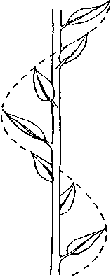
| Phyllotaxis is the study of the ordered position of leaves on a stem. The leaves on this plant are staggered in a spiral pattern to permit optimum exposure to sunlight. If we apply the Golden Ratio to a circle we can see how it is that this plant exhibits Fibonacci qualities. Click on the picture to see a more detailed illustration of leaf arrangements. |
| Picture Credits: Fig.1,3,4 - http://www.goldenmeangauge.co.uk/fibonacci.htm Fig.2 - http://jwilson.coe.uga.edu/emt669/Student.Folders/Frietag.Mark/Homepage/Goldenratio/goldenratio.html Fig. 5,6,7, 8 - http://www.evolutionoftruth.com/goldensection/plants.htm Fig. 9,14 - http://www.sacredarch.com/thenautilusshellspiral.htm Fig.10 - http://www.evolutionoftruth.com/goldensection/nature.htm Fig.11 - http://www.perspective.com/nature/animalia/starfish.html Fig.12,13 - http://www.evolutionoftruth.com/goldensection/hand.htm Fig.15 - http://www.humanities.ccny.cuny.edu/history/reader/vitruman.htm References: Garland, Trudi Hammel. 1987. Fascinating Fibonaccis: Mystery and Magic in Numbers. Dale Seymour Publications, Palo Alto. 103 pp. http://www.goldenmeangauge.co.uk/fibonacci.htm http://www.evolutionoftruth.com/goldensection/plants.htm http://www.evolutionoftruth.com/goldensection/nature.htm http://www.evolutionoftruth.com/goldensection/hand.htm |
 |
| Fig.1 |
 |
| Fig.2 |
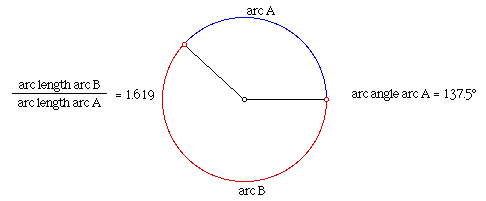
| By dividing a circle into Golden proportions, where the ratio of the arc length are equal to the Golden Ratio, we find the angle of the arcs to be 137.5 degrees. In fact, this is the angle at which adjacent leaves are positioned around the stem. This phenomenon is observed in many types of plants. |
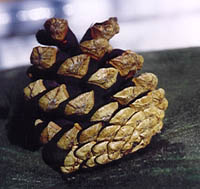 |
| In the case of tapered pinecones or pineapples, we see a double set of spirals - one going in a clockwise direction and one in the opposite direction. When these spirals are counted, the two sets are found to be adjacent Fibonacci numbers. Mouse-over the picture to see the spirals! |
| Fig.3 |
| click |
| contents |
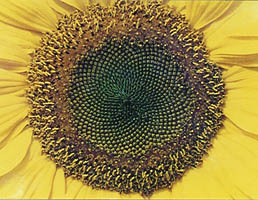
| Similarly, sunflowers have a Golden Spiral seed arrangement. This provides a biological advantage because it maximizes the number of seeds that can be packed into a seed head. |
| Fig.4 |
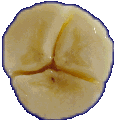
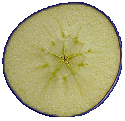
| Inside the fruit of many plants we can observe the presence of Fibonacci order. |
 |
 |
| Fig.5 |
| Fig.6 |
| The banana has 3 sections. |
| The apple has 5 sections. |
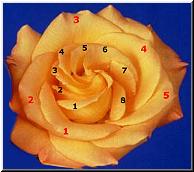 |
| As well, many flowers have a Fibonacci number of petals. Some, like this rose, also have Fibonacci, or Golden Spiral, petal arrangements. |
| Fig.7 |
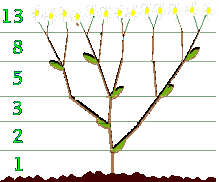
| Branching plants also exhibit Fibonacci numbers. Again, this design provides the best physical accommodation for the number of branches, while maximizing sun exposure. |
 |
| Fig.8 |
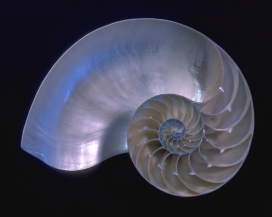
| The shell of the chambered Nautilus has Golden proportions. It is a logarithmic spiral. |
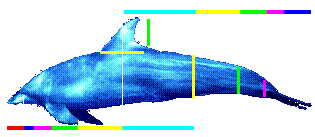 |
| The eyes, fins and tail of the dolphin fall at Golden sections along the body. |
| Fig.10 |
 |
| Fibonacci in Plants |
| Fibonacci in Animals |
| Fig.9 |
|
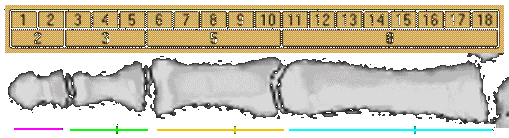
| Humans exhibit Fibonacci characteristics, too. The Golden Ratio is seen in the proportions in the sections of a finger. |
| Fig.12 |
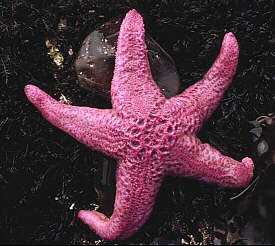
| Do you think Fibonacci could be hiding in this starfish? (Click on the starfish to find out!) |
| Fig.13 |
| Fig.14 |
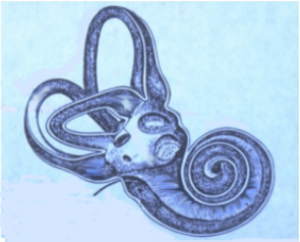
| The cochlea of the inner ear forms a Golden Spiral. |
 |
| Fig.11 |
| (It is also worthwhile to mention that we have 8 fingers in total, 5 digits on each hand, 3 bones in each finger, 2 bones in 1 thumb, and 1 thumb on each hand. Coincidence? You decide.) |
| click |
 |
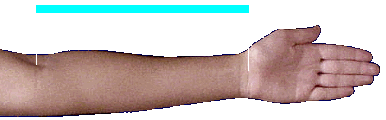
| The ratio between the forearm and the hand is, you guessed it, the Golden Ratio! |
 |
|
|
|
|
|
|
|
 |
 |
| Fig.15 |
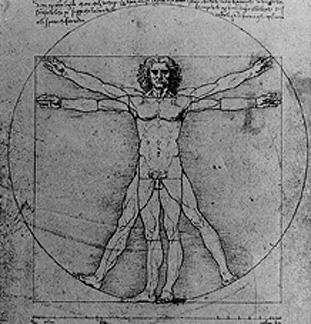
| Looking at DaVinci's Vitruvian Man, we can see that the entire human form may be broken down into a series of Golden Ratios. |
| contents |
 |
 |
   |
 |