 |
|
| contents |
 |
|
| Fibonacci in Music |
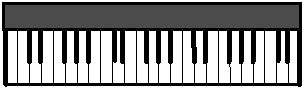
| Fibonacci and the Golden Ratio appear in music. For example, an octave of the chromatic scale has 13 notes. On a piano, 8 of these keys are white and 5 are black. The black keys of the pentatonic scale are grouped into sets of 2 and 3 keys. |
 |
| Picture Credits: Fig.1 - http://www.wolfmans.com/lessons/lesson2.shtml Fig.2 - http://www.ac-nancy-metz.fr/Pres-etab/CollJLagneau/BLUM_CIBP/13ors/VIOLIN.html Fig.3 - http://www.aeroinvest.com/broadcast/mta2000pr/beethovenFibo.htm References: Newton, Lynn D. 1987. Fibonacci in Nature: Mathematics investigations for schools. Mathematics in School. 16:5:2-8. http://www.elliottwave.com/socionomics/slideshow/composers.htm http://www.oxy.edu/~jquinn/home/fibonacci/homecoming/art1.html http://www.ac-nancy-metz.fr/Pres-etab/CollJLagneau/BLUM_CIBP/13ors/VIOLIN.html |
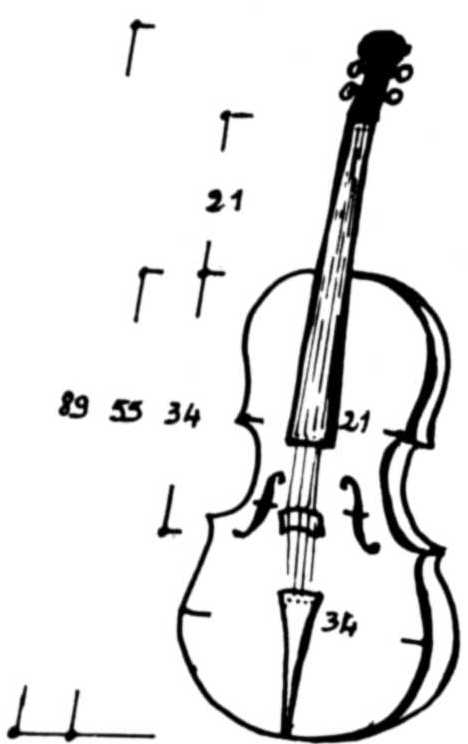
| The sections of a violin are constructed using the Golden Ratio. |
 |
| Fig.1 |
| Fig.2 |
| The Golden Ratio can also be found in many musical compositions. For example, the familiar 5 bar motto in Beethoven's 5th Symphony appears at the beginning and end of the piece, but it is also reiterated at measure 377. There are 610 measures in total; this means that the second repetition of the motto divides the piece at its Golden Section. Other composers such as Debussy, Bach and Mozart also incorporated the Fibonacci numbers and Golden Ratio into their works, either consciously or unconsciously. |
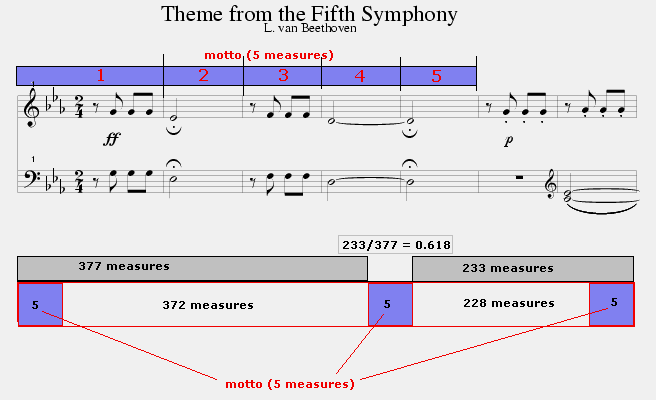 |
| Fig.3 |
   |
 |