Cycle Santa Monica! July 2002 |
|
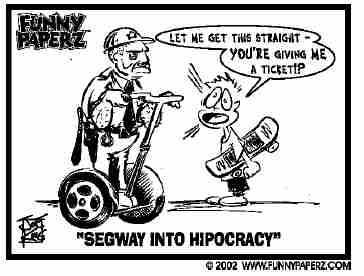
Santa Monica police "Segway" onto the streetsSegway cartoonRed Light Cameras Cut Accidents But Have FlawsMayor to bike patrol through drug-ravaged neighborhoodsWays To Make Use of the November ElectionCampus gets boost to start bike museumWhat's New at Cycle Santa Monica's Website Great weather for Bicycling! |
Santa Monica police Segway onto the streets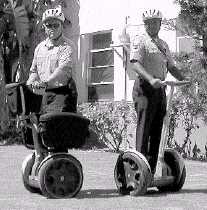
BY ANDREW H. FIXMER “It” has come to Santa Monica. The Santa Monica Police Department is poised to become the state’s first law enforcement agency to use an odd two-wheeled vehicle to protect and serve. Police are field testing Segways, a vehicle that stands upright and is battery powered, to use for traffic services and patrolling of beach lots and parking structures. The company that manufactures Segways has loaned the SMPD two of the vehicles. “With the new transit mall complete, we’re trying new options down there to increase visibility, safety and find new ways of enforcement,” said Lt. Clinton Muir, the SMPD officer in charge of traffic enforcement. “They can get to a troubled intersection and easily park off-site without blocking the intersection and further adding to the congestion,” he said. Besides having zero emissions and requiring almost no maintenance, the machines also could save the city thousands on traffic enforcement cars. The Segway model the police department is considering costs about $9,000 while the traffic cars average $33,000 a piece. “There is a substantial savings,” Muir said. The vehicle looks a little like a Roman chariot without the horse and is able to carry one 250-pound individual and 75 pounds of cargo at a time. Segways can reach top speeds of 17 mph and they can travel 10 to 15 miles on a fully-charged battery. Four gyroscopes and several sensors allow the device to stand upright on its own. A rider leans forward or backward to move in those directions and the vehicle turns by twisting either end of the handle bar’s grips. Batteries are interchangeable and can be recharged in four hours. Should one of the vehicle’s run out of juice in the field, it can be recharged by simply plugging it into any normal electrical socket. Worse-case-scenario, if an outlet can’t be found, the 85- to 95-pound Segway can be rolled back to the station. The invention caused a stir in the media last year when word of “it” leaked out and top computer executives were reported as saying the device would change the world. Dean Kamen, the inventor of the device, officially released the Segway at the beginning of this year. He showcased the vehicle’s abilities on the Santa Monica boardwalk less than a month later. Currently the vehicles are being field tested by police departments in Atlanta and Anaheim, the U.S. Postal Service, the National Parks Service and numerous private corporations. Police officers and civilian traffic enforcement officers have been putting the vehicles through regular parking patrols, including zipping up and down the parking structures and patrolling the boardwalk. Officers also have used them to patrol the city’s alleys. “It gives us a lot more flexibility,” said Orlando Imperial, a traffic patrolman. “I have to say I haven’t found a drawback yet.” Traffic services manager Don Williams added, “There is really endless possibilities for these.” Traffic officers are required to wear bike helmets and lime-green neon vests with SMPD lettering on the back. “We are looking into all safety aspects in our field tests,” Muir said. “It’s important we make sure it’s safe for the riders and the public before using something like this for the first time.” Besides a two-day safety course taught by Segway officials, the officers are not required to have any sort of special license to operate the device — a driver’s license is not even needed. A bill before the California Legislature hopes to define the vehicle as a motorpowered scooter that would not mandate state licensing. The SMPD has not decided if it will purchase any of the vehicles but because officers and operators are so impressed with them, it may be only a matter of time before officers are seen zipping through downtown on them daily. “The chief is always looking at the cutting edge of technology,” said SMPD spokesman Lt. Frank Fabrega, “and looking at how it can be applied to the police department.” Red Light Cameras Cut Accidents But Have FlawsBY STEFANIE FRITH Associated Press Writer SACRAMENTO — Red light cameras at street intersections help reduce automobile accidents, but a review of programs in seven California cities and counties found weaknesses that make them more vulnerable to legal challenges, a state audit released Tuesday shows. The audit found the number of motorists running red lights has dropped 10 percent since cities installed the cameras after a 1996 law. Although 15 states and nations in Africa, Asia and Europe use red light cameras, there are signs of a backlash. Alaska, Nebraska, New Jersey, Wisconsin and Utah have banned the cameras, while Maryland’s legislature is considering bills that would curtail or eliminate them. In San Diego, the cameras have become an issue because of allegations of conflicts of interest involving the for-profit vendor administering the system. Other critics say the presumption of innocence is lost even if a driver ran a red light unintentionally by misjudging a yellow light. California law says only a governmental agency, in cooperation with a law enforcement agency, can operate the red light cameras, but the law has no specific requirements to guide cities in how to do so, said Steve Hendrickson, chief deputy state auditor. While the law also needs to be clarified, cities must also tightly monitor the companies that provide the cameras, Hendrickson said. San Diego and Los Angeles County didn’t follow any of the criteria auditors used to monitor oversight of the program, Hendrickson said. Local governments aren’t required to follow those guidelines, but the report states they’re “needed to avoid legal challenge.” Guita Sheik, senior civil engineer for the Los Angeles County Department of Public Works, said the county agreed with the audit, but that “the criteria they used are not established policy.” The audit surveyed the cities of Fremont, Long Beach, Oxnard, Sacramento, San Diego and San Francisco and Los Angeles County. The audit found that only Fremont, Long Beach and Sacramento conduct at least one oversight visit to the vendor’s facility and only Long Beach and Sacramento periodically conduct technical inspections of the cameras. Auditors recommended tighter oversight of camera vendors and periodic inspections of the camera intersections. Complaints in San Diego led Sen. Steve Peace, D-El Cajon, to request the audit. Officials in San Diego, which suspended its program in 2001 after numerous complaints, did not return repeated telephone calls. But Josh Krimston, a firefighter paramedic and director of operations for Eliminate Preventable Injuries of Children, a nonprofit organization in San Diego, said San Diego needs the cameras back. “The technology has proven that it works at changing people’s behavior,” Krimston said. Although the most common reason for choosing red light camera sites was traffic safety, four of the seven cities surveyed avoided placing cameras at some of their most dangerous intersections along stateowned highways, the audit found. It would have taken too long to get state permission, officials from Fremont, San Diego and Long Beach said, while Los Angeles said it didn’t consider stateowned highways for its program. Caltrans officials, Hendrickson said, told auditors it would take only two to five months for a city to get the permits for state-owned highways. Mayor to bike patrol through drug-ravaged neighborhoodsBY JOANN LOVIGLIO Associated Press Writer PHILADELPHIA — Mayor John F. Street is combining his enthusiasm for exercise with a new crime-fighting program. He’s hopping on a bicycle to patrol some of the city’s most notorious drug corners, and he wants citizens to join him. Starting this week, Street plans to spend four hours a week pedaling on his donated police-issue Mercedes-Benz mountain bicycle through neighborhoods where drug dealing has been most common. He has recruited some of the city’s top officials to ride with him as part of an expansion of Operation Safe Streets, an aggressive crackdown on open-air drug markets. “In the end, if you’re going to have a world-class city ... our streets have to be safe and free of drugs and all the violence that goes along with that illegal activity,” Street said. Since May 1, hundreds of officers have patrolled more than 200 corners and blocks to help stop drug dealing. Serious crime dropped 12 percent in May and 16 percent in June, police said. U.S. Sen. Arlen Specter announced last week that $500,000 in federal funding had been approved for the program. Street said reduced crime has made it safe for citizens to accompany police officers on bike patrols to discourage dealers from re-establishing their old corners. “We want neighborhood kids, everyone, to get on their bikes and come out and ride with us,” said Street. As they help fight crime, citizens can also get exercise. Since taking office in 1999, Street has established healthy-living programs to help flabby Philadelphians lose weight and put a “fitness czar” in City Hall. The 58-year-old mayor, a fitness fanatic who once weighed around 250 pounds but now is down to about 190, is known for getting up at 4:30 a.m. to work out before heading to work. Ways to Make Use of the November Election in Santa MonicaElected officials are like most peoplethey listen best when its intensely in their interest to do so. Politicians never feel so vulnerable to other peoples opinion of them, as they do around election time. Elections, primaries, or general elections are the best time to float new ideas, extract fresh promises and make friends with those who can help you most when the election is over. Here are four primary ways for bicycle advocates to make the most of election year opportunities. 1. Determine what you want: Election time is the perfect time to assess what your bicycle group wants from whichever officeholders are on the ballot. 2. Get promises from the candidates. A well written survey mailed out to the candidates can be an effective to get elected leaders on your side and, more importantly, on the record. The Bicycle Coalition of the Delaware Valley in Philadelphia used this tactic very successfully.Another way to educate not only the candidates, but other voters, is to attend public candidates' nights and ask bicycle-related questions. Or hold your own candidate forum, in which candidates can discuss their answers to your survey questions. 3. Help your friends now (and they will help you later). Lending assistance to bikefriendly incumbents is the best way to communicate to them that you understand the political process, are grateful for their help and care about their ability to stay in office. Run their pictures in your newsletter with the headline "Don’t Forget Our Friends on Election Day!’That’s a fine message, stroking your friends, without taking the risk of specifically endorsing candidates. Remember, too, that as a bicycle group leader, you are a leader in the community. You can hold fund-raisers in your living room for the most pro-bicycle incumbents and ask only your bike friends to attend. Invite some bicyclist friends to come with you to help out on a candidate’s campaign. And, have you personally written a check for, say, $25, to the incumbent who has been closest to your organization? Expressing gratitude in these types of ways can have enormous benefits in terms of access and trust between you and the candidate. And isn’t four more years of better bicycling worth the cost of dinner and a movie? 4. Run for office yourself. A handful of cyclists have run for office on explicit bicyclerelated platforms. Even if your candidacy is a long shot, other candidates will see you as a peer and respect you more for running —so long as you stay positive and run a clean, issues-oriented campaign. After the election, they will have a different relationship with you, having shared with you the same challenges and indignities of the campaign trail.The other side-benefit is that some other candidates will inevitably see the audiences a acandidates’ nights responding positively to your ideas. They will then try to co-opt your turf, and steal your issues —which is great! 5. Follow up! Don’t print the replies and then sit back and wait for all the great promises to start taking place. Neither you nor the elected officials will be totally pleased with the result. Instead, contact the official next January, with a request to follow up on the questions. Offer to help them keep their campaign promises. The smarter ones among them will be grateful. And those are ones that are best to know, anyway! Source: "Ways to Make Use of Elections." Pro Bike News. July 1994. National Center for Bicycling and Walking
6.Call for Questions for a Santa Monica candidate Survey!! Put on your Thinking Caps. What questions do you want answered from Santa Monica Council candidates? There are three city council seats up for grabs! Also, there are a couple Rent Control Board Seats, a couple School Board seats, and a couple College Board seats up for grabs too. A survey is being compiled with questions. Send question to [email protected]
By Susanne Rockwell
The dream of starting the first bicycle museum west of the Mississippi just
got wheels.
After multiple attempts to find funding for a bicycle/transportation museum
in Davis, the university succeeded in late June in obtaining $440,000 from the
Statewide Transportation Enhancement Activities funds, reports Brodie Hamilton,
director of campus Transportation and
Parking Services. After a matching $60,000 is raised locally, Hamilton and a team of three
other bicycle aficionados plan to buy a collection of 60 antique bicycles,
velocipedes, tandems and other examples of human-powered transportation spanning
from the 1820s to the 1920s. It’s just the beginning, though. Due to the need to develop a full-fledged
museum program and find the funding to support it, the doors aren’t expected to
open for several years, Hamilton said. The museum creators include Hamilton, UC Davis Bicycle Program Coordinator
David Takemoto-Weerts, city of Davis
Bicycle/Pedestrian
Coordinator Tim Bustos and Sacramento bike historian/collector Jacques
Graber. "Up to this point, our idea has not been a ‘project,’ only a concept," Bustos
said. However, since the announcement of the transportation grant to the campus,
Bustos has been talking with city officials about the possibility of using at
least part of the old City Hall as a museum site. That building, now occupied by
the Davis Police Department, will be vacated within a year. In the meantime, Hamilton, Takemoto-Weerts and Bustos are looking at how they
can set up a city/campus project that eventually will turn into a private,
nonprofit museum. "We’re looking at this not only from a historical standpoint -- to preserve
the collection and have it grow -- but also as a visitor attraction to Davis and
Yolo County," Hamilton said. "People will come to see this because it will be
the only bicycle museum west of the Mississippi." He said the bike museum would complement the vehicle-related exhibits in the
Sacramento area that already draw tourists: the California State Railroad Museum
and Towe Auto Museum in Old Sacramento, and the Hays Antique Truck Museum and
Heidrick Ag History Center in Woodland. City and university officials have been thinking about a bicycle museum since
a group contacted Hamilton and Takemoto-Weerts in 1995 with suggestion that
Davis would be an ideal site for a bicycle museum. "All they had was this concept: no resources, sponsors, building or
collections, but it became a catalyst from our perspective," Bustos said. The next step came two years later when Takemoto-Weerts was helping to
promote the annual spring Cyclebration, a
city-university-downtown-merchant celebration of bicycles. After hearing about
the event, the owner of a bicycle collection contacted Takemoto-Weerts for
appraisal information. Takemoto put him in touch with Graber, an expert on
antique bicycles, and then joined Graber, Bustos and Hamilton on a trip to check
out the collection, which has been stored in a barn since the 1930s. "It’s a fabulous collection in need of preservation," Takemoto-Weerts says.
"I know enough about the history of cycling to know that the machines in this
collection, almost all pre-1920 and most of them pre-1900, are quite rare." Part of the state grant money will be used to restore the collection,
Hamilton said. Bustos and Hamilton believe the museum would enhance the reputation of Davis
as the "Bicycle Capital of the U.S." "We also see this as a way of exposing both
children and adults to the science and technology related to bicycles and how
science and technology is used in everyday life," Hamilton said. Takemoto-Weerts would like to couple the museum with a bicycle information
center that would eventually be a statewide resource. "With enough space, it could serve as a meeting space for bike clubs, for
holding cyclist education classes, occasional lectures, films, etc.," he said.
"The history of cycling is very rich -- and there is no place out West to
display, preserve, celebrate and research this important part of our heritage.
What better place than Davis, ‘City of Bicycles,’ to
make this happen?" Hamilton hopes to involve interested faculty and staff members in the
project, pointing to departments with natural ties to the bicycle, including the
Institute for Transportation Studies and the departments of History, and
Mechanical and Aeronautical Engineering. "I’m really hoping both the city and university will be significant
supporters," he said. For more information, contact Hamilton at (530) 752-3253, [email protected], or
Takemoto-Weerts at 752-BIKE, dltakemo [email protected], or
Bustos at (530) 757-5669, [email protected]. More Links |