
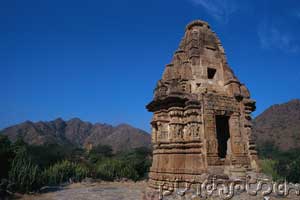
About 43 kilometers west of Barmer in Rajasthan lie the remains of five temples in a picturesque amphitheatre of hills. Kiratakupa, the ancient name of Kiradu, must have once been a place of some consquence. It is possible that the place once had about twelve more temples.
These temples are datable to circa 1000 A.D. and later. They represent the final achievement of the Gurjara-Praihara School of the Nagara or north Indian style of temple building before the ornate style known as Solaki (from the dominant Gujarat dynasty of that appellation) took over in western India. One may begin by seeing the Vishnu temple. Only the shell of the sanctum and the pillars of the central octagon of the mandapa or hall now survive. The five-faceted (pancharatha) walls of the sanctum rise over a tall and elaborate molded plinth. The multi turreted spire or sikhara is all gone barring a few mini-spires.
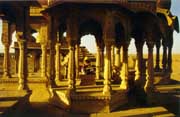
Of the large open mandapa in front, only the central pillars remain. The basal portion of the shaft is octagonal and each face features an apsara or heavenly maiden. They are now sadly mutilated but still form a comely bunch. They resemble figures from Baroli, south-west of Kota.
Next, one may see the Somesvara, which like the other three small temples also, is dedicated to Shiva. The Somesvara is a major monument and deserves careful study.
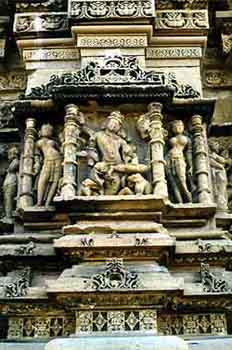
The sanctum, as in the case of the Vishnu temple, is five-faceted. The plinth features, among other moldings, a beautiful, deeply stenciled Jadyakumbha or inverted cymarecta. Also notable are the three very lively figural bands or tharas featuring, in that order and from below, elephants, horses and human beings. The main feature of the middle (jangha i.e. thigh) portion of the walls above is a rupadhara or figural band placed below the niches figures on all the subsidiary facets. On the bhadra or cardinal facet, however, the niche is made bigger to accommodate a bigger image. This is an advance over the Vishnu temples, already noticed. The multi turreted spire has lost its upper elements but the remnants speak well of the whole as it might have been.
The half roundels below the vases carry exquisite foliate designs. The torans or decorated arches spanning the spaces between the pillars and the caryatid figures are now gone. (Two toranas can, however, still be seen in the Vishnu temples).
The figural decoration on the exterior of the mandapa is as refined and varied as that on the sanctum. These surfaces of the Somevara of life and bring to mind the similar cavalcades seen in the Hoysala temples of Karnataka and the great Konark of Orissa. Particularly notable are the scenes of combat and palace life, kaudakapalik rites and preceptors scenes from the Ramayana and from everyday life. One can round off by seeing the three smaller Shiva temples Architecturally they do not have much to offer but some sculptured depictions of ritual eroticism, temple-building, Bhishma Pitamah lying on a couch of arrows and scenes from daily life, such as a group of acrobats.
The Kiradu group has remained largely unknown and underrated because of its location. It is a very significant group, nevertheless, because it unfolds the 10th century denouncement of a movement in architecture, which began, as far as Rajasthan is concerned, in the 8th century at Osian and other places. A visit to Kiradu is a must for a discerning lover of architecture.