Mormons teach that family relationships can endure beyond the grave - forever.
But to them, eternity extends not only forward, but also back into infinity. This belief makes them care deeply about ancestors who lived centuries ago - even before Christianity on earth.
But when Mormons speak of "family," they mean not just their living relatives and descendants, or those forebears they happen to know about. "Family," to them, means all their relatives, all the way back.
"SPIRITS IN PRISON"
Mormons are certain that God's love, like God Himself, is infinite - without end, without beginning. It extends forward into the ever shall be, and backward into the ever was. They are certain that God's promise of eternal life must include all of mankind - not just those who happened to be born since the foundation of Christianity.
Mormons further believe that all who gain the Kingdom of Heaven must first accept Christ as "the way, the truth, and the life," and be baptized, in His name, for the forgiveness of sins. According to Mormon doctrine, those who die without these ordinances inhabit a special realm of life hereafter. The Apostle Peter called them "spirits in prison."
As Christ said, "Except a man be born of water and of the Spirit, he cannot enter into the kingdom of God."
To Mormons, whose Church is founded on family love and loyalty, the glory of their religion is that it provides the spirits of these deceased an opportunity to accept the baptism that Jesus taught in His gospel. Acceptance, they believe, will bring deliverance from the spirit prison, and make it possible for these ancestors to join the blessed family reunion in the hereafter.
BORN ANEW
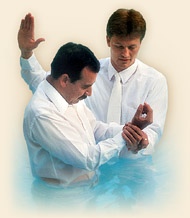
How is this achieved? Through ceremonies in a Mormon Temple in which they, the living descendants, are literally baptized by immersion in water in behalf of their deceased ancestors. First, of course, they must seek out these ancestors in genealogical records, verify their names and if possible their dates, and establish their lines of kinship.
To Mormons, baptism performed for the dead is a sacred expression of their love for their families and their forebears. Those who receive this baptism by proxy after death have the freedom, in the spirit world, to accept or reject it, since "free agency" is a basic principle of Mormon belief.
But baptism, as Paul indicates, is an ordinance of this world; thus, to those who did not receive it during life on earth the Mormon Church offers it vicariously, that is, through a stand-in, or representative-a living, loving relative. Christ followed this practice when He offered Himself as a sacrifice for all mankind.
"The last enemy that shall be destroyed," wrote the Apostle Paul, "is death...Else what shall they do which are baptized for the dead, if the dead rise not at all?"
Thus one may understand why Mormons regard Temple work for the dead among the most profound of their Church responsibilities. Indeed, a Mormon leader said recently, they are prepared to perform the necessary genealogical research so that all those now or ever in the spirit world can be vicariously baptized.
"You mean," an astounded listener asked, "you are out to offer the gospel to every human being who ever lived on earth?"
"Yes," the leader answered simply, "for we have been commanded to do so."
"For the entire human family? -- Why, that is impossible!"
"Perhaps," said the leader, "but we shall try to do it anyway."
Website