According to most dictionaries, including the Oxford English Dictionary
the word "God" can be plausibly derived from the Sanskrit word "HU"
"There are two Aryan roots of the required form:
one meaning ‘to invoke’ (Skr. hū),
the other ‘to pour, to offer sacrifice’ (Skr. hu)
http://www.oed.com/
Listen to
a few thousand people singing HU in a rolling chant
"The word is HU, the universal name of God,
which is in the language
of every living thing. It is everywhere, in everything.
- Paul Twitchell
Shariyat-Ki-Sugmad - Book II
"HU is the ancient name for God, a love song to
God.
When Soul has heard this sound, Soul yearns to go home."
- Harold Klemp
Recognize that your imagination and your
thinking
and your sense-perception are reed canes
that children cut and pretend are horsies.
The Knowing of mystic Lovers is different.
The empirical, sensory, sciences
are like a donkey loaded with books,
or like the makeup woman's makeup.
It washes off.
But if you lift the baggage rightly, it will
give you joy.
Don't carry your knowledge-load for some selfish reason.
Deny your desires and willfulness,
and a real mount may appear under you.
Don't be satisfied with the name of HU,
with just words about it.
Experience That Drunkenness.
From books and words come fantasy,
and sometimes, from fantasy
comes UNION.
- Rumi
We Are Three
Translated by Coleman Barks
"I thought some of you
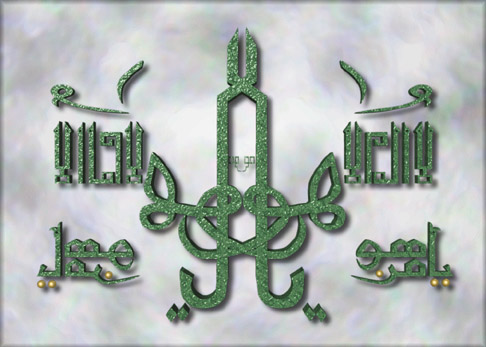
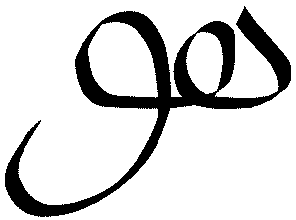
might be interested in seeing how a darvish might send Hu to someone.
... below you will find two image files. The second gif file is a very simple rendition
of how Hu would commonly be written in Arabic or Persian (or old Turkish).
It is read from right to left and it is common to use the image as a visual remembrance
The First image, hu.jpg, is much more complex. It is my rendition of a classical way
of representing the Zikr "Ya Hu ya Hu ya man Hu, la illa ha illa Hu".
(Which means basically, "Oh Hu, there is no divine reality but Hu").
You can find the basic pattern of this design at the Hageia Sophia and Rumi's tomb."
"On the historical side, an ECKist who has
studied a collection of
Coptic texts known as the Nag Hammadi Library learned something of
interest to Eck initiates. The text of the Nag Hammadi Library are
mostly fourth-century copies of earlier Greek versions. The
original texts were based upon the inner experiences of the
gnostics. In those first three hundred years of the Christian
church, however, the outer path had lost the inner journeys of Soul.
All that remained were degenerated myths that reduced earlier
spiritual experiences into nothing more than allegories.
In his research, this ECK initiate found a
dimension to the original
biblical teachings that has been lost in today's church. In the
Marsanes, a fragmentary codex, there is a guide to thirteen planes
and a discussion of sound keys to the planes and luminaries of those
planes. The Paraphrase of Shem talks of inner travel as the mind's
separation from the body, "as if in sleep". Another text, the
Apocalypse of Paul, tells of Paul's heavenly journeys and his
transformation upon reaching the tenth heaven. But it is The
Discourse on the Eighth and the Ninth which is most interesting for
us. It gives a hermetic exercise for travel to purely spiritual
planes, including chanting a secret "name" that can be
transliterated from the original Coptic as HU.
The Gnostics were people whose spiritual path
was an inner one.
Unfortunately, they did not balance it with a strong outer path,
which is why they succumbed to the institutional church of
orthodoxy. Therefore, the secret name of God which had been set into
their midst by Zadok was eventually lost.
The future of Eckankar could hold the potential
for a repeat of
those early times. The difference between (Eckists) and the
Gnostics, however, is that we must be sensible enough to keep a
balance between the inner and outer teachings--giving the needed
attention to both. Unless this balance is maintained, there is but a
broken, one-sided path that cannot truly minister to the spiritual
needs of people."
- Harold Klemp
Wisdom of the Heart
"HU is the main mantra used in
Eckankar. It has also been used in "It's powerful because it's the ancient name
for God. It's a name "HU is ancient. When they come back to ECK,
it's the name people
Muhammed is said to have said, Our weak, uneven breathings, It doesn't want to be used up Its droplet form is gone, Listen to me, friends, because you than to have the ocean come For God's sake, don't postpone your yes! - Rumi "HU is both a name for God and a sound of the
Audible Life Stream, "People glimpse a quality of the Supreme Deity
and fit a name to "In ECK, we do know this: HU is foremost among
the ancient names "The word HU descends from the highest
spiritual realms. It springs "The Shariyat-Ki-Sugmad, Way of the Eternal,
says of the sacred "HU, adds The Shariyat, is the way out of
'personal misery of every
kind; When one is united to the core of another, to
speak of that "This word has a spiritual force that speaks
volumes by itself. "The word is HU. It depends upon no human
authority for validation. "HU is a love song to God. It uplifts and
purifies us of the evils "In all heaven and earth no name is mightier
than HU. It can lift "Anytime you sing HU as a love offering to
Sugmad, the Lord of all "So sing HU softly, gently. Once among the
most secret names of This sound develops through ten different aspects because of its
manifestation This sound Hu is the beginning and the end of all sounds, be they from
man, The Supreme Being has been called by various names in different languages, The mystery of Hu is revealed to the Sufi who journeys through the
path of initiation. - Hazrat Inayat Khan
"The Living ECK Master at that time was a man
named Rama, who came "Even today, there is a faint remembrance of
HU, the secret name of "When Rama spoke of HU, he was referring to the
divine Light and "The word HU was later used among the Druids,
but they eventually - Harold Klemp
-------------------------------------------------------------- The following ecstatic poems, translated from
Punjabi, sometimes In most all of his poems, in the original
language every other line akkheen surkh te mooheen zardee, The name "Bahu" means, "with God." ___ Then, in an ecstasy of love, HU is within, HU is without, Mystics live in this world as HU personified;
HU is within, HU is without, HU is an ancient name for God. It's a love song
to God...
- Imam Ali By filling our world with the creative sound of
HU, the unknown name - Paul Twitchell "You have the potential for greater happiness,
love and Throughout the ages, followers of many
spiritual traditions have Regardless of your beliefs or religion, you can
sing HU to become HU is woven into the language of life. It is
the Sound of all Its sound is heard in laughter, weeping, the
din of city traffic,
other spiritual traditions in the past. What makes this
one-syllable word so powerful?"
that some of the Eastern religions are aware of, but in the West
it's pretty much an unknown name. And it is much more effective as
a love song to God than just the simple Anglo-Saxon word God."
recognize from other lifetimes. When they come back to ECK, they're
going to remember. They're going to find help in their lives when
using it, when singing it, because it makes a connection all the way
back through the earliest times when people came to this planet."
- Harold Klemp
The Slow Burning Love of God, pg. 67
"Whoever belongs to God, God belongs to."
these dissolving personalities,
were breathed out by the eternal
Huuuuuuuu, that never changes!
A drop of water constantly fears
that it may evaporate into the air,
or be absorbed by the ground.
in those ways, but when it lets go
and falls into the ocean it came from,
it finds protection from the other deaths.
but its watery essence has become
vast and inviolable.
are a drop, and you can honor yourselves
in this way. What could be luckier
to court the drop?
Give up and become the giver.
One-Handed Basket Weaving
Translated by Coleman Barks
which we know as the ECK, or Holy Spirit. HU, along with Sugmad,
is a charged name for God that can spiritually uplift the people
of any religion."
their concept of the All-in-the-All in their native tongue. Despite
the many names for God, none is God. It exists alone and supreme,
beyond the grasp of the human mind. God exists in and of Itself."
for God. It is the true, universal name drawn from the Sound
Current Itself, for HU is woven into the language of life.
It is the Sound of all sounds. It is the wind in the leaves,
falling rain thunder of jets, singing of birds, the awful
rumble of a tornado. Again, Its sound is heard in laughter,
weeping, the din of city traffic, ocean waves, and the quiet
rippling of a mountain stream. And yet, the word HU is not God. It
is a word people anywhere can use to address the Originator of Life."
from the tenth plane, the Nameless World."
sound HU: 'In this mantric sound all the positive and
forward-pressing forces of the human, which are trying to blow up
its limitations and burst the fetters of ignorance, are united and
concentrated on the ECK, like an arrow point.'"
out of the meaninglessness of life; out of boredom,
discouragement,
failure, obsessive anxiety, or depression; and out of fear."
- Harold Klemp
The Living Word, Book 2 pg. 1
is to breathe the name HU, empty of self and filled
with love. As the saying goes, The pot drips what is in it.
The saffron spice of connecting, laughter.
The onion-smell of separation, crying.
Others have many things and people they love.
This is not the way of Friend and friend.
- Rumi
Open Secret - Versions of Rumi
Translated by John Moyne and Coleman Barks
It has little need for a human agent, except for the Light Giver.
He is the Mahanta, who links Soul with the Sound Current.
He helps each find spiritual freedom by passing along this
forgotten, holy name of God."
No priest, minister, or spiritual figure can say HU is this or that.
It is what it is. From a practical standpoint, it is love's golden
thread, drawing Soul closer to God, like an infant to its parent."
that make life too much to bear. It heals our wounds, soothes our
brow: sweet, but mighty, name of God."
the grieving heart to a temple of solace. A companion in trouble,
it is likewise a friend in times of prosperity. And is it any
wonder, for HU is Soul's most precious gift from God."
creation, your heart fills with the Light and Sound of God. They
are the twin aspects of ECK, the Holy Spirit. HU, the name of God,
brings us into a holy alliance with the Light and Sound, the Word
of God. Should the worlds tremble and all else fail, HU carries
us into the ocean of God's love and mercy."
God, the Order of Vairagi Adepts has now brought it into the world
for the upliftment of all. It is for those who desire true love,
true freedom, wisdom, and truth."
- Harold Klemp
The Living Word, Book 2 pg. 3
through ten different tubes of the body; it sounds like thunder,
the roaring of the sea, the jingling of bells, running the water, the buzzing of
bees,
the twittering of sparrows, the Vina, the whistle, or the sound of Shankha
until it finally becomes Hu, the most sacred of all sounds.
bird, beast, or thing. A careful study will prove this fact, which can be
realized
by listening to the sound of the steam engine or of a mill, while the
echo of bells
or gongs gives a typical illustration of the sound Hu.
but the mystics have known him as Hu, the natural name, not man-made,
the
only name of the Nameless, which all nature constantly proclaims.
The sound
Hu is most sacred; the mystics call Ism-i Azam, the name of the
Most
High, for it is the origin and end of every sound as well as the background
of
each word. The word Hu is the spirit of all sounds and of all words,
and
is hidden within them all, as the spirit in the body. It does not belong to
any
language, but no language can help belonging to it. This alone is the true
name
of God, a name that no people and no religion can claim as their own.
This word
is not only uttered by human beings, but is repeated by animals
and birds. All
things and beings proclaim this name of the Lord, for every
activity of life
expresses distinctly or indistinctly this very sound. This is the
word mentioned
in the Bible as existing before the light came into being,
'In the beginning was
the Word, and the Word was with God, and the Word was God.'
from the dark forests of Germany and traveled to Tibet. On his way
there, he left the message of ECK--the teaching of the Sound and
Light of God and how to reach the Kingdom of Heaven in this
lifetime-- with the primitive people of northern Europe."
God that he left with the people. This word can be chanted or sung
quietly to yourself when you are in trouble or when you need
consolation in time of grief. It gives strength, it gives health,
it opens you as a channel for the greater healing of Divine Spirit."
Sound. The Sound of God, the Audible Life Stream, is the purifying
element which uplifts Soul, so that one day It may return home to
God, Its creator."
lost the information about its true meaning. All that remained of
Rama's teachings was a dim memory of the Light, and the brightest
light they were aware of was the sun. This is why historians today
claim the Druids worshiped the Sun God HU."
How to Find God
Dennis Webber wrote:
poetry of Sultan Bahu 1628 -- 1691, a Sufi Master of the Light and
Sound of God (Qadriya Order) who lived in northern India.
contain the word "HU," pronounced "WHOOOOOOOOOOOOOOO," a name of God
which symbolizes and even mimics to some extent, the Kalma or Word,
also known as the Sound Current -- the Music of the Spheres.
ends with a HOO, for example:
har wallon dil aaheen HOO
Muhaa muhaar khushboi waalaa,
pahuntaa vanj kadaaeen HOO
Ishq mushk na chhuppe raihnde,
zaahir theen uthaaeen HOO
Naam faqeer tinhaan daa Baahoo,
jin laamakaanee jaaeen HOO
you will repeat the Name of HU constantly,
devoting every breath of your life
in contemplation of Him.
Only when your soul merges
in the Essence of the Lord,
will you deserve the name 'Bahu.'
___
HU pervades everything;
where then is Bahu to find HU [God]?
He has wounded his own heart,
he has tortured his own soul
with austerities of all manner,
with worship of all kinds.
Having read millions of books,
he has also come to be called 'wise.'
But the name 'faqir' befits only him, O Bahu,
whose very grave breathes life!
___
they practice the Name that is the essence of God.
They live in HU --
beyond religion,
beyond belief and unbelief,
beyond life and death.
If you explore the Path within yourself,
you will find God nearby, through the Royal Vein.
He now lives in me and I in Him, O Bahu:
not only distance from Him
but even nearness to Him
have become irrelevant!
___
HU always reverberates in my heart.
The wound in my heart aches constantly
with the unabating pain of HU's love.
The darkness of ignorance departs
from the heart lit by HU [God, Allah].
I sacrifice myself to the one, O Bahu,
who has realized the significance of HU.
--------------------------------------------------------------
It represents the love of God for Soul. And we are Soul.
It represents the enormous love that the Creator has for ITS creation.
- Harold Klemp
And Hu has made the sea subservient (to God's laws)
... (Quran 16:14)
...Allah looses
(sends) the winds, that stir up clouds,
and Hu spreads them over the skies as Hu wills... (Quran 30:48)
Hu knows what penetrates into the earth, and
what comes forth from it,
what comes down from heaven, and what goes up into it... (Quran 57:4)
Hu has made the sun a radiance (diya)
(Quran 10:5)
Are you not aware of
your Sustainer, how the shadows are stretched out,
had Hu willed, it (the shadow) would stand still.
Then We appointed the sun, to be a guide to it; and then,
We draw it in towards Ourselves with a gradual drawing-in... (Quran 25:45)
...it
is Hu who sent down out of heaven water, and thereby We have brought forth
the
shoot of every plant...
(Quran, 6:99)
Hu gives you life and death. When a thing is created, Hu says to it: "Be," and
it is.
(Quran 40:68)
This world and the next have
submitted to Hu their reins,
and the skies and earths have flung their keys
towards Hu.
The thriving trees bow to Hu in the morning and evening,
and produce
for Hu flaming fire from their branches,
and at His command, turn their own feed into ripe fruits.
- Imam Ali
And Hu knows...all that which is concealed under the darkness of
night
and all that on which the light of day is shining, and that on which
sometimes darkness prevails and sometimes light shines...
of God, we will become a channel for divine spirit. When used
properly, uttered aloud or silently, the creative Soul will enable
our Soul to ride the divine vibrations through all the realms of
time and space to our own glorious destination.
The Flute of God p. 84
understanding. Singing HU can bring these to you--through the Light
and Sound of God.
used prayer, the singing of holy words, and meditation to bring
themselves closer to God. In the same way, those who have discovered
HU, an ancient name for God, sing it for their spiritual upliftment.
happier and more secure in God's love.
sounds. It is the wind in the leaves, falling rain, thunder of jets,
singing of birds, the awful rumble of a tornado.
ocean waves, and the quiet rippling of a mountain stream. And yet,
the word HU is not God, ITSELF. It is a word people anywhere can use
to address the Originator of Life."
- Harold Klemp
"And that which came to
meet the soul
(as light and sound come to meet our outer eyes and ears)
was called HU, the spiritual world." (p. 137)
"The God HU was the all-ruling Divinity of
Western Celtic mythology.
He represented the power and the glory of the spiritual world." (p. 153)
"The Mysteries of HU revealed the other pole of
human life:
the ascent out of the body into the 'glorified' state of expansion
of the consciousness in the spiritual world." (p. 153)
"And HU could bring music to the consciousness
of waking man
and teach it to him,
because he himself could hear in sleep
the harmonies of the spheres, and his
passage from waking
to sleeping to waking was unbroken by any obliteration of consciousness.
This was always the summit of initiation experience." (p. 165)
- Eleanor C. Merry
The Flaming Door: Mission of the Celtic Fold Soul