First Game: April 1901 Last Game: Sptember 1902 Moved to New York |
Played As: Baltimore Orioles 1901-1902 New York HIghlanders 1903-1912 New York Yankees 1913-Present Managerial History: John McGraw 1901-1902 Wilbert Robinson 1902 Stadium History: Oriole Park 1901-1902 AL Championships: None Hall of Famers: (5) Roger Bresnahan 1901-1902 Joe Kelley OF 1902 Joe McGinnity RHP 1901-1902 John McGraw MGR 1901-1902 Wilbert Robinson MGR 1902 No Hitters: None Best Season: 1901 (68-65) Worst Season: 1902 (50-88 Historical Moments: 1890's: Under the savvy tutelage of Ned Hanlon, the Orioles line-up of John McGraw, along with the likes of Wee Willie Keeler, Hugh Jennings, Wilbert Robinson, and Joe Kelley defined and dominated the NL in the 1890s. Keeler would hit in 44 straight in 1896 a record that would only be topped by Joe DiMaggio's 56, and equaled by Pete Rose in 1978. These Orioles that won 3 straight pennants in 1894, 1895, and 1896, were practitioners of Hanlon's "scientific" or "inside" baseball, an aggressive brand of the game that celebrated the hit and run, the Baltimore chop (which earned its name from this Orioles edition), hidden baseballs and phantom runners, along with stealing and hustling, in every sense. However, the good times for Baltimore in the NL would not last. The NL wanted to get rid of 4 teams, and made arrangements in which Ned Hanlon would move North to Brooklyn take the Orioles core talent with him. The Orioles leftovers had a respectable finish in 1899, but were still a victim of NL contraction after the 1899 season. 1901: Ban Johnson had saw what happened in 1899, and decided to take advantage. Johnson was president of the Western League a minor league in the Central region of the country. Johnson decided it was time for a step up and decided to add teams in a few of the cities victimized by the NL's actions including Baltimore. With the new teams in the NL disposed cities of Washington, Cleveland, and Baltimore Johnson encouraged the teams to raid NL rosters and the American League was born. The new Orioles were led by 1890's hero john McGraw, and would finish 4th with a respectable 68-65 record. 1902: On April 29th, Player-Manager John McGraw was plunked five times by Boston hurler Bill Dineen. Apparently home plate umpire Jack Sheridan didn't think Mr. McGraw was making a game attempt to avoid the pitches, because the Bird's skipper was never awarded first base. After he was plunked for the fifth time, McGraw sat down in the batter's box and refused to get off the field. Because of McGraw's "sit-down" protest, American League President Ban Johnson suspended McGraw for 5 games. Old Oriole Park was the site of the next imbroglio when McGraw and Joe Kelley of the Orioles got into a heated discussion with umpires Tom Connolly and Jimmy Johnstone. The Orioles manager was ejected and Kelley let his feelings be crystal clear. The Birds forfeited the game, and both Kelley and McGraw were suspended indefinitely. "Little Napoleon's" days in Baltimore and in the American League were now numbered. By early July, John McGraw was the manager of the New York Giants, and shortly there after several of the Orioles stars would join him. The Orioles were left in a shambles. AL President Ban Johnson picked up the scraps and took over operation of the Birds for the rest of the season. (It would be these incidents that would lead in part to there being no World Series in 1904.) 1903: In January Ban Johnson, NL Henry Pullman, and the owners of the two feuding leagues met for a peace summit. At this meeting in January the 2 leagues formed a co-existence, with AL agreeing to a few of the NL's rules. Including the reserve clause, and the "Gentlemen's Agreement". They also agreed on a post-season series for one champion, and that the AL would stay with the same 8 teams, and be on level par with NL. However, Johnson agreed only when he was allowed to move one team to New York to make the league competitive, and had a presence in the Biggest City. Unfortunately, for Baltimore the team that was chosen to move north was the Orioles. This would leave Baltimore without a Major League team for 52 years. 1903-1953: Baltimore would have to wait its turn to be Major League again, but the Orioles would establish themselves as one of the top Minor League franchises in the International Leagues. In 1914 the Orioles signed a resident from a local boarding school. His name was George Herman Ruth better known as Babe to his teammates. The Babe was so impressive that the Red Sox signed him midway through that first year, and the rest was history. Spring Training History: Baltimore, MD 1901 Savannah, GA 1902 |
�MMII Tank Productions in association with Chris Creamer Properties Inc. Stats researched
by Frank Fleming, all information, statistics, logos, and team names are property of Major League Baseball. This site is not affiliated with the Baltimore Orioles or the American League, Major League Baseball. This site is maintained for research purposes only. All logos used on this page were from Chris Creamer's Sports Logos Page. Page created on March 23, 2001. Last updated on March 18, 2002 at 1:50 pm ET. |
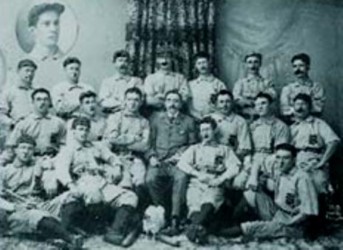
1896 NL Baltimore Orioles 1894, 1895 & 1896 Champs |
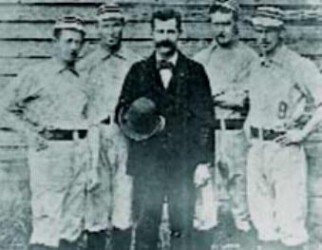
Joe Kelley and John McGraw Right with some of their 1890's temamates. |
ORIOLES |
BALTIMORE |
Logo 1901 |
Logo 1902 |