 |
 |
 |
 |
| This article was initially written as part of the Cardigan History. Although I am sure that none of my Cardis and none of our Australian dogs for that matter, are carriers of PRA, because of the mindset of the general public these days, I decided that I had better have proof, just to cover my own butt. I started to check my own dogs with the result that I began to think about a register of Australian dogs. I also needed to update my knowledge on the subject. The result is that I now have a fair amount of up to date information. This register was put together to help me and a friend determine which, if any, of our dogs needed to be tested. As a result of conversations with other breeders, I decided to give you all access to it. If you wish, you may add your dogs to it, so that eventually it becomes an Australian Register. If that happens, it will eventually have to be put into the hands of someone else, perhaps one of our Corgi Clubs (after all I don�t suppose I will be around forever) I have thus decided to make my information available to you all by adding my latest info to the article & my own register on this site These pages will be updated regularly, as more information is received/found, so remember to check back from time to time. If you have any queries or information, please don't hesitate to contact me. |
| Notes re the register:
US CWCA Public List = taken from the American CWCA register
This is the comment at the beginning of their register. I believe we should be able to trust this register. |
| "The following dogs� names are a result of blood testing for the presence of the alpha subunit cGMP phosphodiesterase gene mutation known to cause Progressive Retinal Atrophy (PRA) in Cardigan Welsh Corgis. Dogs found to be unaffected/clear of the mutation do not pass it on to their offspring. The offspring of two unaffected/clear dogs should be unaffected/clear themselves. There were additional dogs posted to various computer lists and identified there as either carriers or clear/unaffected. However, because the results have not been verified, they are not included here.
This PRA Status Page is provided by the CWCCA as a service to breeders and puppy buyers. Breeders will find the list invaluable in identifying both PRA carriers and unaffected dogs in the pedigrees of their breeding stock. By identifying carriers and carefully selecting mates for these dogs, the eventual elimination of this disease is now possible. Puppy buyers can use this list to identify carriers in their puppy's pedigree, also. However, be aware that the "Carrier" status of any individual dog does not affect that dog's health in any way. It is the breeding of two carriers together that produces PRA. According to the American College of Veterinary Ophthalmologists, the Cardigan breed in North America has less than 1% of dogs affected with PRA. To include a dog, please send either copies of the test results for tested dogs or pedigree information for line-cleared dogs to" |
| To have your dog/s added to this register, please forward to me copies of their test results - by e-mail see above by snail-mail "Keeper's Gate" Mitchell Hwy, Lucknow 2800 |
 |
| The Kennel Club (Britain) also maintains a register of UK dogs tested. |
| PM I have inspected the pedigree and concluded that the dog is clear |
| Progressive retinal atrophy (PRA) is a hereditary disease of the eye.
The human equivalent is retinitis pigmentosa. It is a disease of the retina which contains specialized cells photoreceptors) that absorb the light focused on them by the eye's lens. |
| They convert light into electrical messages that are sent to the brain via the optic nerve.
There are two types of photoreceptor cells - rods and cones. The rod photoreceptors are designed to function in dim light and do not register colours. The cone photoreceptors work in brighter light and are responsible for daytime & colour vision (yes, dogs do see in colour, although not quite in the same way as humans). The first modern description of this problem was in Irish Setters in Europe, in the early twentieth century. Since then PRA has been recognized in many breeds of dogs. |
| In all dog breeds PRA has some common features.
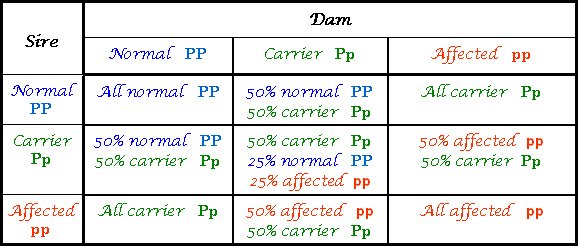
- early in the disease, affected dogs are night blind - they lack the ability to adjust their vision to dim light - later their daytime vision also fails - as their vision deteriorates, affected dogs will adapt to their handicap as long as their environment remains constant, and they are not faced with situations requiring excellent vision - the pupils of their eyes become increasingly dilated, causing a noticeable "shine" to their eyes - the lens of their eyes may become cloudy, or opaque, resulting in a cataract The main difference in PRA between breeds is the age of onset and the rate of progression of the disease. The dog�s DNA molecule contains between 50,000 and 100,000 genes. These genes are the plans that control every characteristic displayed by the dog, its colour, type & length of coat, size etc. Unfortunately, the plans embedded in genes can become altered by a process called mutation. When this happens to a gene that controls a crucial function, the result is disease. Since the mutation makes an irreversible change in the gene, if the mutated gene is passed into either an egg or sperm cell an inherited disease results. Offspring will inherit the potential for the disease as part of the DNA that is present in the fertilised egg. Such a mutation apparently occurred in the gene that affects the rod photoreceptors in the eyes of Cardigan Corgis, resulting in the disease, Progressive Retinal Atrophy (PRA). This gene defect leads to an abnormal accumulation of material in the rod photoreceptor causing it to die. This affects the rods very early in life; they may not even form correctly. This results in affected puppies having defective nighttime vision as early as 6 weeks of age. The cone photoreceptors then start to die, probably as a result of the mass death of the surrounding rod cells. As the cones die the affected dogs also lose their daytime vision. In Cardis, PRA is inherited in an autosomal recessive way. autosomal - the defective genes are not carried on sex chromosomes; both sexes are equally affected. recessive - two copies of the defective gene are needed to produce disease - dogs with only copy of the defective gene can pass it on to their offspring, but do not develop disease Therefore, if P is the normal gene and is p the defective gene, then a dog that carries: - PP has normal sight and cannot pass the disease to offspring Pp has normal sight and can pass the disease to offspring (is a carrier) pp is blind, or will be very soon, and all the offspring will be carriers or blind themselves Remember genetics is a science of probabilities, so in the table below, when a carrier is mated to a normal, the chances are that half the puppies will be normal & half will be carriers; they may all be normal, all carriers or in any other proportion. If a very large number of puppies (maybe 50 or more) were produced half will be normal and half will be carriers. |
 |
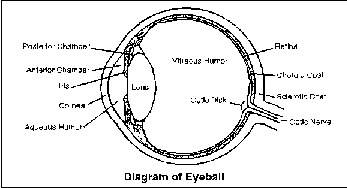 |
| I will have to find a clearer pic than this!!! |
| A Register of Australasian Dogs & Imported Dogs/Semen Tested for PRA |
| A Little History |
| * History cont'd * The Present * Testing |
 |
| Introduction What is PRA? |
|
|
 |
 |