Day 11-12 - Aug 1-2 - Tena Tena Camp
Trip start
On August 1, we left Nkwali in the morning on a game drive. Getting to Tena Tena
The next day will be unusual as we will visit a Zambian school and village, supported by RPS, instead of the usual game drives
Send questions and comments to [email protected] and I will answer when time permits
Safari start
previous - Nkwali Camp

Camp involved being transported across the Luangwa River and switching
vehicles. The new one was stuck in the sand but they managed to free it
before be crossed the river.

Leaving Nkwali Camp (Chris, Helen, Vaughan)

The classical look of an experienced safari participant on a cool morning drive

Close-up of same

A young brown snake eagle, on the early morning drive

The 10x zoom again

Mother and baby zebra

Rather large baobob tree
FACT: The world's widest tree. The trunk of the baobab can store more than 30,000 gallons of water. Its size varies as it uses and collects water. Leaves - deciduous tree, with new leaves appearing in late spring or early summer. Digitata's leaves have 5-to-7 leaflets, which can seem to be like fingers (hence "digitata"). Shape and Trunk - a fat tree, due to its short, thick, grey trunk. May be the widest trunk in the world, up to 45 feet in diameter. Not tall, usually 45-75 feet. A few thin branches spread from the top of the trunk. The trunk of a baobab stores water, and its size may vary from season to season, as it uses water or stores it. Reproduction - 6"-wide sweet-scented flowers. Pollinated by nocturnal creatures, including bats. Egg-shaped fruit with a green velvety coating over a woody, thick shell. Flesh of the fruit is white and pulpy, and holds the black seeds.

The crocodile appears to have the head of an antelope in its mouth

Herd of hippos ... there were many such groups on the Luangwa River

How we crossed the river during the morning game drive

Tena Tena is the oldest RPS camp and has been in existence since 1950. It is located north of Nkwali Camp and south of Nsefu Camp.
The main open building (with bar) and the chalets are along the east side of the river ... and you hear the wonderful sounds of the hippos day and night.
Each camp's chalets are built of different materials. Portions of the chalets are re-built at the end of the rainy season each year, when the roads are passable again.
In Tena Tena, the toilet and shower in each chalet are permanent and the sleeping area is of tenting material that is permanent until Dec (when the rains come again).

Our chalet was on the side of a lagoon area frequented by many elephants, hippos, antelope (impala, kudu, puku, bushbuck ... wildebeest, sable and eland are later in the safari) and warthogs. The nice thing about the chalets is they are completely open in the back and have big chairs set up for easy animal viewing.
From the main building, we watched the many birds (kingfishers hovering before their many unrewarding dives for fish, fish eagles, etc), large motionless crocodiles, very sociable hippos, grazing elephants, the occasional monitor lizard ... and the meandering Luangwa River.

Another angle

Chris and Vaughan's chalet

Chris and Vaughan's view

These little lizards were quietly around our chalets

The ever-present rather large crocs

Looks like a crowned plover

Albino baboon ... tolerated by the others

These may be crowned cranes ... quite plentiful

puku

This elephant was busy eating rain tree leaves ... just a few feet from our chalet (protected by a camouflaged electric wire)

About 100 yards away from our chalet

Puku in the same location as the elephants

Very bright and always move quickly together ... swallowtailed bee-eaters or gorgeous bush shrike or Lillian's love birds or ...

Afternoon game drive

Afternoon game drive, sundowner

Supper the first night with the other guests

Sunset on the first night

Our guide located these two male lions the next day in an open field in the morning game drive

the second male lion

Good focus, Vaughan

This is a very colourful whitefronted bee-eater (click picture for enlargement)

Vaughan showing Helen and Chris how his 10x zoom camera is sooo much better than my 300mm zoom attachment!

Another herd of hippos in the Luangwa River

Lunch the second day

The whole group at lunch (including staff and other guests)
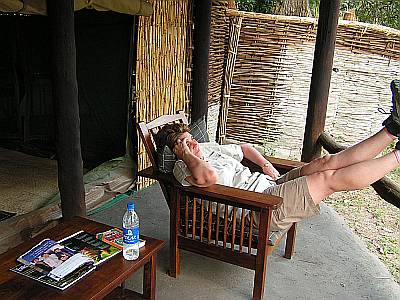
Chris relaxing after lunch

My 300mm zoom of water buffalo on afternoon drive

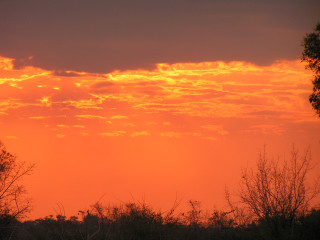
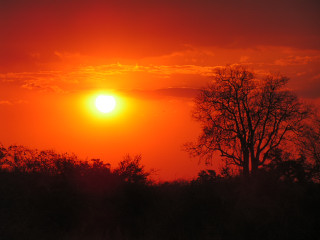
Sunsets that night
next - Kawaza School
Safari start
Trip start