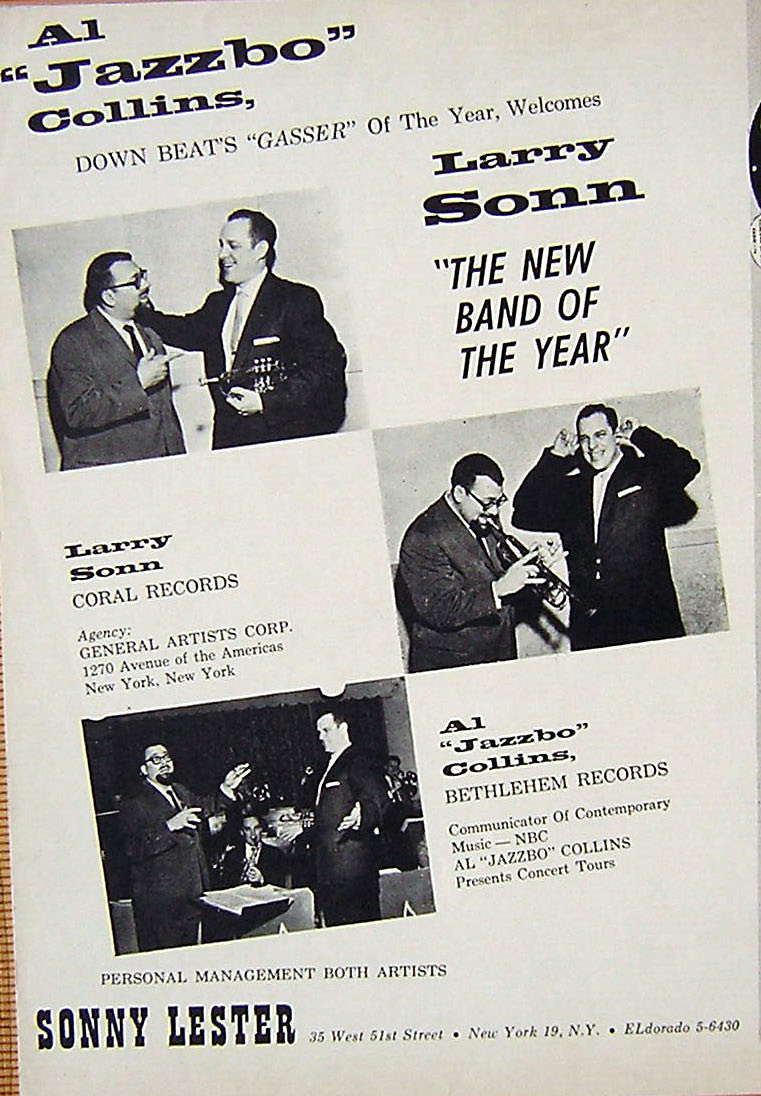
IN BASEBALL, time was when a major league player jumped to Mexico for new fame and fortune. Bandleader Larry Sonn did his jumping in reverse.
In the early 1950s. Sonn had the top recording and dance band in Mexico. In 1955, he left the security of his position and jumped back to the United States to take a crack at the sagging band scene here.
Since that time, he has slowly and steadily built a band with a sound, through his in-person appearances and a stream of Coral singles and LPs.
Larry was born on Long Island, not far from New York City. His first band work as a teenager was with a group led by Dick Jacobs, a pop bandleader and recording artist today. Also in on some of those growing-pains sessions was a young mandolin player who later grew a beard and cultivated his voice ... Al (Jazzbo) Collins.
SONN STARTED studying piano at the age of 8, but later switched to trumpet. He won a scholarship and studied trumpet at Julliard. Although he was building toward what was apparently a classical music career, he cocked an appreciative youthful ear to what Bunny Berigan and Harry James were doing. He also played with the Southern Symphony but soon returned North to take a chair in the Vincent Lopez band.
In 1946, Larry went south of the border to stay six months. He made such a hit that he stayed nine years.
Col. Enrique R. Vega, an assistant to President Adolfo Ruiz Cortines, had opened a lavish club in Mexico City and needed an American bandleader, vocalist, and musicians.
Sonn built the band, set its style, and gradually drew top Mexican musicians into the organization.
"It was simplest thing in the world to build a style in Mexico," he recalled. "This is the reason: the existing bands there fell into three categories -- bands playing only stocks, bands with three tenors, and the hotel style, and bands which imitated other top bands, namely Glenn Miller.
"We had a differnt sound and our own book. The arrangements were simple. We made an immediate hit because we could buck those three styles quite easily."
During the nine years south of the border, Larry and the band played the new club, Bugambilia, and played virtually every city and hamlet in the country. He liked the Mexican people, and they took to his music.
HE FOUND THE musicians ranging from adequate to excellent, and the latter became annexed to his band.
But soon, a growing tide of nationalism and a desire to move beyond the marks he had achieved figured in his decision to head back to the States.
"I had gone as far musically as I could," he said. "I was actually becoming bored with that scene and found myself only repeating what we had done before.
"There was also an attitude I couldn't cope with and be happy. I had made some of the most wonderful friends and associations in that country. But there was a feeling among the musicians that what they were doing was monor league. Maybe it's hard to explain. It's like playing baseball in the minors all your career. The musician feels that what he's doing is second best."
"I don't have that with my band now," Sonn added. "For instance, the a&r men down there would rather have the band record a stock tune.
"With this band we are always looking for fresh sounds, and we are getting them, things we feel are bright and modern and still danceable."
The Sonn band has a book largely written by chief arranger Manny Albam, with contributions by Al Cohn, and scores by Sonn himself. Larry writes the arrangements built around his lyrical, forceful trumpet.
There is a good spirit in the band. Recently, on a layover in Cincinnati, Larry found that the band members wanted to rehearse on their day off. Some were even nosing around, looking for a spot to play.
"Thery're enthusiastic about the band," he said. "They're getting a chance to blow some jazz and some good dance music, too."
AT A RECENT DANCE date in the Lynwood ballroom, Edison, N. J., the band fought horrible acoustics and a tortured sound system and still managed to come out the winner. It was obvious, from listening to the Sonn recordings and then hearing the band in person that Larry and Manny had been synthesizing the style to a definite sound.
At Lynwood, the band sounded bright and punching. Ballads were voiced low in the reeds, and Sonn's open horn sang above the sections. Up numbers, such as Al Cohn's From A to Z, drew the standees around the stage. Larry's version of My Silent Love, Stardust and such ballads, was mindful of the heyday of bands with a featured soloist soaring over the reeds. He has a clean, legitimate open-horn sound.
From time to time now, Sonn moves back to the section, to whip them through the bright brass figures on up tunes. A recent addition, Al Baldini on drums,formerly a small-group drummer, is apparently at home driving the 15-piece Sonn crew.
In the sections are such stalwarts as Spincer Sinatra on tenor; Jay Cameron, baritone; Bob Swope, trombone; Bob Corwin, piano, and Joe Lopes and Hal Stein, altos. Vocalist Arlene Corwin fits in pleasantly.
"The only thing that will pull the band business out of the hole," Larry said, "is more bands.
"There's so much constructive criticism of hip bands and putting down of others, that it doesn't help things. I'd like to see more emphasis and constructive criticism of all bands. This would help the band business go up."
SONN'S BAND IS an efficiently operated business proposition. His function is solely as leader and music director. The headaches and bookkeeping are handled by the staff, much in the manner of a corporation.
The thinking behind this setup has paid off. The band has repaid all of the money initially invested in it. While other new bands may be struggling to dig out from under a $15,000 or $20,000 backing, Sonn's crew is riding along debt-free. It was a struggle to reach the break-even point, but it was accomplished in less than two years.
The business staff co-ordinates the financial work with a search for new locations and jobs for the band to play.
"There are a lot of new things we do," Sonn said. "Industrial trade shows, for one. MCA and GAC book a lot of those. Between that and the school dances and proms, a band can keep busy.
"The dance dates are good money dates, of course. But there just are not enough of them. A band can't really work six or seven days a week. And road trips aren't as long as they used to be." Sonn said.
Working so close to the band's income has resulted in some tight moments. But one management spokesman declared,
"We're better off. The other way, you have to give out so many pieces of the band that you could spend the rest of
your life buying them back. And you are liable to find yourself with no ownership when you hit big."
-- dom