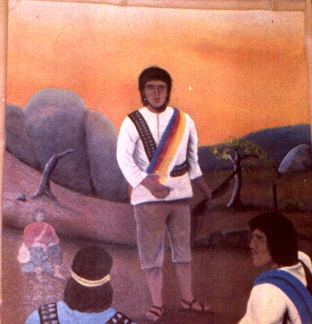
But the Nonualco leader Anastasio Aquino, operating out of the town of Santiago, presented the grievances of his community in terms broader than any simple resentment against San Miguel. The criollos, he said, took their land, then came among them as military politicians, drafting the Natives to fight as cannon fodder in factional armies. Quickly, he raised some 3,000 men -- which would have been a significant force in Mexico or the United States at that time, and was enormous for Central America.
For several weeks he defeated every government unit sent against him, with a standard call to action against any patrol that risked itself on the switchbacks up the mountain:
"Men of Santiago! A hundred of you uphill, a hundred down, then close in!"
Against Aquino, the criollos finally amassed a force of some 5,000. They sent in a priest as emissary, offering autonomy if the rebel leader would lay down his arms -- which he would not. With superior arms, they seized the Nonualco towns, drove Aquino into hiding, then pressured the locals into revealing his refuge. He was captured and shot. The criollos' own civil wars could resume in peace. |