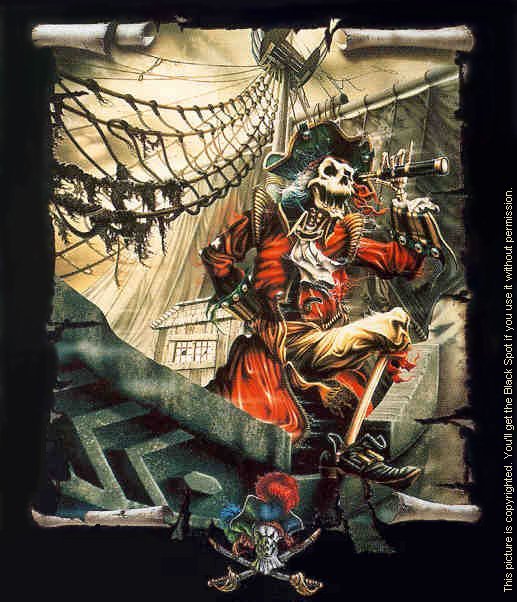
Captain (ships commander; all oceans, all era's) Captains traditionally have exercised almost
unlimited authority over a ship at sea.
Pirate captains generally
retained unlimited power during battles, but they were subject to the quartermaster in many
routine matters.
First Mate/Quartermaster (pirate officer) Captains delegated
unusual amounts of authority to the quartermaster who became almost the captain's equal. Pirates
disliked ridgid rules, and there were exceptional situations. The captain retained almost unlimited
authority during battle, but he was subject to the quartermaster in many routine situations. In this
way, as Walter Kennedy explained at his trial, pirate crew's avoided putting too much power in
one persons hands. As with the captain, the quartermaster was elected by the crew and received
and extra share when the booty was divided. If the pirates decide to keep a captured ship, the
quartermaster often took over as captain. The quartermaster represented the "Interest of the
Crew". Above all, he protected the seaman against each other by maintaining order, settling
quarrels, and distributing food and other essentials. Serious crimes were tried by jury, but the
quartermaster could punish minor offenses. Only the quartermaster could flog a seaman after a
vote from the Crew. The quartermaster took part in all battles and often led attacks by boarding
parties. If the pirates won, he decided what loot to take. He was compelled to seize gold, silver
and jewels. But he took more bulky cargo at his discretion.
Boatswain: like the quartermaster functioned as something of a foreman. He summoned the crew
to work. His specific duties centered around the upkeep of the rigging. He had to be sure that all
lines and cables were sound and that the sails and anchors were in good condition.
Gunner: sometimes with the help of a boy or "powder monkey", tended the artillery and
ammunition. The Gunner needed experience to avert or handle the potential disaster of a cannon
bursting or overheating, or recoiling out of control. A knowledgeable Gunner was essential to the
crew's safety if a ship had any pretense to self-defense.
Carpenter: an important specialist in a wooden world, was responsible for the soundness of the
ship. He repaired masts, yards, boats and machinery. He checked the hull regularly placing
oakum between the seems of the planks, and used wooden plugs on leaks to keep the vessel tight.
His was highly skilled work which he learned through apprenticeship. Often he had a mate whom
he in turn trained.
The common sailor, which was the backbone to the ship, needed to know the rigging and the
sails. As well as how to steer the ship and applying it to the purposes of navigation. He needed to
know how to read the skies, whether, winds and moods of his commanders. Other jobs on the
ships were surgeon (for large vessels), cooks, cabin boys and navigators. There were many jobs
divided up amongst the officers, sometimes one man would perform two functions. During this
time in history if you were part of his majesty's navy you would be ruled with an iron fist on land
and at sea was a bit worse. In the Royal Navy the Captain had complete authority to hang you if
he so decided. One of the most alluring attractions to becoming a pirate was escaping dictatorship
and embracing democracy. This was also the chance for the trampled poor man to make a name
and fortune for himself. The pirates called themselves "The Brethren of the Coast".
Shanty Man: payed to sing song fer the crew tae work too...Most work aboard a ship has easier accomplished when set to a pace, so the shanty man had songs that would help the men keep better rythem.
Navagator:control the course of the ship
Pilot: conducts the ship in and out of port or through dangerous waters. ship's helmsman
Ship's Doctor: To give medical treatment.
It is safe to say that life as a pirate was a very hazardous one prone to serious injury and even death. Besides
death, a pirate's worst fear was becoming disabled. If the injured pirate survived the amputation
and received proper medical attention (which was highly unlikely aboard a pirate ship) he
received some sort of primitive substitute for his arm or limb (usually a spare plank, or sometimes nothing at all).
For obvious reasons an injured pirate was no longer as effective as an able bodied seamen, and for the most
part could no longer carryout his designated duties. Such pirates were compensated for their loss (quite
dequately for their times,). Actually, most pirate crews organized fairly sophisticated and
favorable conditions for injured crew members. Injured pirates were not only compensated financially, but
oftentimes they were also offered to do non-physically demanding work on the ship. Such work could include
operating cannons, cooking meals, and washing the ship decks.