
Rigging Basics
If you think you're confused about what type of ship is what, then you're in good company. Ship rigging is very confusing and
rarely explained in anything resembling English. This section will try and clarify how the ships are rigged, that is how the sails
are arranged.
Three things will determine what kind of ship you're about to board.
1.The number of masts
2.The way the sails are attached to the mast
3.The number of gun decks
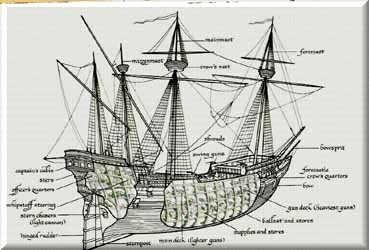
A mast is the tall pole sticking up from the deck of a ship. Most sailing ships have between one and three mast but some have
four. To simplify matters I'm going to only discuss ships of three masts or less.
Each mast has a particular name
1.Foremast: the front mast on three masted ship
2.Mizzenmast: rear mast of ship with more than two masts
3.Mainmast: middle mast of three masted ship or the front mast of two masted ship or the only mast on a one masted
ship.
The sails can be rigged to the mast in two fashions. Typically only one fashion of rigging is used throughout the vessel but in
some cases their is a mix of both types of rigging. Rigging is simply defined as the way the sail is attached to the ship.
Or a sail can be attached to a "yard"or "yardarm" which is a cross beam on the mast which is permanently attached.
Types of Rigging
There are two basic ways to rig sails:
1.Square Rigged Rig in which the sails are bent to the yards carried athwart the mast and trimmed with braces. The
advantage is the square rigged sails are quite sturdy and can catch a lot of wind.
2.Fore & Aft Rigged. A rig in which the sails are not attached to the yards but are bent to gaffs or set on the mast or
on stays in the midship line of the ship. The advantage is increased maneuverability.
To add to the confusion, some ships alo possessed lanteen sails which were used heavily in the Mediterranian on merchant
ships. The lanteen is a sail shaped like a right triangle. Lanteen sails added to the manuerverablity of the ship, allowing ships
to sail in directions other than directly with the wind. However they were not as good for speed because they caught less
wind than a square sail. Typically the Lanteen had a yard arm which is lossely affixed to a mast and hangs diagonally. This
allows for the sail to be shifted about to catch the wind. Lanteens are common among many small sailing vessels in use today.
Gaff sails also helped in manuevering ships. Gaff sails hung from a gaff or spar extending from a mast on a ship.
If a ship does not have its sails in place then the presence of gaffs and yards can help determine what kind of ship you're
looking at. However, almost all Square rigged ships have supplemental gaffs!
Of course, to complicate the matter, you'll run across numerous other terms for the way a ship is rigged. Here are the most
common terms.
Ship Rigged: square rigged on three masts
Brig or Barq Rigged: square rigged on all but the mizzenmast. Fore and aft rigged on the mizzenmast. (However most
Brigs are completely square rigged).
Schooner or Sloop Rigged: Sails rigged fore and aft but sometimes carrying a square rigged top sail on the mainmast.
To further complicate the matter, Square rigged ships also have gaffs on every mast. These gaffs are there to rig fore & aft
sails in the even of storms. These special sails are called Trysails. In the event of heavy seas or violent storms the square
rigged sails would be put away and try sails will be used in their place. If the square rigged sails were left in place three
possible disasters could occur:
1.The square rigged sails could be torn from the yards due to winds being to strong.
2.If the sails aren't torn from the Yards then the masts stand a good chance of breaking due to the added weight of the
wet sails or simply from the wind.
3.If the masts don't break, then the sails could force the ship to capsize, that is roll over in the water.
The trysails are smaller and attached only to the bottom portion of the mast. This reduces the possibility of the ship capsizing
and also reduces the strain on the very tall masts. Because the try sails are rigged fore and aft they assist in the
maneuverability of the ship during the storm.
Gun Decks
The number of decks containing guns or cannons is a determining factor when discussion Man of Wars or fighting ships.
Fighting ships fall into three classes. Those with one gun deck (corvettes), those with one and half gun decks (frigates) and
those with two or more gun decks (Ship of the Line)
The number of masts on on a Man of War would give some clue as to how many gun decks she would have.
Merchant ships would also be armed but most likely not as well armed as a Man of War. More likely the Merchant ship
would only have one gun deck.
The Heiland Revenge
The Man-O-War
A naval ship that was designed for combat and not for merchant service. It was typically heavily armed.
Ship of the Line
Captain E. Drummond
An old British Man O' War
Crew: 500 to 1000 seamen
Guns: 100 24 pounders - 140 16 pounders depending on outfitting (Orders by Captain Drummond to outrig with only 24 pounders)
Sea worth: Very high
Manuverability: Slow (Modofications are being undertaken by order of Captain Drummond to lighten ship)
Masts: 4
Number of sails: 18
Decks: 3
Hold: can carry the equivalent of 18 frigates
Also the ships would be deployed strategically just beyond the horizon or in the shadow of merchant ships as a trap.
There are three general classes of Man-O-Wars.
Frigate
Corvette (Sloop of War)
Flagship
Endless Tide
Queen's Flag Ship
Captain Donwyn Nightblade
When used as a warship, Cromsters would
act as escorts for the larger galleons. While
the cromster lacked the speed of a sloop it
would have at least twice the firepower and
possilbe three or four times the crew. It
would also hold more loot.
A cromster could have a gun deck and
could also lash extra guns to its top deck.
The cromster would cary between eight and
sixteen guns on the gundeck ranging from 4
to 12 pounders. The crew could easily top
sixty, depending on the number of cannons
and living conditions would be quite
cramped.
The Cromster which looks like a small galleon (also spelled Crompster or
Crumster) was a merchant ship by trade,
relatively fast but not as manueverable as a
sloop. The Cromster have a foremast and
mainmast but also supports a third mast to
the rear which sporting a lanteen sail. Some
cromster lacked the lanteen mast at the rear
and instead used a gaff sail as seen on a
sloop of war or corvette.