 |
| Honeymoon in Chester |
|
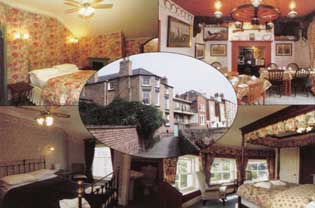
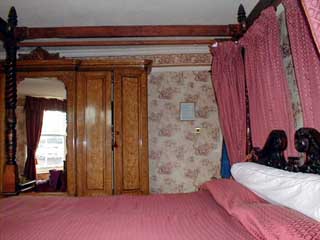
| We stayed in the Recorder Hotel, located on the City Walls, a lovely old place. We had a front facing room, overlooking the River Dee, with a huge bay window and full of antiques. The best part of the room was the 7 foot wide four-poster bed, the only problem being we kept losing each other in it...but it was lovely and comfortable. We had a full English breakfast every morning and the owners were very friendly as were the rest of the staff. |
 |
| Now for a history lesson...are you sitting comfortably? Then I'll begin... The ancient city of Chester, standing proudly above the River Dee, has attracted visitors since the Roman occupation of Britain. The medieval walls encompass not only the city itself but also nearly 2,000 years of history - from Chester's foundation as a Roman fortress to its present role as a thriving centre of commerce and administration. Much of the city was rebuilt in the late 19th century and its present black-and-white appearance was largely created by Victorian architects John Douglas and T.M. Lockwood. Since the 1960s, over 600 buildings of every age have been restored with loving attention to detail. Lining its busy streets, they provide a constant source of interest. Step inside one of the many shops, restaurants or pubs and you may well step back in time, finding yourself in a medieval crypt or a former meeting-place for soldiers of the Civil War. The massive sandstone walls of Chester provide a pleasant two-mile walk, sometimes 39 feet above street level, with unparalleled view of the city and countryside. To the north and east they follow the line of the old Roman walls, traces of which can still be seen. The southern walls, extended down to the river by the Saxons, were rebuilt by the Normans, who added the western walls to complete the circuit. By the 1500s, dotted with watchtowers and heavily fortified, the Walls presented a formidable barrier and were able to withstand heavy cannon bombardment during the Civil War siege of 1644-6. Repairs and restoration in the early 18th century resulted in today's pleasant walkway. The medieval gates were later replaced by arches and the Walls were breached to accommodate roads and railway. |
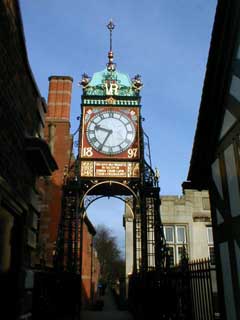 |
| Eastgate Clock - The clock stands atop Eastgate, which was built in 1768-9, replacing the medieval gate, which was said to have incorporated Roman arches. Traces of the original Roman gateway were found during repairs to a sewer in 1972. The Eastgate clock tower is a well-known feature of Chester. It was erected in 1899 to commemorate the Diamond Jubilee of Queen Victoria two years earlier, in 1897. The ornate iron framework was designed by John Douglas and built by James Swindley, a Handbridge blacksmith. The clock itself was made by J.B. Joyce of Whitchurch, with a pinwheel deadbeat mechanism operated by a pendulum weighing over 110 pounds. |
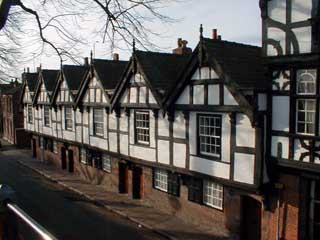 |
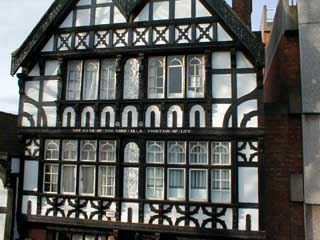
| The Nine Houses - Two of the original nine almshouses in this row were joined together and another two were demolished, so there are now only six. Built in the 17th century, they have a timber framed superstructure on a sandstone base, a feature peculiar to Chester. The Victorian half-timbered house at the end of the row is an interesting contrast, being taller, with large, more geometrically-patterned gables. |
 |
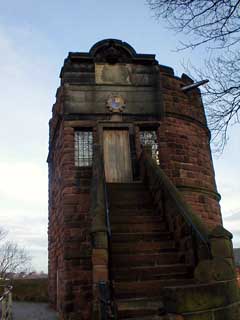 |
| King Charles's Tower - Originally known as Newton's Tower, this was adopted as a meeting-place by the Guild of Painters, Glaziers, Embroiderers and Stationers in the early 17th century, when it became known as the Phoenix Tower. According to the inscription above the upper door 'King Charles stood on this Tower, September 24th, 1645 and saw his army defeated on Rowton Moor'. It is to this legend that the tower owes its current name. Badly damaged during the siege of 1644-6, it was almost certainly entirely rebuilt in 1658. The tower now houses a small museum. |
 |
 |
 |