|
|
|
|
|
Cusco Destination Guide the best trips with the best tour guides, hotels...
.
|
|
THE ANDEAN CONSTELLATIONS
|

|
|
ANDEAN ASTRONOMY BY BRYAN BRAWER
One source of the well-regulated order of the Inca empire was its calendar system. Based on a complex integration of solar, lunar, stellar and even biologycal cycles, the Inca calendar provided an orderly basis for all aspects of inca life. Agricultural and herding activities, the celebration of state and provincial rituals and the performance of public works for the Inca, well all coordinated with clockwork precision by calendar specialists in Cusco and in other administrative centers throughout the empire.
The inka moon year
|
The astronomical knowledge of the Incas derived from regular, naked-eye observations of celestial events. Astronomical cycles were probably preserved on the knotted-string recording devices called quipus. The center for the collection, storage and interpretation of the astronomical information, and for the coordination of provincial calendars throughout the empire, was Cusco. Stone towers, or pillars (called sucanca), were set up at the appropiate places on the horizon around Cusco to mark the points of sunrise and sunset on the days of the solstices, the equinoxes and days when in Cusco the sun stood straight overhead, in the zenith, at noon (october 30 and february 13). Observations of moonrise and moonset at the horizon (solar) pillars, as well as the recording of the phases of the moon, combined with the solar observations to provide month-like units of time and an overall greater precision in the annual calendar.
Subscribe to newsletters
|
The inca knowledge of the stars and constellations was as rich (and as complex) as that of any other ancient civilization. The morning and evening stars (venus) were recognized and named and were accorded a special room for their worship in the Coricancha.
The principal stars and constallations of the incas were located within or near the Milky Way; the inca called this bright path of stars mayu ("river"). In Inca cosmology, the "river" of the sky had its earthly counterpart in the Urubamba river, along which are located Pisac, Ollantaytambo and Machupicchu. According to their vision, the two great rivers of the inca universe, the Milky Way and the Urubamba, were joined at the edge of the known universe in the waters of a great cosmic sea which encircled the earth. The Milky Way was thought to have its source in the cosmic sea, from which it took water into th sky. As the Milky Way passed through the sky at night, it deposited moisture in the sky which fell to the earth in the form of rain, replenishing the waters of the Urubamba river.
|
THE CELESTIAL ANDES:
- The Incas recognized two major types of constellations along the Mayu, the celestial river. One type, similar to the constellation western Europe, traced familiar shapes in the sky by conceptually joining together neighboring bright stars. These constellations included such shapes and objects as bridges, storehouses, crosses, and animals. One of the most important constellations of the incas was the cluster of stars known to us as the Pleiades, in the constellation of centaurus. The pleiades were considered to be a "storehouse" (colca), and they were observed regularly to help determine the times of planting and harvesting the crops.
|
|
-
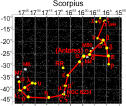
For example, the constellation which we know as scorpious was considered by the incas to represent a great serpent (the tail of scorpious) which was changing into a condor (the head of scorpius.)
|
|
|
|
|
|
|