| The Lord of the Rings: The Two Towers |
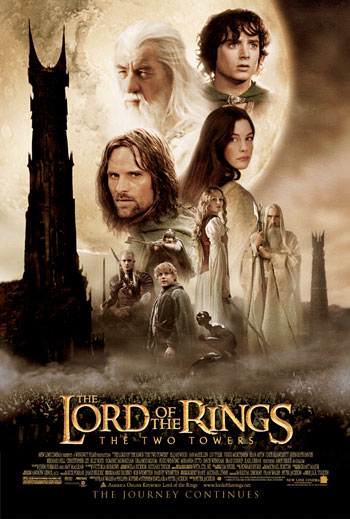
| 2002, New Line Cinema. Directed by Peter Jackson. Starring Elijah Wood, Ian McKellen, Viggo Mortensen, Sean Astin, Liv Tyler, John Rhys-Davies, Orlando Bloom, Billy Boyd, Dominic Monaghan, Miranda Otto, Brad Dourif, Karl Urban, Bernard Hill, David Wenham, Christopher Lee, and Andy Serkis. Rated PG-13 for epic battle violence and scary images. |
| Grade: A+ |
| Review by Anthony |
 |
| The second film in Peter Jackson's trilogy based on J.R.R.Tolkien's much-beloved books continues the spectacular story-telling begun in the first film. Frodo and Sam continue their journey to Mordor to destroy the ring and are joined by Gollum who becomes their guide. Meanwhile, Aragorn, Legolas, and Gimli are in deep pursuit of the Uruk-hai who have captured Merry and Pippin. They meet up with an unexpected friend who takes them to the city of Rohan, the kingdom of Theoden. They all prepare to do battle with Saruman's fast-approaching army of Uruk-hai, who intend to destroy the race of man. The movie takes more liberties from the book than did the first film. To begin with, some of the book's most significant parts have been omitted and reportedly moved to the next film (the reason for this being that the third and final book actually contains the least amount of story, so parts in The Two Towers have been moved, understandably, to the final movie in order to beef it up). One such scene is Frodo and Sam's climactic encounter with a character called Shelob. This alteration led to another. With the omission of this important part of the book, it was necessary to come up with some other event to happen to Frodo and Sam (otherwise Frodo and Sam's part of the story would have ended abruptly and dully). To serve this purpose the character Faramir, brother of Boromir, was drastically changed. This also led to an extended detour for Frodo and Sam which found them in the city of Gondor. This change is by far the biggest the movie-makers have made. I myself am altogether indifferent towards this change (that is I'm not particularly pleased with it, but I'm not exactly up in arms over it either), but it may dishearten other die-hard fans of the books. There are other changes as well that may displease some fans - such as the elves' appearance at Helm's Deep and an extended sequence with Aragorn and Arwen. The former isn't really too serious of a change, and much of the latter is actually taken from the appendices at the end of the trilogy (so it's not exactly a completely new idea that the film-makers thought up; I actually thought including some of that material into the movie was a pretty smart move). But do not in the least let these alterations keep you away from the movie. I mention them only as observations of the film's departures from its source, but the film more than makes up for these departures. For all its changes, Peter Jackson's The Two Towers still retains the heart of Tolkien's books. It still marvelously depicts Tolkien's story of good versus evil; and it brings the characters, settings, and battles of Middle-Earth to life. One of my favorite aspects of this movie is the character of Gollum. I have had a personal liking for Gollum since I first read the books. He's funny, pitiful, and complex all in one; and the movie creates him wonderfully. Gollum is the first computer-graphics character to be fully controlled by the movements of an actor, Andy Serkis, who is also the voice of Gollum. But Gollum not only looks great; his interior stuggle with himself outwardly expressed is captured on screen superbly. These moments make Gollum's character a very interesting one. He is torn between his evil self, who just wants the ring, and his good self, who wants to remain loyal to Frodo. One infamous and highly anticipated (for me at least) scene in particular shows Gollum amusingly arguing with himself extensively (definitely one of the movie's highlights). Other highlights include the Battle of Helm's Deep and the Ents' attack on Isengard, both very impressive and climactic visual moments. Also of note is the continuing devotion to Tolkien's religious symbolism (Peter Jackson actually said in a TV special that they wanted to stay true to Tolkien's spiritual themes). For example, the movie contains not one, but two "resurrections" (the second one being an addition on the film-makers' part). The first one that also appears in the book is especially reminescent of Christ's resurrection. Tolkien also likened Frodo's burden of carrying the ring to Christ's burden of carring the cross. Also of interest is the "exorcism" of King Theoden. Whether The Two Towers surpasses The Fellowship of the Ring is a matter that both critics and fans disagree on. I think a personal friend of mine said it best: both movies are part of a whole; they are continuous chapters of one story and should be judged accordingly. The Two Towers continues the masterpiece begun with The Fellowship of the Rings and remains a fine re-telling of Tolkien's work. |