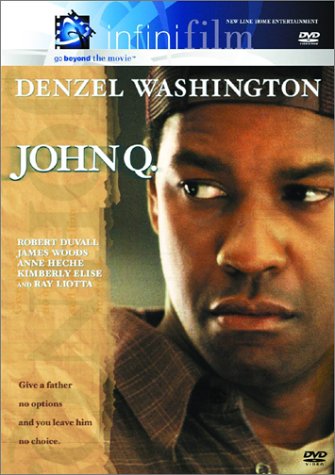
"And why not do evil that good may come?-as some people slanderously charge us with saying. Their condemnation is just." (Romans 3:8). Although John Quincy Archibald and his family are Christians, they (as well as most of the characters in John Q.) either have not read the preceding verse or else just don't believe in it. John Q. is about a man whose son's heart is failing. What his son needs is a heart transplant; but unfortunately, John's health care won't pay for the operation. John has to scrape up $75,000 in cash. He tries everything, including selling his wedding band; but he is still too poor and can't raise the money. After a phone conversation with his wife, who frantically demands that John do something, John makes a decision. He goes to the hospital and makes one last plea with his son's doctor. When that doesn't work, John pulls out a gun, locks the doors, and holds everyone inside hostage until his son's name is put on the list of patients to receive heart surgery.
The movie suffers from much unreality. To begin with, the doctor and other people working at the hospital are unrealistically cold and stiff. They have no problem with expressing no sympathy or condolence at all toward the Archibalds, and they actually seem quite annoyed when John's wife starts crying loudly when she first hears the bad news. I suppose this was done in part in order to increase sympathy towards the Archibalds, but it really comes across as overdone (also, because the main purpose of the film is to promote the availability of proper health care to everyone, I think these people are supposed to be portrayed as unfavorably as possible).
Furthermore, John himself is unrealistically considerate of the hostages. He tries to see to it that everyone who is in need of medical attention gets it. And the hostages (or most of them anyway) in turn unrealistically start liking John and rooting for him (at the end of the movie, one of them even calls John his hero). Another unrealistic moment (and one of the worst) takes place when John, suddenly attacked by one of the hostages, loses his gun; and another one of the hostages has the perfect opportunity to get the gun. All she has to do is bend over and pick it up, but she doesn't. She just leaves it. Who in the world would possibly do such a thing no matter how well John may be treating them?
But John Q. has a bigger problem (alluded to at the beginning of this review). This problem is a moral one. In John Q., a man who commits acts of terrorism is regarded as a hero. His crime is pardoned by many (including some of the hostages themselves) because of his purpose in committing these acts (after all, he's just trying to help his son, right?), but traditional Christian morality teaches that the end can never justify the means. This is exactly what John Q. tries to do.
For all its weaknesses, John Q. is a movie that will pull the wool over many peoples' eyes. It does this by making you sympathize with the protaginist (and indeed it's pretty hard not to). Consequently, the movie practically forces you to root for John; but this is exactly the problem with the movie. John's actions are not morally licit, and the movie attempts to make us pardon his actions anyway. |