
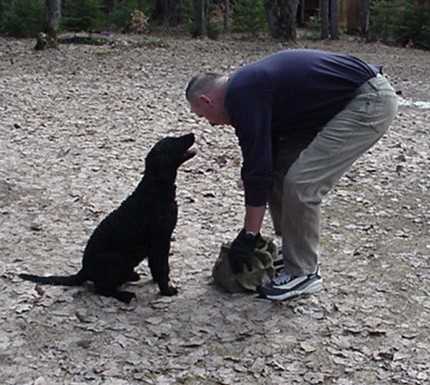
What's in the bag?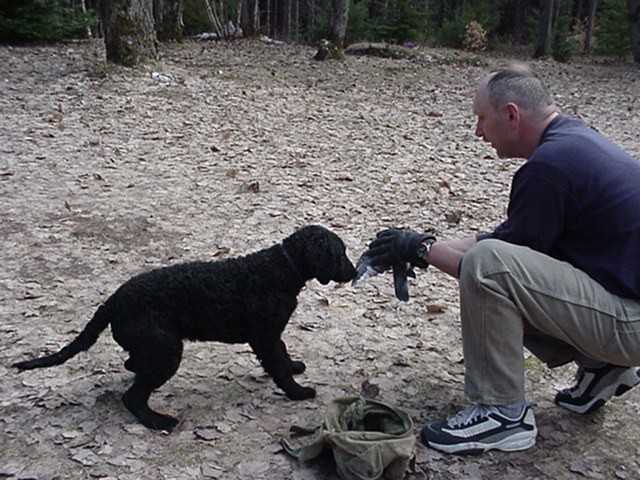
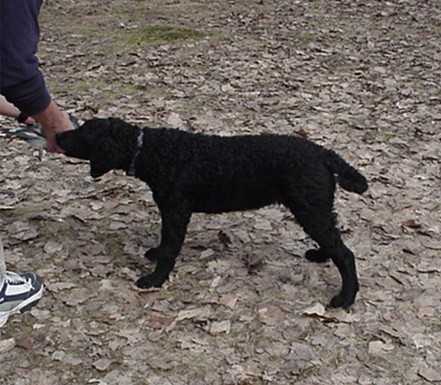
Sniff...Sniff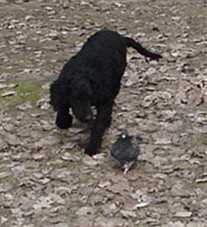
The chase is on! 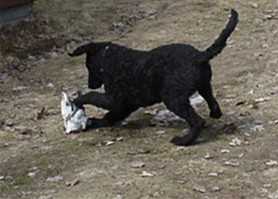

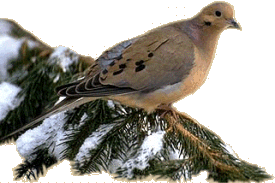
 Birds: Birds should be introduced gradually. Pigeons are a wonderful training tool, and are cheap and readily obtained. They are not even remotely
endangered-in fact cities and building owners are appreciative of efforts to rid them of these pests. Pigeons, however, seem to smell like a game bird to a dog, and
have plenty of scent. Perfect for pups and training adults alike.
Birds: Birds should be introduced gradually. Pigeons are a wonderful training tool, and are cheap and readily obtained. They are not even remotely
endangered-in fact cities and building owners are appreciative of efforts to rid them of these pests. Pigeons, however, seem to smell like a game bird to a dog, and
have plenty of scent. Perfect for pups and training adults alike.But a live bird, even a pigeon, can peck a pup and make him shy or unnecessarily aggressive. First introduction should be with a fresh killed pigeon. Let pup sniff and toy with the bird. This is a new smell that wakes up some very old instincts so let him have fun with it. Toss it, wave it around, tease pup with the bird, and get him excited. Don�t force him to pick it up and hold it yet. That will come.
The first time pup retrieves a bird to hand is an exciting event. If pup is reliably retrieving bumpers, get him ramped up chasing close bumpers. Then mix the pigeon in with the bumpers. Odds are that the first time pup will chase out after the bird and them stop, looking back like "What�s this Dad?" Stay excited, and if he picks it up and runs toward you make a big, happy commotion and encourage him back towards you. If he drops it, just praise him and toss a few bumpers again. Alternate a bird in every once in a while until he brings the bird all the way to you. Then praise him greatly, tell him how wonderful a pup he is, and quit while you are ahead. He�s not going to forget, so don�t push it. Keep everything fun and up.
From Training the Hunting Curly; 1997, 1998 Backcast Retrievers and James Crosby
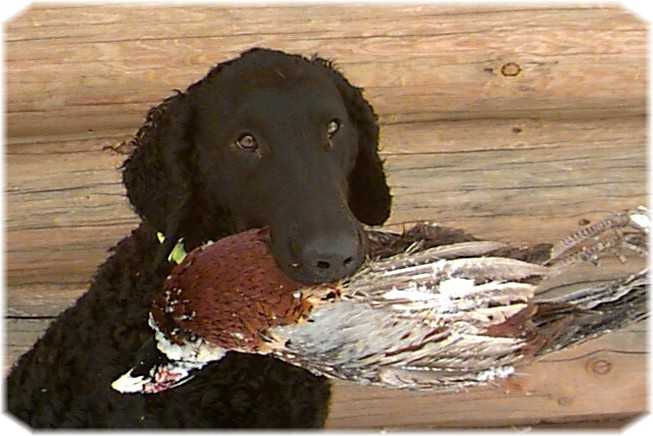
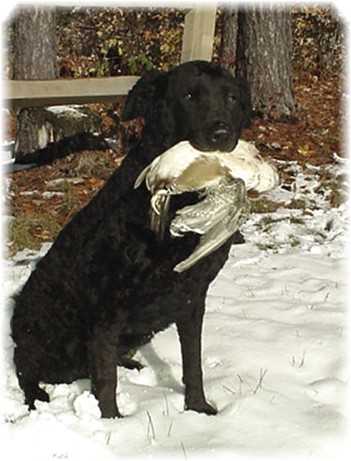
 I like to introduce feathers to a young dog in the following manner.
 I would cut the wings off of the teal you have and put them on her bumpers securing them with rubber bands and pulling the feathers over the rubber bands. Start her out this way. Then if she is picking these up with no problem I would take the teal and tuck the teals head under its wings and put rubber bands around the bird to keep the head and wings intact. I would throw this for her... you need to be very excited when throwing the bird and encouring her to pick it up using lots of praise when she does.
There are also dead fowl trainers made by Dokken make that can be purchesed at sporting dog stores that carry dog training equipment. They have small ducks teal, large ducks mallard as awell as quail and grouse etc. These can be scented with scents. You can take these and add feathers to these. If all of the above does not work and she has not been force fetched then you will have no choice but to put a force fetch program in her. If you have to do that you can email me and I will see that you get instructions on how to accomplish this. Good luck.
Kim Moses
Hunters Marsh Kennels
 How you raise and care for your retriever puppy for the first six months will have a great impact on the quality of retriever you end up with. This is an attempt to give
you the benefit of our experience to help you make the most of this vital period. Please give careful attention to the section on health care. Canine Parvovirus is
abundant in
parts of the country
right now, and is nearly always fatal.
How you raise and care for your retriever puppy for the first six months will have a great impact on the quality of retriever you end up with. This is an attempt to give
you the benefit of our experience to help you make the most of this vital period. Please give careful attention to the section on health care. Canine Parvovirus is
abundant in
parts of the country
right now, and is nearly always fatal.
Frequent human contact and exposure to a variety of environments is very important. We recommend that you keep the puppy in the house or, if that is impossible, get it out at least twice a day and do something with it (take a walk or drive, play retrieves, give it attention). Play retrieves are an excellent activity but must be strictly limited in order to develop an intense desire to retrieve. We recommend 2-3 retrieves per session, twice a day. At first, try to gently guide your puppy into correct behavior without any correction. Throwing a rolled-up washcloth down a hallway is an excellent way to start developing the right habits. With any training you do, recognize that a dog, especially a puppy, has a short attention span. Frequent short sessions are best.
In handling your puppy, encourage it to be calm. You can hold it and restrain it gently, and require it to be calm in order to be petted. Supervise others when they play with the pup (especially children) to make sure they don't egg it on to high excitement. A good retriever pup is energetic and rambunctious, and you don't want to force control upon it, but if it learns that the appropriate response to human attention is to go bonkers, it will be harder to make it into a well- behaved retriever later on. Avoid roughhousing or playing tug-of-war with the pup.
If you have another dog--avoid letting your puppy bond to the other dog instead of you! House them separately and allow little or no free time together. Unrestricted play time with another dog is the surest way to render a retriever pup totalIy untrainable. (The second worst thing you could do is keep it in a kennel or yard and never get it out and work or play with it.) Use a strategy of "confine and supervise." When you cannot supervise the puppy and prevent its developing bad habits, confine it in a kennel or crate. Be sure it is not confined and ignored, however.
Puppy training: Start out gently! Your pup must develop confidence in you, and until it understands the concept of "being trained," it may see any harsh action on your part as "coming out of the blue." Repetition and consistency work wonders and are overall much more effective than either brute force or food bribes. This is especially true in housebreaking.
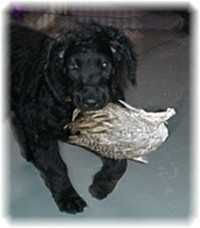 Around four months many puppies can withstand a correction. Unfortunately this is the time they start teething and if their mouth hurts, they may act generally
sensitive. If this is the case, be patient and wait for all those baby teeth to fall out. In training, retrievers often respond to physical correction better than verbal
correction. While "NO!" is extremely useful if puppy is about to bite an electrical cord or steal food off the table, when you are teaching them something (like
obedience) a sharp jerk on their lead or swat with a stick gets the message across with less emotion and less effect on their confidence. If they drop the dummy and
act like their mouth hurts when they are teething, stop all retrieving and wait for their mouth to feel better. A correction should be just severe enough to get the dog to
respond.
Repeated weak corrections are very stressful to the dog.
Around four months many puppies can withstand a correction. Unfortunately this is the time they start teething and if their mouth hurts, they may act generally
sensitive. If this is the case, be patient and wait for all those baby teeth to fall out. In training, retrievers often respond to physical correction better than verbal
correction. While "NO!" is extremely useful if puppy is about to bite an electrical cord or steal food off the table, when you are teaching them something (like
obedience) a sharp jerk on their lead or swat with a stick gets the message across with less emotion and less effect on their confidence. If they drop the dummy and
act like their mouth hurts when they are teething, stop all retrieving and wait for their mouth to feel better. A correction should be just severe enough to get the dog to
respond.
Repeated weak corrections are very stressful to the dog.
Sometimes desirable traits in the dog can show up as irritating behavior. An example is when your pup gets the dummy and heads off in the opposite direction (or under a vehicle) with it. This pup wants to have that dummy in its mouth. If it runs around and is hard to catch but doesn't drop the dummy, be happy and resolve to be patient. You can train it to come when called and you can teach it to respect you in general much more easily than you can train it to hold and carry the dummy well. Work on the "Here!" command totally separately from retrieving sessions (and never give the command when you can't enforce it). Find a way to prevent the dog's running off on retrieves without correcting it. You could go back to the hallway, or, if the pup goes in the water well, have it retrieve only in water until it is solid on "Here!" Almost always, the pup will swim back towards you and only head in another direction when its feet are on solid ground, so if you meet it at water's edge, you should be able to catch it. A limited amount of chasing the puppy while it carries the dummy will reinforce its tendency to hold and carry. A lot will teach it that "keep away" is a really good game (not something you want a retriever to think).
Difficulty of retrieves: After you get your dog coming back, you can start challenging it by making retrieves more difficult: giving it longer retrieves, falls in cover, etc. Be careful not to overdo the difficulty--the #1 consideration is to keep the dog's eagerness to retrieve at a peak. If it shows you a good, long hunt in the cover, reward it with an easy-to-find throw. Extend distance on land before you extend distance on water. For a youngster, a long swim can be a lot of work for the reward it gets. Try to progress but resist the temptation to show off how precocious your dog is "youngest dog ever to do ____" etc.
Water: Don't panic if your puppy is slow to learn that it can swim. If it won't swim after making a couple of retrieves in the shallows, try wading out and calling it. If this doesn't work, wait awhile and try again. When it is confident in you, you can wade out carrying it and set it down in the water. It will swim to shore, but if you call it, it may swim back.
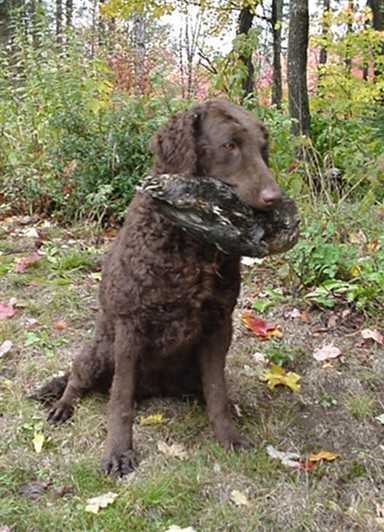 Steadiness: Do not try to enforce this too early. We usually teach it only after force-breaking. For play retrieves, restrain your puppy until the dummy is
nearly on the ground. If it leaps and struggles to get away, it will not mark the fall, so you want to try to correct this. We suggest teaching the dog to sit (in separate
sessions) and then for retrieves, tell the dog to sit and do not release it until it sits and is still for a moment. After some repetition, it will learn to sit still for a throw.
Steadiness: Do not try to enforce this too early. We usually teach it only after force-breaking. For play retrieves, restrain your puppy until the dummy is
nearly on the ground. If it leaps and struggles to get away, it will not mark the fall, so you want to try to correct this. We suggest teaching the dog to sit (in separate
sessions) and then for retrieves, tell the dog to sit and do not release it until it sits and is still for a moment. After some repetition, it will learn to sit still for a throw.
Birds: It is desirable to introduce the puppy to birds before the age of 6 months.
Crates: We recommend using them. The "kennel" command is one of the most useful your dog can know, and use of a crate can make housebreaking less traumatic for you and the pup. Dogs adapt well to being confined for part of the day (or all night)--they do a lot of sleeping anyhow.
For further training information you have several options. There are some good books, although books are of limited usefulness because they cannot interpret your dog's behavior. Any book which claims there is a foolproof method which works with all retrievers should be regarded with suspicion. Four books from which you can learn a lot (although far from all you need to know) are:
- Training Your Retriever, by James Lamb Free
- Charles Morgan on Retrievers, by D. L. and Anne Walters
- Training Retrievers to Handle, by D. L. Walters
- The Working Retrievers, by Tom Quinn.
(Exert from)
Raising a Retriever
Puppy raising tips from professional trainers John and Amy Dahl

Back to Ask The Trainer