 |
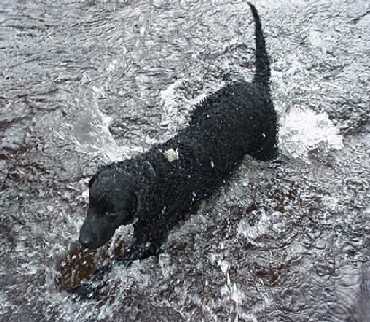
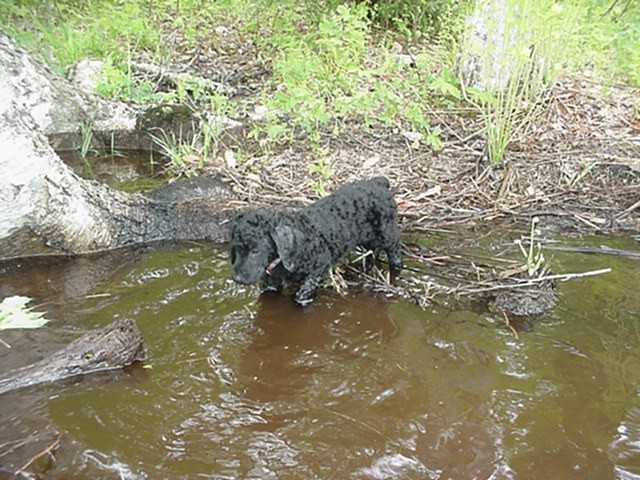
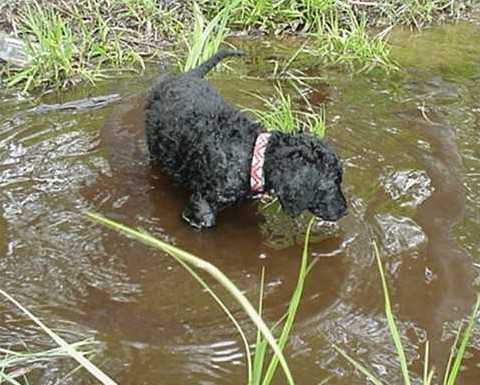
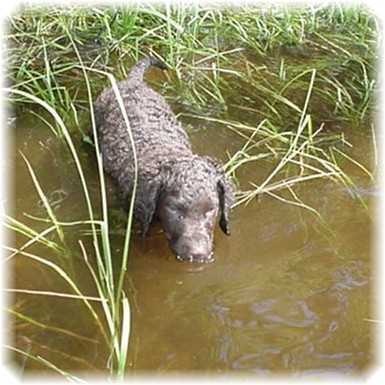
The most important thing to avoid, is to allow your puppy to have a �bad experience� when introduced to water. Make sure the water is warm enough the first time. (water temperature over 50 degrees) You may want to get a child's wading pool and throw some floatable toys in it for the pup. Place a non slip tub mat in the bottom if it is real slick. Don't take the pup in the first time to a body of water with steep drop offs or water that has lots of "scary" objects. Remember your pup may be going through a fear stage, and submerged logs or stumps may give throw him off.

If this fails repeatedly and your puppy gets to four or five months without taking to the water, try wading out, carrying the puppy and a dummy. Set the puppy down in water deep enough that it will have to swim. Probably it will swim straight to shore. Try calling it; if it doesn�t come, go get it and wade out again. Tease it with the dummy, try to get it swimming after the dummy, and toss the dummy a few feet in front of the pup, towards the middle of the lake. After doing a few short retrieves when it is already swimming, your puppy will soon be able to retrieve in the water from shore. Do not be discouraged if your puppy needs extra work to get going in the water. Many dogs who are initially hesitant become good water dogs.
Not all retrievers come with the innate ability to swim.
Pup should see water when it is warm and in an area that has a gradual slope to the bottom. You need to be prepared to get wet with pup. Avoid the temptation to bring older dogs with to "get pup in the water". Pup could attempt to follow his buddy out in water way beyond his skills and cause fear. Just you and pup, quiet warm lake....let him play, snort around and wade. Have a bumper for him to push around in the shallows. As he gains confidence you can walk out a bit deeper and encourage him to follow. Go slow, if he panics he could use your legs as a scratching post. Keep is fun, don't push him. He may just jump in and swim like a trooper, great. If it takes a bit, don't worry. Some dogs have a time figuring out how to get the "rear end' to plane. Help him a bit, gently supporting his tummy till he gets the idea. The puppy splash paddling is very common, they will out grow it has the skills improve. Do not let pup jump off docks until he is sure of his swimming ability, many a fine swimmer was scared by this too soon and became fearful of water. If a dog sinks, they DO NOT come back up, there is no "third time down". Be ready to get to pup within seconds. In my "dog days" I have had pups that just get out there and swim like they have been doing it all their lives and others sank. You can't tell until they try to swim. Avoid swimming in water over you head with a dog, he may attempt to "climb aboard", swimmers have been drowned by their dogs. Kris Altenbernd
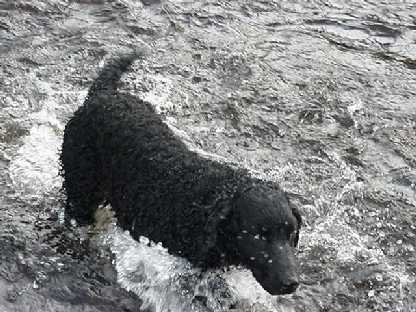
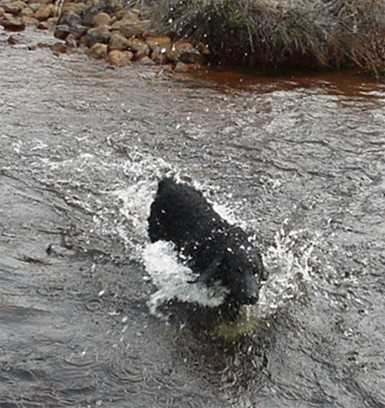
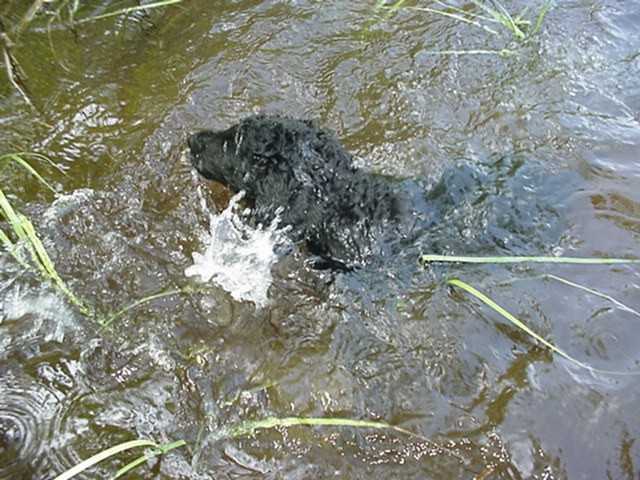
Retrievers are born loving the water, the trainer�s job is to insure that the trainer doesn�t teach them not to love it. The best philosophy is to get pup trained on land where you can control the outcome. After pup is reliable on land, then go to the water. Basically the main learning requirement for pup in the water is developing his confidence. If you train pup well on land, and develop his confidence in the water, then those trained behaviors will operate in the water. Introduction to Water The easiest water introduction for puppies occurs when you have a whole litter that is seven to eight weeks old and it is summertime. Find part of the lake or pond where the bank gently slopes into the water. Put on your boots or tennis shoes and take the litter of puppies for a walk. Walk them around on land for a while so that they get very warm. Then walk into the water. They will follow you and probably automatically swim without ever missing a stroke. Puppies at this age have a natural inclination to swim and will do it automatically. However, be very careful not to try this in the winter. Putting a small puppy into cold water will simply teach him not to like it. If pup is born in fall or winter he may be several months old before you introduce him to the water, or you may have acquired an older puppy who has missed a young introduction to the water, or you may have acquired a pup who has had a bad introduction to the water. In any case the rules for pup�s introduction to water are the same:
Pick a gently sloping bank
Occasionally you encounter a pup that has missed the age window of activation for the swimming instinct and who has a lot of trouble learning to swim. They keep trying to climb out. They persist in slapping the water with their front feet while their rear feet don�t do much paddling. The solution is to get their front end down which levels them out and they will then swim naturally. One great trick that helps is the large plastic dummies. These are heavy enough that pup tires more quickly and gets that front end down so that he begins swimming naturally. Another strategy is to wade into the water with pup and gently hold him by the collar while putting an arm under his belly to keep the rear end up. After they�ve made a few strokes in proper level orientation, the swimming instinct will usually kick in.
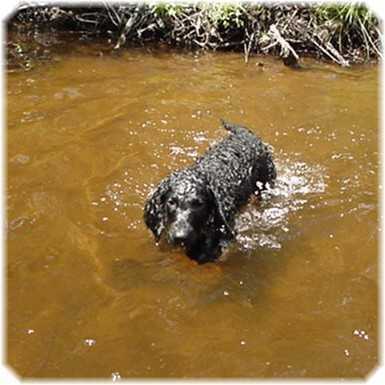
Teaching Puppies To Swim
After putting Rowdy through some basic obedience and work on delivering bumpers and frozen birds to hand, I was more than satisfied with his initial progress; so we took him to the water to see how he performed. I had no reason to expect any problems - this was one of the most athletic dogs I had ever worked with. My helper threw a bumper into the pond about 50 yards or so, and, just as I had expected, Rowdy took a run and exploded into the water with an impressive water-spraying leap. Then, he completely disappeared; no part of him could be seen. When he surfaced, with legs flailing in all directions, he went over backward and disappeared again under the water. I had never seen a dog with so little fear, yet no clue of how to swim. We watched this display for several minutes, and when it was evident that he had no idea how to move in the water or even stay afloat, we had no choice but to wade in and rescue him. He was tiring quickly and making no progress toward shore. The time that he spent submerged was lengthening, and he was only coming up long enough to gasp for air, beat the water to a froth with his front feet, and then roll over backward and disappear under the surface again. This had turned into a tense situation such as I had never experienced before. After rescuing the dog and returning to the kennel, I immediately called Rowdy�s owner and asked why he had not taught the dog to swim at an age when his size would have made him much more manageable. Of course, the owner had a million excuses why he hadn�t worked with the dog on his swimming, but I think it boiled down to, He�s a retriever - he should know how to swim. After all, don�t all dogs know how to swim? And, since I was going to send him off for training, let the trainer deal with it. Sorry, folks; I hate to have to be the one to break the news, but it doesn�t necessarily work that way! Just because a dog�s last name is �retriever� Labrador retriever, golden retriever, or Chesapeake Bay retriever, etc. - it doesn�t mean that he comes from the womb knowing how to swim! And, as the dog�s size gets bigger, the tougher it gets to teach this most basic of all skills necessary to the retriever�s life work. Think about something for a moment: Retrievers, of any breed, that are beyond six months or so of age can usually stand on their hind legs and put their front feet above your waist or on your chest. So, if you take them into the water at this age and have any trouble at all teaching the dog to get their rear end up in order to level out and swim correctly, they will likely be able to plant their back feet on the pond bottom and climb up on you with their front feet. This is a real pain and usually results in both a wet dog and trainer! With one hand under his belly and the other holding his rear end up by the tail, face the pup toward the shore. You'll notice his legs instinctively start paddling. Sure, there are ways of teaching a large dog to swim where he can�t try to drown you; you can do as we did with Rowdy for the next six weeks (it took six weeks of our training time and the owner�s money to teach him to swim efficiently and get him to the same level of skill that he demonstrated on land). Day after day, we put him on a rope behind a rowboat, like a fish on a stringer, and encouraged him, all the while towing him around the pond and forcing him to level out by getting his front down and his rear end up. We also utilized a training trick that one of the old timers taught me: Stand out in the river current with the dog on a rope, where it is deep enough that his feet can�t hit bottom. Hold on tight (and be careful of your footing) as you let him drift downstream on the end of the rope. By holding him against the flow of the river, the current pushes his rear end up as it forces him to swim against the current. Then, when the lesson is over, reel him in like a fish or work him toward shore. Both of these tricks, followed by a good measure of ever-longer marks in deep water, worked quite effectively in developing Rowdy�s swimming. But why should having to resort to these tricks have been necessary? Like human babies, it is quite easy to teach pups to swim. And, at the age of two to five months, pups are still at a size where they are quite manageable. This is also the time when they should learn to feel as comfortable - and gain the same self-confidence - in the water as they do on land, finding it a pleasure to swim. After all, most of a retriever�s work will involve water.
Actually, all it takes to begin to teach a pup to swim and not fear water is a warm day, a pond that is about knee- to waist-deep, a pair of shorts or waders, and a helper on the bank. Young pups don�t have any reason to be apprehensive about water - they haven�t learned to fear it. They have only recently mastered the thrill of walking and running; and, at this stage, swimming is simply another trick to learn, another environment to learn to move in. With lots of hand clapping and encouragement from the helper on the bank, the pup will easily make it to shore. Try this: Carry your young pup out into the pond in your arms to a distance of 10 yards or so. Place one hand under his belly, and with the other hand hold his rear end up by his tail so that he is level in the water. Face toward your helper on shore, and place the pup in the water. Watch his feet start to move as soon as you place him on the water. He will inherently start to paddle, even though he is being held anchored by your hands. If you don�t believe it, pick him up out of the water and watch his feet still moving! When he is really paddling for all he�s worth, take your hand from under his belly, and, for a few seconds, hold his rear end up by his tail to keep him level. Then, with lots of hand clapping and encouragement from the helper on the bank, release his tail and watch him swim directly to your helper. Walk to the bank where the helper has gathered him up, take him back out in the pond, and do it again. Repeat the lesson several times, and call it a day. Come back and do the same exercise tomorrow. And the next day. Gradually increase the swimming distance day by day until you are satisfied that he understands the mechanics of correct swimming form. It�s that simple to develop a pup�s basic swimming skills and confidence in the water. Now it is time to encourage your pup to want to go into the water on his own. He is already confident and knows how to swim, but he will possibly have to be enticed to dive right in. I accomplish this by using live, wing-tied pigeons tossed a very short distance out in the pond. (If their wings aren�t tied at the base and they are only wing-clipped, the bird can use his wings to propel himself quite quickly across the surface of the water.) If your pup�s burning desire for birds has been developed early on, he should dive right in after a live bird since he now has no fear of the water. If you don�t have access to live birds and you have developed his desire for frozen birds or bumpers, he still should enter the water without hesitation. One note here, however: Always start your pup in shallow water where you can go out and help him if he gets into trouble, and always start him right on the edge of the water or even standing with his feet in the water. There is no reason to develop a bad habit of running down the bank after a bird or a bumper, a habit that if you let develop, will later have to be broken. So, influence him from the very start to enter straight into the water by not giving him the option of anywhere else to go; you can always back away from the edge as he progresses. Naturally, in all the instances I�ve discussed here, the water should not be chillingly cold; pups don�t yet have the heat-producing mechanism that mature dogs possess. Remember, �retrieve� means retrieving anywhere, especially from the water where their assistance is the most vital for recovering game. Don�t put this important developmental lesson off too long.
|