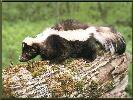
Oo-wee! There are few things worse than getting skunked! Just ask my Curly filly, Always Natasha, who innocently stomped a two-striper who ambled through her pasture last week. Or husband John: he rendezvoused with a stink-kitty while checking on our horses one night a few months back.
Skunked: it's an eye-watering, lung-seering, gosh-awful fiasco neither Tasha nor John will likely soon forget.
Horses, especially curious youngsters like Tasha, unfortunately do get skunked. Worse, in some parts of the country, skunks are notorious rabies carriers, able to infect any mammals, including horses and humans, they happen to bite.
Skunks and horses plain don't mix. That's why I've done my homework and I'd like to share my new 'skunk preparedness plan' with you.
But first: let's meet the adversary...
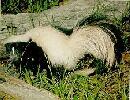
There are four species of skunks in North America: the striped, spotted, hooded, and hognose skunks. Most common by far, and the one most likely to zap you or your steeds, is the striped skunk, Mephitis mephitis (which translated means "stinky, stinky"). This house cat size marauder thrives in all forty-eight contiguous states; his range stretches far into Canada and south throughout Mexico. He's the familiar stink-kitty, Pepe Le Pew in the flesh: glossy jet black with two white stripes down his back.
All skunks are slow moving, silent, and deliberate. They are peaceful unless provoked, amiable, and playful (we've watched them frolic with farm cats). Away from inhabited houses and barns, humans and horses, they're beneficial little beasts. Voracious mousers, they also savor pesky snakes, Japanese beetles, gypsy moth caterpillars, and yellow jackets. Insects and insect larvae make up most of their menu; they sometimes eat eggs and meat, the latter usually as carrion. Only 5% of their diet consists of items economically valuable to humans.
Skunks are creatures of the night. They leave their dens in late afternoon or early evening and forage until dawn. They den in ground burrows under abandoned buildings (and sometimes not-so-abandoned ones too), boulders, wood and rock piles. They also set up camp in abandoned fox and groundhog dens. Except when females share a winter den, skunks are solitary animals.
Skunks don't hibernate but they do chunk on a layer of fat and snooze intermittently all winter. During their early spring mating season, male skunks turn moody, pugnacious, and quarrelsome. They blast each other, horses, humans, rocks, trees, and anything else that annoys them with their musk and they'll bite without provocation. A male skunk in the throes of lust is best avoided.
Every skunk has two musk glands, each about the size of a grape, located at the base of his or her tail. These glands open to the outside through teeny revolving nozzles. A skunk can fire straight up, back, down, to either side, or to the front, simply by changing aim. It can zap its target with either, alternate, or both barrels.
Each gland contains roughly one tablespoon of thick, yellowish-greenish, phosphorescent, abominably stinky, horrendously nasty, reeky, oily fluid. Plenty for five or six rounds.
Being splattered with skunk musk is like being fried by lightning. Guts roil. Eyes gush tears. Nasal passages slam shut. And that's just the beginning.
Barring heroic measures, washing off eau de phew? Can't be done. The slightest contact with water triggers thioacetates in the loathsome stuff. Even air humidity triggers thiols for up to three weeks.
Skunks are generally pacifists; except for lusty males, skunks spray only if cornered, threatened, or alarmed. Before opening fire, they growl,
hiss, and snap their teeth. They stamp their feet and hoist their bottle-brushed tails. But when a skunk turns her rump and draws a bead, look out! Any skunk can spray twelve to fifteen feet with remarkable accuracy and she will probably aim at your face. If you back away slowly and quietly and you don't annoy her, you probably won't get zapped.
Too bad horses don't retreat.
Skunked horses usually fall into two camps: young, foolish, curious ones like Tasha and grownups who don't like cats. Whatever the equine rationale, skunks don't tolerate nudging, nipping, or being knocked around.
Youngsters, because they examine things with their muzzles and forefeet, often get blitzed in the face. A direct hit can cause temporary blindness, but it usually passes within ten or fifteen minutes. If it doesn't, call your vet. Otherwise, repeatedly flood your skunked horse's eyes with eye drops manufactured for humans, and plenty of them, until his eyes stop streaming tears.
Folk wisdom insists: douse a skunked dog with tomato juice. And it works. Sort of. But a horse? It can be done but it takes a lot of juice. To do it, bathe your horse with his regular shampoo, then, using a sweat scraper, squeegee off as much moisture as you can. Smear on the tomato juice, saturating his hair down to his skin. Let him soak for twenty minutes, then rinse off the juice and bathe him again.
A better ploy, and the one we recommend, is to give him a vinegar bath. Pour cider vinegar, full strength, over your dry, stinky horse. Drench his coat; don't wash the vinegar off. Next day, bathe him with horse shampoo, rinse him, then sop on a solution of two parts cider vinegar to one part water. Rinse or let it wear off.
Dog groomers swear by de-skunking solution concocted by adding four ounces of Massengill, an over the counter medicated douche, to each gallon of water needed to saturate the animal's coat. Slather it on, let it stand for fifteen minutes, then rinse. Chase the Massengill application with a bath using standard shampoo. It works!
 In the 1990's biologists proved that Krebaum's
Formula (named for the researcher who developed it) neutralizes skunk
musk. To mix this magical brew, combine one quart 3% hydrogen
peroxide, one quarter cup baking soda, and one teaspoon liquid soap.
Drench your horse's hair and hide, let him steep for ten minutes,
then rinse him very thoroughly. Don't dribble this solution in his
eyes, nose, or mouth.
In the 1990's biologists proved that Krebaum's
Formula (named for the researcher who developed it) neutralizes skunk
musk. To mix this magical brew, combine one quart 3% hydrogen
peroxide, one quarter cup baking soda, and one teaspoon liquid soap.
Drench your horse's hair and hide, let him steep for ten minutes,
then rinse him very thoroughly. Don't dribble this solution in his
eyes, nose, or mouth.
Dog de-skunking products like Skunk Off and Skunk Kleen work on horses. The up side: they're handy sprays and prepared rinses. But it takes a lot of the stuff to unstink a horse.
Unless it's an item you hold most dear, discard reeky clothing. If you must save something, a favorite shirt, a pair of boots, try marinating it in a weak solution of chloride bleach or ammonia, or in tomato juice or cider vinegar, or spray neutroleum alpha (a scent-masking solution available from commercial cleaners) on it. Out trail riding without a change of clothes? Slow-smoking gamy clothing over a cedar or juniper fire helps in a pinch.
Yep, it's no picnic dealing with the stench, but the scary thing is: your skunked steed might have been exposed to rabies.
More than one quarter of the rabies cases reported annually in the United States involve skunks. Because of the powerful weapon they pack, skunks fear nothing. That's why they get bitten by rabid raccoons, foxes, dogs, and other skunks; rabid animals don't mind being sprayed.
Most rabid skunks behave erratically. They amble in circles, they reel down the center lines of highways, they toddle abroad in the noonday sun. But rabid skunks don't always act deranged. Because they don't manifest symptoms as quickly as other mammals do, skunk saliva can be crawling with rabies virus while the skunk still seems sane.
Skunk musk doesn't harbor the virus, but if your horse has been blitzed, he might have been nipped or scratched&emdash;and his assailant, even if it didn't appear to be, could have been rabid. To play safe, give him a rabies booster within five days.
If your horse has been bitten by an animal you suspect might be rabid, isolate him and give him a booster shot, pronto. If he isn't vaccinated (and every horse should be), he'll have to be euthanized or quarantined for six months, depending on state law. Since the rabies virus is susceptible to most disinfectants, immediately flood the wound with lots of soapy water, then liberally swab it with iodine or alcohol. Wear disposable gloves. Call your veterinarian; at his discretion, rabies antiserum can be infiltrated into the wound.
Rabid horses don't usually foam at the mouth and few go mad. Normally, a rabid horse appears weak, depressed, dazed, and most are oblivious to food and surroundings. He might have difficulty swallowing. Muscles give out, hindquarters failing first. Four or five days later, his lungs collapse or his heart stops pumping. He dies.
Any rapidly developing fatal illness should be suspect. The intact brain of any possibly rabid horse must be shipped to a lab equipped to diagnose rabies. Meanwhile, humans exposed to the horse must begin a series of rabies shots, even if the horse in question was vaccinated.
So skunks around your horses? Who needs 'em. And it's not so hard to keep them away.
Just don't feed them. Don't leave uncovered pans of dog or cat food in your barn or on your deck or patio overnight&emdash;skunks love the stuff. Use only garbage cans with snug-fitting lids. Dispose of tasty garbage away from barns and living structures. A skunk's favorite nosh is mousey du jour; eliminate rodents living in your barns, sheds, and garage.
And don't provide them with a cozy home. Old fox or woodchuck burrows? Fill 'em in. "A skunk in the wood pile" isn't just a cliche; don't stack fire wood, lumber, fence posts, or rocks near your stable or home.
Cozy holes beneath building foundations are a skunk's favorite digs. Fill them in or cap them with sheet metal, wire mesh, or concrete. But don't seal them if the skunk is at home. Sprinkle a film of flour around the opening, then wait until nightfall. Check for footprints; if the skunk is away, cork his front door. If you suspect he's a she and there are babies in the den, try live trapping the mom and her kits.
Havahart makes a skunk-size box trap. County agricultural agents and wildlife specialists can provide plans for home made devices. Bait them with skunk yummies: peanut butter, sardines, canned fish-flavored cat food or chicken innards. Before you set the trap, shroud it with canvas; this creates a dark, secure environment for the trapped skunk. As long as you cover the trap and you approach it slowly and quietly, live trapped skunks rarely spray. Transport skunks at least ten miles and release them far from human dwellings. Clip a cord or fishing line to the trap door; release the skunk from a distance.
And don't pick up those wickedly adorable, wee baby skunks! Tiny skunks can get rabies from their mothers, and whoever decided skunk kits can't spray never handled one.
One thing not to do with a resident skunk: as our county agricultural agent succinctly says, "For sure don't shoot it under your deck". Shot or leg hold trapped skunks nearly always spray. It's better to move them alive.