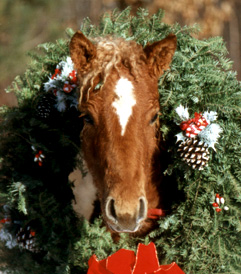
 But taking great Curly
pictures is more a matter of planning than requiring great skill and
our newest equipment is over twenty years old. If we can do it, so
can you...and in this and the next few Curlezines we'll show you how
it's done.
But taking great Curly
pictures is more a matter of planning than requiring great skill and
our newest equipment is over twenty years old. If we can do it, so
can you...and in this and the next few Curlezines we'll show you how
it's done.
"How do you take those pictures?" people ask us. "I'll bet you use expensive cameras," others say.
But taking great Curly
pictures is more a matter of planning than requiring great skill and
our newest equipment is over twenty years old. If we can do it, so
can you...and in this and the next few Curlezines we'll show you how
it's done.
Some of the best horse pictures I've taken were shot over 35 years ago...with a $10 Instamatic camera. Inexpensive cameras are limiting only because they lack zoom features and you must plan each shot carefully to eliminate distortion (but it can be done).
Zooms are every horse photographer's best friend. If buying a new camera--35 mm or digital--chose one with or compatible with the best zoom lens you can afford. Ours is an 80-200 mm Tokina lens that cost $120 in 1980; it retails for less brand new today. Considering the money we've saved in bad prints, this lens paid for itself at least ten times over.
If money is an issue and you're buying a 35mm
outfit, opt for a cheaper camera and buy that zoom lens! You won't
need lots of bells and whistles to shoot good horse pictures, anyway.
In fact, they're more easily taken with simple cameras that don't
require a lot of fiddling with while your subject gets bored or
antsy. We like Pentax cameras and  prefer our older model, a
match stick-metered big, clunky, cheapo K-1000.
prefer our older model, a
match stick-metered big, clunky, cheapo K-1000.
Digital or 35mm and a scanner? It's your choice. Digitals are nice because they're essentially instant and you can zap dud pictures you wouldn't print. Their down side is that your printed pictures aren't as permanent as regular process photos are and magazines can't use them for publication purposes. A good 35mm camera kit with an additional zoom lens and a scanner are apt to cost far less than a high end digital camera will. Yes, 35mm prints must be processed and developed, but that's where your photo album fodder originates!
If shooting with a digital camera, should you possibly wish to have prints made from your efforts, choose the highest resolution setting your camera is capable of.
If you're a 35mm fan, use quality film and take it to a photo processor who uses chemicals designed for the brand of film you've chosen. For instance, if you take your film to Wal-Mart or Sam's for processing, use Fuji film; K-Mart, choose Kodak. If you use a local photo processor, ask which film he recommends for the developing system he's using. It can make a dramatic difference!
Too, choose the lowest ASA film you can use considering your current weather conditions. Because they are grainy, higher ASA films don't enlarge as well as slower film and colors are often richer the slower you can go, down to about 100 ASA for horses. If it's cloudy or you're planning action shots, up your ASA. You'll rarely require higher than 400 ASA for photographing horses with any modern 35mm camera.
Must-have accessories are a good, padded carrying bag and if your camera needs a lens cap, an elastic doodad to dangle it from the camera while you're. It's also wise to buy a clear filter to protect your lens. Horses can (and usually do) unexpected things midway through a photo session so if you want your equipment to last, think protection from the get-go.
Every horse photographer carries a bag of
goodies and toys to help get those ears up at just the crucial
moment. And no one needs a bulging bag of attention-getters than
s/he who sets out to
photograph Curlies. It's true. What keeps our Arabians' ears up and
bright-eyed for six or eight shots earns one alert picture of most
Curlies. They see something once, then say, "Ho hum, bor-ring, now
I'm going to go asleep". And they do.
who sets out to
photograph Curlies. It's true. What keeps our Arabians' ears up and
bright-eyed for six or eight shots earns one alert picture of most
Curlies. They see something once, then say, "Ho hum, bor-ring, now
I'm going to go asleep". And they do.
Therefore, to take great Curly photos, plan on using an assistant (if possible, in addition to the person handling in posed photos). It's her job to dance and leap around while whistling and squeezing the squeaky toy. It's not a prestige job. She will also keep the horse(s) nose(s) off your lens while shooting candids of babies and at-pasture Curlies. I simply don't try any more unless I have a helper.
1) A crinkly plastic bag tied to a stick or whip or anything else you can wave around (hats, colorful scarves, flags...you get the picture).
2) A noisemaker such as a bell, whistle, or your child's or dog's obnoxiously noisy toy. If you can find a toy or gag gift that 'explodes' (jack-in-the-box, 'canned snakes', etc.), these are ideal.
3) Food (a bit of grain in a bucket, abag of apples or carrots, Mrs. Pasture's Cookies--whatever your horses like).
4) A timer. The ticking truly fascinates many horses.
5) Keys. The jingling really perks up ears.
6) A kazoo. The ultimate horse waker-up, especially if your assistant dances around while playing a tune!
1) Dance in place while employing any of the above.
2) Lie down and roll on the ground (flailing legs and arms are a nice touch). No kidding. This works especially well with foals; why do you think they seem so alert in many of the pictures I post? :o)
3) Gently toss something toward (but directly at) the subject. Squeaky toys, keys, a hat, a lead rope or halter...even a small rock or meadow muffin will do in a pinch.
4) Bait the subject with another horse. This works especially well when photographing stallions. It's how Arabian owners shoot those marvelous head portraits, telescoping necks and all. Needless to say, make certain the subject's handler and your assistant are capable of controling their respective horses. Otherwise, better omit this ploy.
Click HERE to return to
CurleZine Volume 1 - Number 1