 BEATING THE BURDOCK BLUES
BEATING THE BURDOCK BLUES
BEATING THE BURDOCK BLUES
Burdock. From border to border and coast to coast, horse owners detest this pervasive pasture pest. Throughout most of America, burdock flourishes in grazing areas, fence rows, and barn lots, often to the detriment of forage plants. But that's not why it's hated so. The real reason: from late autumn, throughout winter, and in some areas well into spring, burdock's pesky Velcro®-like burrs latch onto whatever passes by, including pants legs, dogs' fur, and equine manes and tails.
At one time or another, most of us have dealt with a hopelessly burr-matted mane or tail. It can be a formidable task, and an ongoing one in parts of the country where burdock thrives. Still, there are ploys to help the burr-cursed cope. Here are a few of the best.
ELIMINATE PEST PLANTS
The best way to keep your horses' manes and tails burr-free is to banish burdock from your grazing areas. It isn't easy. Herbicides tough enough to fry burdock are not equine-friendly. Still, persistent horse owners who recognize the plant and are savvy to its growth patterns can manually eradicate burdock. Here's what they need to know.
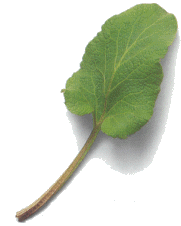
Burdock, also called cocklebur, clotburr, and beggar's buttons,
resembles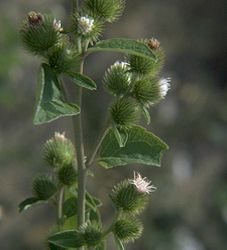 grayed-green garden rhubarb. Like rhubarb, its huge,
wavy-edged lower leaves (up to three feet long) adjoin reddish
stalks; unlike rhubarb leaves, they are wooly and white underneath.
In late summer burdock's reddish-purple thistle-like flowers bloom,
after which seed ponds (burrs) form. Its bushy flower stalk included,
common burdock grows up to five feet, great burdock up to nine feet
tall. Both species were purposely introduced (from Asia and Europe)
food and herb plants. Now they grow wild throughout most of North
America.
grayed-green garden rhubarb. Like rhubarb, its huge,
wavy-edged lower leaves (up to three feet long) adjoin reddish
stalks; unlike rhubarb leaves, they are wooly and white underneath.
In late summer burdock's reddish-purple thistle-like flowers bloom,
after which seed ponds (burrs) form. Its bushy flower stalk included,
common burdock grows up to five feet, great burdock up to nine feet
tall. Both species were purposely introduced (from Asia and Europe)
food and herb plants. Now they grow wild throughout most of North
America.
Burdock is a biennial. A biennial plant grows from seed during its first growing season, then goes dormant through the cold winter months. During its second summer its tap root weakens and atrophies even as its aerial growth flourishes and matures seeds of its own. Then the plant dies.
During its first growing season, burdock fires down a thick, parsnip-like tap root capable of boring straight down five or more feet into the earth, even in harsh, rocky soils. This taproot sprouts lateral side branches which hook under stones and other obstructions, anchoring the plant firmly in place. When lopped off or uprooted, first year burdock can grow an entire new plant from any root fragment left behind. Thus first year burdocks must never be dug or pulled, doing so helps them multiply and they're harmless: first year burdocks don't produce burrs.
However, because a typical second year plant produces up to 400,000 seeds, if you want to control or eradicate burdock, second year mustn't be allowed to mature.
The solution: in mid to late summer, whack off burdock's emerging flower stalks with pruning shears or a machete. Once is rarely enough; in warmer growing zones as many as three or more choppings may be needed. Persevere. Remember: no flower stalks, no burrs, no seeds, no new burdock&emdash;and after two seasons of diligent lopping, no burr-matted manes and tails to unsnarl.
COPE WITH THOSE BURRS
There are few tasks more outwardly daunting than deburring a horse's burdock-matted mane and tail. Some folks pick at stubborn mats for awhile, then give up. They hack at that hair with a pocket knife or buzz it off with clippers, not realizing deburring isn't a hopeless task&emdash;if you know how it's rightly done.