| THE EVIDENCE SUGGESTS MARREE MAN
WAS CREATED BY PEOPLE WITH EXPERT KNOWLEDGE OF ABORIGINES - An academic says the
huge carving in the South Australian desert is culturally accurate, writes Penelope
Debelle. Anthropologists
in South Australia are arguing over the cultural authenticity of the desert drawing known
as the Marree Man, which may be more accurate than first believed.
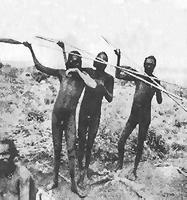
A possible source of the drawing has
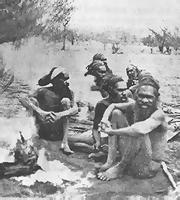
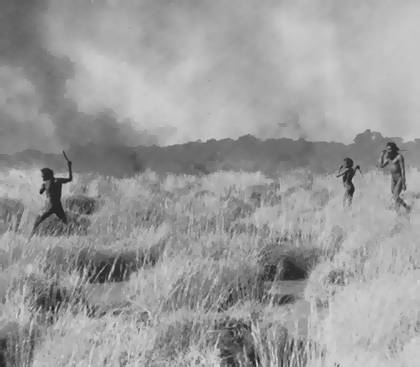
also been identified by an anonymous South Australian academic who discovered similar
photographs in journals of the Royal Society of South Australia from the early 1900's.
(See below)
The figure looks to have been an
amalgam of the body of a man photographed in the distinctive throwing stance depicted in
the desert drawing and the head of another man wearing a headband and chignon.
The Marree Man, gouged out of red
soil on a remote plateau 60km outside of the town of Marree on the Oodnadatta track, is
the world's largest known art work but its authorship is unknown.
It is about 4km long and its scale
is so vast it has to be appreciated from the air.
The creators meticulously and
secretly surveyed the man's outline using a satellite based global positioning system then
ploughed the figure into the earth where it was discovered by accident last July. No crime
was committed and police investigations have been dropped but intense curiosity remains
about who did it and why.
"At least 80% of the people who
stay here at some point in our conversation will mention the Marree Man and ask a question
or two," says Ms. Susan McGuire, proprietor of the Marree Hotel.
Detailed information sent to THE AGE
disputes the judgement by South Australian Museum anthropologist, Dr. Philip Jones, that
the figure was "cartoon-like" and culturally incorrect. It also challenges Dr.
Jones' contention that the figure was holding a boomerang whose shape could not be clearly
seen.
Instead of the weapon looks to be a
throwing stick that historic records say were used by some South Australian desert
Aborigines to throw into flocks of small birds.
An accompanying letter written by a
South Australian anthropologist - and a member of an academic community still scarred by
bitter divisions over who said what during the Hindmarsh Island bridge affair - says this
is the strongest clue yet to who did it.
"Considering the size of the
object, many details are astonishingly accurate, such as the perfect posture of the
non-throwing hand in standard Aboriginal throwing technique, the perfect placement of
chest initiation scars and the excellent representation of the hair ties," the letter
said.
The writer concludes this level of
knowledge points either to Aborigines themselves, or more likely, to those familiar with
details of desert Aboriginal culture, " e.g. my own anthropological
community".
But Dr. Jones, a published authority
on boomerangs, said the Marree Man's characteristics - his beard, chignon, and chest scars
- put him in a cultural region, namely the central desert, that did not use throwing
sticks for hunting.
"You are looking at an image
that amalgamates discordant elements together," Dr. Jones said. "So why be
surprised that here is this central Australian figure using an artefact from south-eastern
Australia?"
Contract pilot Mr. Mark Koster said
the figure is still visible although its outline has blended in more with surrounding
land.
Mr. Koster marvels at the ingenuity
that went into the figure and is amazed that, having gone to so much trouble, no one has
claimed it.
"I love it," Mr. Koster
said, "I've seen it hundreds of times now and it never fails to amaze me that they'd
go to so much trouble. Incredible stuff." |