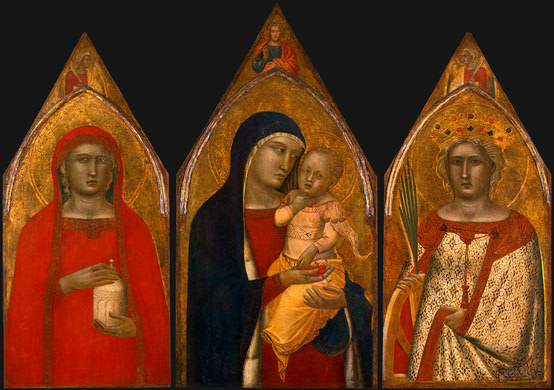
Madonna and Child with Saint Mary Magdalene and Saint Catherine
To become educated about how our times are changing, right now, for a group of religiously and horrifically oppressed women, check out the RAWA site. You can also find out how to help our sisters in Afghanistan survive aftermath of the recent earthquakes decimation of what little was left after 30 years of war by visiting the site of the Afghan Women's Mission
The longest journey begins with one click.
EARLY Christianity has always held a fascination for me. Codification
and charisma have long been at war. Before that war broke out, before
the chasm between gnosticism and patriarchial Christianity opened
and hardened into a nearly untraversable gulf, there was a cultish judaic
movement focused on love, acceptance and equality between the classes and
the sexes, between the living and the dead. To attract so many women,
so many slaves, it must have spoken clearly and to the heart without threats
of damnation. Underclasses, women, the inferm, and slaves are used
to being threatened, I do not believe they would be motivated by threats.
I am fascinated by what the early church was really like, how it inspired,
and how it was subverted. I believe it must have been inspiring and
quite different from what we know -- today's churches, overall, seem to
be medieval constructs. I personally feel we need to draw from all
we know of what shaped and inspired our foremothers and fathers so that
we can add to amend the wisdom of the ages... we need to draw upon all
the wisdom we can. So this page was created to house my musings.
Madonna and Child with Saint Mary Magdalene and Saint Catherine
I whole heartedly encourage you to check out: The
Role of Woman in the Church by Frank Daniels for a discussion of the
role of women through time in the Christian Church.
http://www.umilta.net/vangelo.html Excellent discussion of women in the Gospels. But even this site makes the assumption that the conversion of the Sinning Woman speaks of Mary Magdalen. Yet no where is this stated. I would love to hear more about sources for this assumption if you know of them.
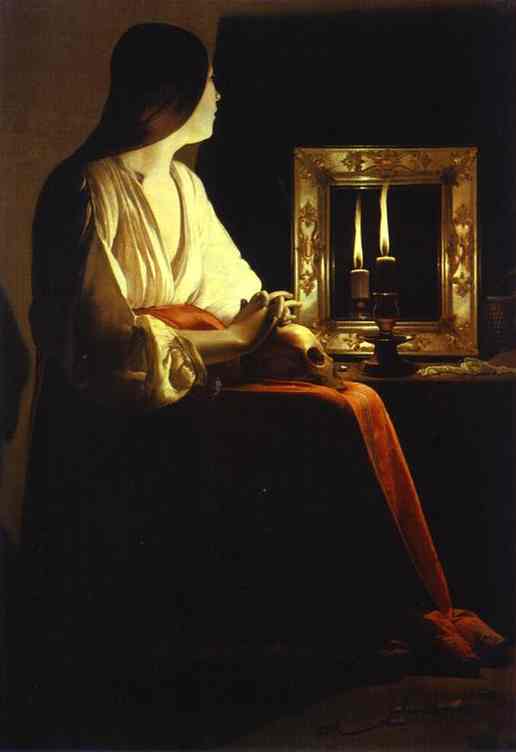
Georges de La Tour. Repenting Magdalene
And of course there is the Gospel
of Mary. And mid-20th Century archaeological
discoveries give a very different picture of the early church than
Acts would suggest.
Jesus said to them, "When you make the two into one, and when you make the inner like the outer and the outer like the inner, and the upper like the lower, and when you make male and female into a single one, so that the male will not be male nor the female be female, when you make eyes in place of an eye, a hand in place of a hand, a foot in place of a foot, an image in place of an image, then you will enter [the (Father's) domain]." From the gospel of Thomas.Early Christian gnostic texts are extremely important works for understanding the role of women in the early Christian Church. Women played a much larger role in the foundation and practice of original While the gnostic gospels were discarded by the papal mainstream after the 3rd century AD, the original Christian scriptures included gnostic texts and the gnostic sects were quite powerful although they eventually lost control of the church to the papists.
The gnosticism of the early church should not be confused with contemporary
Gnosticism. The Gnostic Church of today has undergone 2000 years of change
just as has papist derived Christianity.
The linkage of women and ritual in paleolithic european belief systems is possibly best known through the presumed fertility fetish images known as "venus figures."
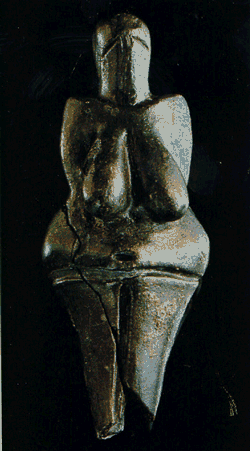
Venus Figurine from Dolni Vestonice
These figurines are widely distributed
throughout Eurasia and suggest a widely held shared value. What that value
was is open to interpretation.
A bit "out
there" but a still quite interesting piece written by a woman who "channels"
Jesus. Most of the information the author references in this work appears
to be distilled from relatively well established information (primarily
archaeological) about the early first millennium Christian churches.
Hadewijch. The Complete Works. Trans. Columbia Hart, Preface Paul Mommaers. New York: Paulist Press, 1980.
Harding, Wendy. 'Body into Text: The Book of Margery Kempe'. InFeminist
Approaches to the Body in Medieval Literature.
Ed. Linda Lomperis and Sarah Stanbury. Philadelphia: University of Pennsylvania
Press, 1993. Pp. 168-187.
