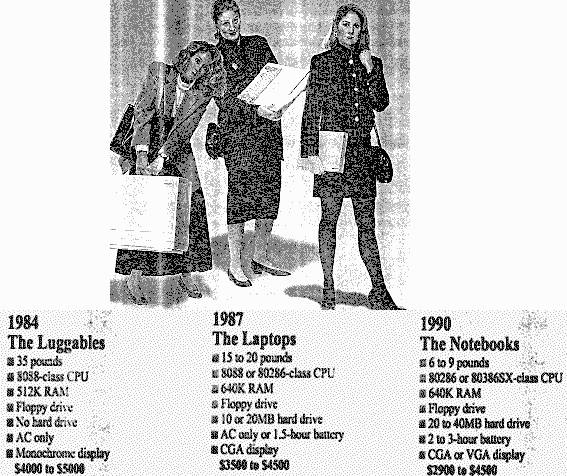
I hope this section will provide some amusement for youngsters (who tend to be fond of dinosaurs anyway) and some memories for my fellow Baby Boomers. And maybe even a better understanding of the possible future for everyone.
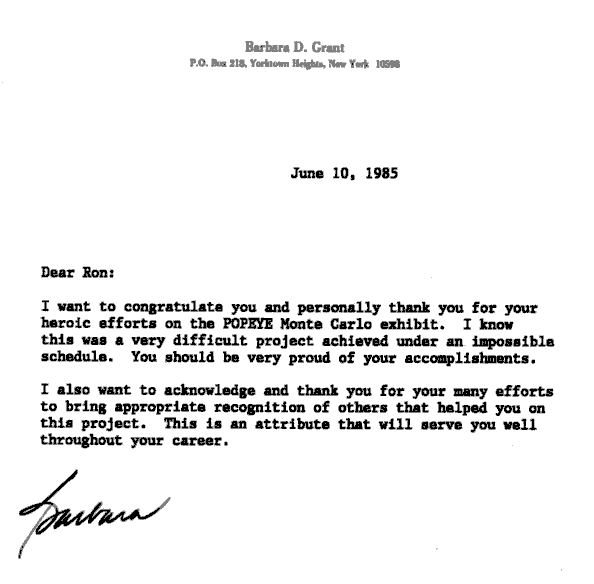
Early PC's emerged in the late 1970's. People liked personal computers so much they wanted to take them along when they traveled. They were happy when so-called luggable computers (cf. above), like the Osborne I in 1981, made this possible. These luggables had small (5") CRT displays. But many older people with enough money to buy a PC hated the teeny-weeny display. So when I joined IBM in the early 1980's, I set out to build the smallest computer I could with a full-size, CRT-quality display. Although I started alone, by the end of the project, I enjoyed the help of many others I was happy to thank.
Actually, even in the early 1980's, there were alternatives to using a CRT. I was impressed when I saw the Radio Shack Model 100 computer which was released in March 1983, shortly after I joined IBM. Allegedly, it used the last code that Bill Gates ever wrote for a shipping product. The book "Gates", by Manes and Andrews, describes its display as "a dim, black-on-gray, 8-line by 40-character LCD". That was the problem for us. Sure, it was a wonderful design for such a tidy little 4-pound package. But I was told that our customers, graying corporate types, needed a display as detailed and easy to read as the large 25-line by 80-character CRT displays on their desktops. They would not tolerate an early LCD, not even on the road.
My solution reached back into the earliest days of electronic display technology. We would use a miniature CRT and then optically magnify the image for projection onto a screen. Unlike the rigid glass picture tube needed for a conventional CRT display, most of the volume of the display we would build would be empty air-space that could be collapsed away when we wanted to move it around. Here is a picture of a prototype we built and showed at the annual congress of the Society for Information Display (SID), as well as elsewhere:
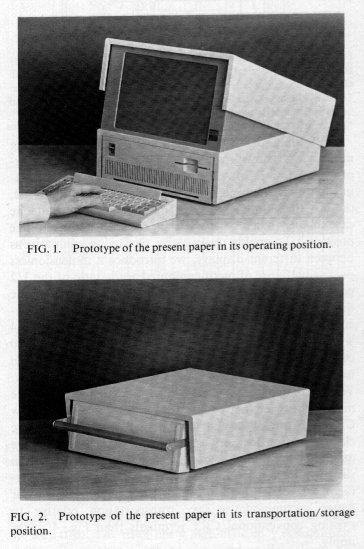
This unit had a screen raster like that of a 14" CRT - almost 8 times the area of those on luggable PCs. To save money prototyping, we did not squeeze down the weight, but we were confident that we could build a portable PC using this display weighing 20 pounds. And by scaling down the size of the screen, we could scale down everything display-related as well. We had built a computer which could fit under an airline seat, but with a display of desktop size and quality. As Dick Brass will be happy to tell you, it is no good building a display which is hard to read!
No, our model did not come in yummy fruit-flavored colors; just standard Big Blue beige. But the semi-transparent screen was narrow-band green, hence its unofficial name, Popeye. And yes, there was a modem so you could network via POTS. Maybe today they'd call it the iBum. (You could ride the rails with it.) Lou's IP lawyers will call yours in the morning Steve, LOL.
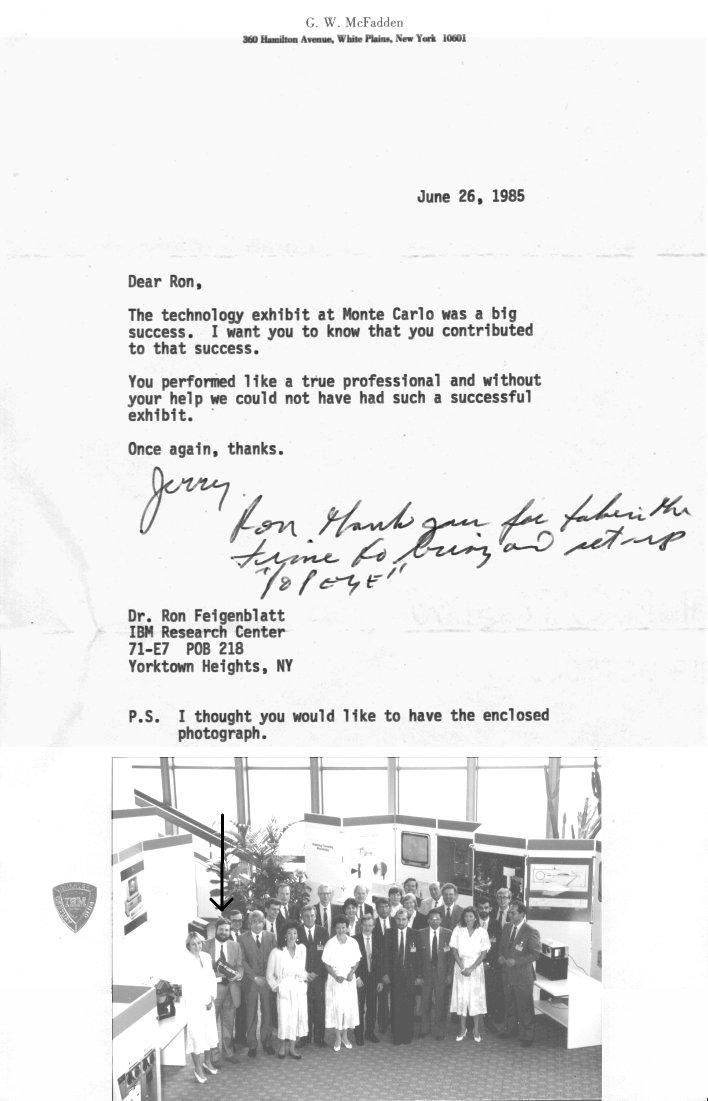
While our achievement is laughable by the standards of today's vastly improved basic technology, people thought this was pretty cool in the early 1980s. IBM thought enough of it to have me demo the prototype at the public technology exposition it held annually in Monte Carlo, where cutting-edge stuff from the company was trotted out to elicit oohs and ahs. At the bottom of the letter here you can see a snapshot of the scientists, engineers and support staff who comprised IBM's team that year. That's me holding a foam-cradled spare miniature CRT.
I met interesting people in Monte Carlo. Edward Heath, the former UK prime minister, addressed the exposition as the featured speaker and toured our exhibits. He and I exchanged some levity during my presentation I will remember, but keep private. My fellow baby-boomer Bill Hill no doubt recalls Mr. Heath. Actually, I met my first real Scotsman while on this trip. Someone from IBM's Greenock lab took over the job of demonstrating the prototype so I could make another visit in Europe and then return to the USA. I found this amusing because when I had been a physicist I had done extensive studies using Greenockite.
The then-recently-retired long-term chairman of National Semiconductor wrote me to propose equity participation in a start-up firm using technology related to this project. I politely declined his offer and stayed at IBM. We had decided that flat-panel technology would now move fast enough it made little sense to try to extend the use of the CRT for any but high-end displays. But within a year of putting our project to sleep at the Monte Carlo exposition, Hewlett-Packard demonstrated a display much like ours, albeit with the addition of a color wheel. Its paper on their project credited the idea for their work to a Luis Alvarez. I never confirmed if it was the well-known Nobel Laureate of that name, sometimes called by colleagues "prize wild idea man" in recognition of the diverse interests he inventively pursued before his demise in 1988.
Perhaps my old IBM colleague, the brilliant liquid crystal physicist Dr. Hiap Ong, remembers me asking about this time how small one could make a working LCD pixel. What I had in mind was this. Miniature CRTs, similar to the one I used in the project described here, had already been employed for some considerable time in the so-called "helmet displays" of military vehicle operators. But even small CRTs are bulky, and require inconvenient infrastructure like high voltage. I had hoped that LCDs could be scaled down in size so that they might be used to make very light-weight head-mounted displays, not much different from eyeglasses. Ultimately, Ong wisely left IBM and is now Chief LCD Technologist for Kopin in Massachusetts.
A recent SID press release asks if 2000 is "The Year of the Microdisplay". Kopin, active in the field over a decade now, and its 1995 spinoff MicroOptical, appear to be leaders today, using liquid crystal technology. Microdisplays are cool for several reasons, including the fact they require so little power to light their screens. When you sit in front of your desktop CRT, it splashes light everywhere, "because" it does not know where you will put the teeny pupils of your eyes, which are the only things which collect light for your retinas to perceive. But a display mounted on your face like eyeglasses knows where your pupils are, and need not waste enormous amounts of energy producing light. That sure sounds like a great way to save battery power, doesn't it?
An interesting aspect of Mr. Platt's "OFPD" paper is that the optimum filter he would compute depends, in theory, on how far the observer is from the display. That is one example of why it is sometimes useful for an electronic display to look back at you looking at it.
As we noted above, the field-optic effects in a virtual projection system like a microdisplay can be of advantage. A real-image projection system like in the portable computer above is also "holographic" in a limited sense: rather than seeing 'different' images from different angles, you see the 'same' image, but with varying intensities. A field lens makes sure that all parts of the viewing screen show comparable brightnesses from a given viewing position, avoiding "hot-spotting".
Another trick one can pull with a field lens is the design of an autostereoscopic electronic display - one that produces a "3D" display using stereopsis without the need for glasses. In 1985 I described such a design which was eventually defensively disclosed here. A prototype display Sanyo built using this method was reported to the general public in the May 16, 1995 issue of PC Magazine. Philips Research continued to make improvements in this technology in the mid and late 1990's.
The Philips work emphasized the advantage of multiple viewing zones as one moved one's head laterally. But this came at the expense of the spatial resolution of the display. Perhaps one day some clever researcher will devise a practical electro-optic variable field lens which could track the viewer's head position and recover this lost resolution. A dynamic field lens could also benefit non-3D screen-based personal projection displays, by exploiting the collimation that accompanies optical magnification to reduce the amount of light that need be generated.
Microdisplays are the basis of efforts in so-called "wearable computing". "A brief history of wearable computing" at the MIT Wearable Computing Project cites certain Columbia University work from 1990. It turns out that project followed earlier prototype work in which I participated. By 1988 Dr. David Bantz had conceived of combining a digital radio link with a stylus-input laptop computer. By the end of that year I had led a project at IBM reporting to him which integrated such a system using readily available commercial examples of the two key components. Another research scientist created a transport protocol and display server in place of something like TCP/IP and X-Windows. I developed a networked hypermedia application which rode this infrastructure as a demonstration.
By combining two pre-existing technologies, namely, a remote display server inspired by MIT X Windows and a hypermedia application inspired by Apple's Hypercard, I had something which might well remind contemporary readers of the World Wide Web. With the triumph of the Web, xmany people forget such previous efforts, stretching back well before my time, which strived toward similar goals.
We made an industrial movie of the system at the end of our project, which provided many details about our system not disclosed here. Typical of the company, the powers in charge thought so little of the potential commercial value of this line of work that we were invited to take the movie home to freely show to our families, outside of any company security protocol.
When in a playful mood, I enjoyed jocularly deprecating what we had accomplished. I said that through our great efforts in digital technology, one could toss away one's color TV set and enjoy slow, monochrome, quasi-static pictures you had to request one by one, and at a much greater price to boot! Of course what we actually had done was demonstrate a wireless prototype of what a great business leader soon termed "Information At Your Fingertips". It was just a pity he was not OUR CEO.
At the start of the 1980's, when I was a spectroscopist, small computers were becoming increasingly available to assist scientists make instrumentation smarter. One setup I created used a small RS-232 terminal which consisted of a remanufactured hand-calculator case with a single-line LED display. This let me use the remote minicomputer to which it was wire-tethered to measure things, perform calculations, and report digested results to me in real-time while I walked around the lab and adjusted various controls.
Even by the mid-1980's, when I had completed the projection display work at IBM discussed above, it was not possible to enjoy flat-panel displays which simultaneously manifested all the nice things they do today. Image quality, size and price slugged it out for favor. That led me to seek ways in which small flat panel displays could actually exploit their diminutive nature.
In early 1986, I described how a small flat panel display could be turned into a location-aware appliance, in this (link is rotten) defensive disclosure. The basic idea was that one could build huge virtual displays which could leverage the "Simonides memory palace" aspect of human cognition. An interesting project by others exploiting this technology was described in "Situated Information Spaces and Spatially Aware Palmtop Computers", "Communications of the ACM" 36, No. 7 (July 1993). I found it satisfying that even ten years after my disclosure, IBM Research managers would still give public talks like "Towards a Better User Interface" in which they would describe my notion as part of their current research.
They say that those who have the time and money to execute rapidly do, and those who lack one or both make timely suggestions and hope kind people will remember later. By the start of 1995 my life had become extremely complicated with matters unrelated to advanced technology, but I took some time to write this e-mail to Dr. Nicholas Negroponte, the famed director of MIT's Media Lab:
Sent: 1995.02.01
To: [email protected]
Cc: [email protected]
Re: rendering audio
I just read your column in Wired (2/95) for the first time and I was struck by the request of your publisher that his dyslexic author read the audio version of the book. I would like to offer you and the Media Lab crew a challenge...
So why not have someone at your shop try their best at electronically rendering your book into an audio tape? Perhaps it can't be done in time well enough to suit your publisher, and of course Penn Jillette has the job anyway, but who says there can't be a special "nerd" edition of the audio tape?
As may be obvious, I'm no expert in speech synthesis, but it seems to me it's not necessary to do things ab initio for all purposes. If someone wants a book read by Director NN, why not digitize and then massage as needed a set of phoneme doublets from "the horse's mouth"?...
...Why not a "voice" typewriter with which an operator could "compose", if not "perform" someone ELSE'S speech, complete with "GML" audio-extension tags for operator-controlled contextual emphasis?...
Dr. Negroponte wrote back that:
...We have sombody at the Lab doing what you say. In fact, we are getting the text which Penn read to see if we can make our machines do as well. Professor Mike Hawley ([email protected]) is doing this work.
I never followed up on what became of the Media Lab work. But at the end of the year, a very interesting piece ran in Wired magazine (for which Negroponte happened to be a monthly columnist, as well as investor). In part it read:
...[Jim] Humes has stumbled upon a revolutionary "soundfont" technology. "A standardized filter translates written English into vector-based phonetic syllables," he explains. This dramatically reduces the memory requirements versus bitmapped sound. "You apply a famous voice to the phonemes the same way you apply Helvetica Bold to ASCII."...
"...his voice-imitator technology is called, creatively, the Talkman.
"To do the fact checking for this article, I revisit Marquee Ventures one last time, in early August... It turns out that just three weeks after Marquee put their half million in Humes, they flipped the technology to IBM for four million."
Gosh, it sure sounds like it costs IBM lots more for independent inventors than wage slaves on its Research Staff! <G>
Ron Feigenblatt - 2000 June 27
Hyperlink rot mending - 2002 February 4; 2002 September 28