2.
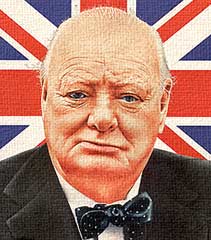
WINSTON CHURCHILL
A True Brit
Thankyou to Londoner Rob Grant and
Ayrshire Loyalists
for their help on this page.
1.
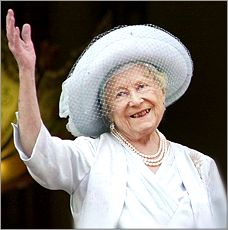
QUEEN MOTHER
Never forgoten
4th august 1900 - 30th march 2002
4th march 1900
30th march 2002
Her Majesty Queen Elizabeth The Queen Mother was the mother of Queen Elizabeth II, the present British sovereign, and the widow of the late King George VI. The daughter of Lord Glamis, later 14th Earl of Strathmore and Kinghorne, she was descended from the Royal House of Scotland and retained strong associations with Scotland. The Queen Mother's remarkable life spanned over a century, a period of immense change. Having married Prince Albert, Duke of York in 1923, she found herself Queen Consort on the abdication of King Edward VIII in 1936. As Queen she played a significant role in the life of the nation, supporting the King and helping to uphold national morale during the difficult years of the Second World War and its aftermath. Widowed at the age of 51, she continued to undertake Royal duties for the next fifty years in support of her daughter, The Queen. Public appearances continued right up to the end of her life, even in periods of ill health. The resilience, sense of duty and gracefulness of The Queen Mother in all areas of her life earned her a secure place in the heart of national life.
Her Majesty Queen Elizabeth The Queen Mother was the mother of Queen Elizabeth II, the present British sovereign, and the widow of King George VI. She was born the Honourable Elizabeth Angela Marguerite Bowes-Lyon on 4 August 1900 (fourth daughter of Lord Glamis, later 14th Earl of Strathmore and Kinghorne) and spent her early childhood at St Paul's Waldenbury in Hertfordshire, north of the capital. This was the country home of her parents. The Bowes-Lyon family is descended from the Royal House of Scotland. One of The Queen Mother's 14th-century ancestors, Sir John Lyon, became Thane of Glamis, home of Macbeth 300 years before, and Glamis Castle is the family seat.
Lady Elizabeth was educated at home By the age of 10, she was fluent in French. When the First World War started - coincidentally on her 14th birthday - Glamis Castle became a hospital. Although Lady Elizabeth was too young to work as a nurse, she did assist with welfare work with the patients. One of her brothers, Fergus, was killed at the Battle of Loos in 1915.
From childhood days Lady Elizabeth and her older sisters had been friendly with the children of King George V and Queen Mary. Occasionally, members of the Royal family stayed at Glamis Castle. In 1922 Lady Elizabeth acted as one of the bridesmaids at the wedding of their daughter, Princess Mary. In January 1923 came the announcement of her engagement to HRH The Duke of York (Prince Albert Frederick Arthur George), The King and Queen's second son. They were married on 26 April 1923 in Westminster Abbey. They had two children, Princess Elizabeth, born on 21 April 1926 at the Strathmores' London home, 17 Bruton Street, and Princess Margaret, born on 21 August 1930 at Glamis Castle. Princess Margaret predeceased her mother, dying on 9 February 2002.
Churchill arrives at Buckingham Palace "But whether it be peace or war... we must strive to frame some system of human relations in the future which will put an end to this prolonged hideous uncertainty, which will let the working and creative forces of the world get on with their job, and which will no longer leave the whole life of mankind dependent upon the virtues, the caprice, or the wickedness of a single man." No one wanted to fight another world war. The First World War was to be the last. And many people wanted to ensure this was true in spite of contemporary realities. This existing mood in popular opinion gave license to men, such as Neville Chamberlain, to seek out a policy in which British interest are accomplished as much as possible without English entanglement in war. The inability to be forceful in Munich, or to at least utilize a multilateral and comprehensive settlement of the Czechoslovakia crisis created an environment in which strange bed fellows would emerge. Through all of this, the political mastery and historical insight of Winston Churchill laid the foundation for his (Churchill's) eventual rise to power in Britain. 1930's -- Churchill's Isolation William Manchester, in his book titled The Last Lion: Alone (1939-1940), presents a very detailed account of an out-of-power minister of parliament and his trials to become the embodyment of the allied struggle against Hitler. The peace movement of Europe in the 1930's contributed to Mr. Churchill's political isolation. Most British subjects wanted to avoid confrontation and therefore, chose to ignore Hitler's rise to power. Churchill was less willing. Manchester shows evidence of Churchill's weariness of Hitler as early as October of 1930. Churchill is quoted as stating that, if Hitler were to come to power in Germany, England's eventual response must be -- "If a dog makes a dash for my trousers, I shoot him down before he can bite." Manchester goes on to describe the endless uphill struggle endured by Churchill to be heard on his warnings of Europes impending doom. 1938 -- The Beginning of Churchill's Rise to Power The world, as it existed in 1938, showed little comfort for Neville Chamberlain and his policy of appeasement. The Anschluss of Austria was a direct challenge to the British sense of national integrity. Manchester gives a glimpse of Churchill's own hope that Hitler, like a boa constrictor which has swollowed an animal whole, would find Austria more than he can handle. Winston Churchill, always ready to take political advantage and ever staunch supporter of firm resolve, was ready with a stark criticism of every move Chamberlain made. To Churchill, realities made things very clear. Hitler had Austria and was now poised to take the Sudentenland, if not all of Czechoslovakia. The British economy was struggling to recover from the Depression and popular support for another conflict was non-existent. The Munich Agreement of 1938 Chamberlain in Munich Chamberlain set out on two missions to meet with Hitler: One at Berchtesgaden and another at Godesberg. Chamberlain's background was in business and he felt as though Hitler could be handled like any other negotiation. The key to success was to determine his opponents bottom line; and, if possible, give it to him. Once Hitler is satiated, he will cease to be a problem. When Hitler revealed that the Sudentenland was his final territorial request, Chamberlain came to believe it was a small, if unseemly, price to pay for the prevention of a continental war. It never occurred to Chamberlain, as was feared by Churchill, that Hitler was lying. He asked for the bottom line and got it. What Churchill would have taken with an enormous grain of salt, Chamberlain gladly swallowed without issue. By the time the four powers (Britain, France, Italy, and Germany) met at Munich, Czechoslovakia's fate was already sealed. The Munich Conference was about how to give Hitler his prize rather than whether or not he deserved it. Chamberlain's return from Munich is well known. In seeing the popular roar of exhilaration, Chamberlain began to believe that his bargain with Hitler would secure his political fortunes. The public was relieved war was averted, the House was relatively content with the status quo, and the remaining voice of dissention in the cabinet, Duff Cooper (First Lord of the Admiralty), gave his resignation. Churchill's response was to be expected: "How Could honourable men with wide experience and fine records in the Great War condone a policy so cowardly? It was sordid, Squalid, sub-human, and suicidal ....The sequel to the sacrifice of honour." When reviewing the Munich Agreement, Churchill told the House of Commons, "There can never be absolute certainty that there will be a fight if one side is determined that it will give way completely." The Nazi-Soviet Non-Aggression Pact -- August 1939 Molotov and Ribbontrop sign the Pact August 23 The Munich Conference did little to dispel Stalin's long-held feeling that the western powers were conspiring against him. Stalin was looking for a political and military agreement between the Soviet Union and Britain and France. The time was coming when Stalin's patience with the western powers would end. Stalin was seeing his neighborhood shrink before his very eyes and the idea of having Nazi Germany knocking at his front door was simply unacceptable. Munich was the final blow to any possible alliance. "I think we may take it that M. Molotov will not volunteer any new proposals in the near future," cabled Ambassador Seeds. The Soviet attitude to western powers and their ability to deal affectively with international crises can be summed up by Litvinov's last speech to the League of Nations on September 21, 1938: "A fire brigade was set up in the innocent hope that, by some lucky chance, there would be no fires. ... every State must define its role and its responsibility before its contemporaries and before history. That is why I must plainly declare here that the Soviet Government bears noresponsibility whatsoever for the events now taking place, and for the fatal consequences which may inexorably ensue." And ensue they did. After Litvinov was replaced by Molotov the German diplomatic corps was quickly put into action. Hitler, as well as Britain and France, had achieved a major goal of his foreign policy in Munich by isolating the Soviet Union from the international diplomatic scene. As an even better position, this isolation was gained with Britain and France seen as the ones responsible. This created a feeling that a non-aggression treaty with the Nazis would be the only protection for Stalin. Ribbontrop was prepared to put his personal efforts to bear on the Soviet leader and with his enthusiasm convince Stalin of the possibilities of a treaty with Nazi Germany. He was a success; and in August of 1939 the Nazi-Soviet Pact was signed. Churchill had begged the Chamberlain government to make every attempt to form an alliance with the Soviet Union and France to deter a German repproachment. Manchester suggests it was Churchill who had proposed a "Grand Alliance" resembling that one which won the Great War. He was certain that a unified and resolute front could cause Hitler to back down. Churchill even held some belief that such a show of force might cause a defection within the German Army when confronted with the possibility of war with such an alliance. The Invasion of Poland -- September 1939 German troops march in Warsaw Sept. 1939 The Germans, with their eastern front pacified, entered Poland on September 1, 1939. Churchill recognizes the government's commitment to Poland must be kept and war is declared on September 3, 1939. Churchill gives a speech to the House of Commons which is cause for a packed House. Churchill Appointed First Lord of the Admiralty -- Sept. 1939 German Invasion of The Low Countries -- May 1940 Churchill Chosen as Prime Minister -- May 10, 1940 When the time came to confront the Nazi threat to Europe the people of Britain turned to Winston Churchill. He had been the lone voice in the wilderness urging decisive action when Hitler's evil works were but small bidings. Churchill's determination and his consistent stance against appeasement gave him credibility with the British people when eventually he was to be Prime Minister. Churchill had no reason to hate Chamberlain and didn't. He felt convinced that Chamberlain was wrongly advised of certain facts that would have led Chamberlain to a better plan of action. Prime Minister Churchill with the King and Queen When the time came for Churchill to take power he was fully aware that he was a man of his time. Although a relic of a past British Empire struggling to remain alive, it was an image that the people of Great Britain seemed most comfortable with. It was his ability to rouse the public spirit and his staunch belief in the British resolve that led him to tackle the impossible war that raged on in 1939. Churchill knew the realities and was able to communicate the dire consequences: "But if we fail, then the whole world --- Will sink into the abyss of a new Dark Age made more sinister, and perhaps more protracted, by the lights of perverted science. Let us therefore brace ourselves to our duties, and so bear ourselves that if the British Empire and its Commonwealth last for a thousand year, Men will still say: 'This was their finest hour'."