|
|
|
Title: Dawn Of The Dead Year: 1978 Director: George A. Romero Reviewed By: Garrett Chaffin-Quiray
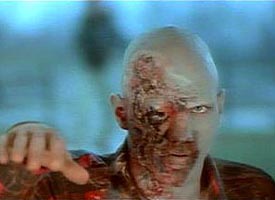
Night of the Living Dead, George Romero�s seminal horror movie from 1968, began his flirtation with zombie- like critters haunting the vigorous and hysterical world in which we live. In its bleak, black and white depiction of inexplicable metaphysical reversals and cannibalistic horror, the lone hero, a black man, withstands and triumphs over the onslaught of his zombie oppressors only to be killed by a redneck cop unable to understand what�s really happening. Later conceived as being the first part of a trilogy, Romero�s master text eventually saw its completion with two similarly transgressive sequels and a color remake at the end of the 1980s. As the trilogy�s middle chapter Dawn of the Dead is a more convincing movie than its prequel with an expanded impetus towards social commentary including giddy on-screen gore as an enjoyable catharsis of violence. It was also produced with a larger budget, better special effects and a potentially richer set of metaphorical implications. Opening in the studio of a live TV talk show�s broadcast, there are confusing reports about dead people rising from the earth to attack the living. Whole cities are being overrun and at least two factions of civil response have been developed with rough equivalents in the American two-party system. Certain pundits, scientists and militant civilians advocate exterminating the killer zombies by puncturing their brains or severing their heads from their bodies. Certain other people, predictably enough, misunderstand the extent of pandemic crisis and lobby for mediation with the man-eaters to discover what they�re really after. In the fray are two TV producers, Francine (Gaylen Ross) and Stephen (David Emge), who have arranged their escape in a supplies-laden news helicopter. Later to join them is one of Stephen�s friends, Roger (Scott H. Reiniger), who, as a riot policeman, is yet to arrive. Posted outside an apartment building in the film�s first action sequence, ostensibly to corral a fugitive Puerto Rican gang, Roger is part of a task force consisting in equal part racist killers and faceless enforcers. Once the standoff breaks open Roger storms into the building only to find the undead that he immediately attacks with the aid of another officer named Peter (Ken Foree). After establishing combat rapport, Roger and Peter together rendezvous with Stephen and Francine and the foursome flies from the city center seeking more peaceful surroundings. Unfortunately their fuel runs low so they land on the roof of a mall and slowly penetrate its interior to establish a base of operations. Working together they cordon off the mall and rid it of zombie interlopers. Francine reveals she�s pregnant with Stephen�s baby and in the struggle to create their barricaded retreat a pair of zombies bite Roger, meaning he will ultimately become one of them. As his friend deteriorates, and as the creature comforts of the shopping mall fascinates him, Peter realizes the coming quandary of the foursome�s siege state. Unable to leave the mall they will be forced to wait, potentially forever, for an outside force to reach them through an ever-growing zombie population. The possibility of being raided by other outlaw human groups is equally troubling but when Roger dies and is reborn a zombie Peter shoots him through the head as the three survivors prepare for eternity. Then a roving band of outlaw bikers breaks into the mall consequently letting in the zombies and upsetting Stephen who�s angered at having his utopian vigil interrupted. Very quickly the battle between the three leads and the commercially driven bikers is overcome by the tide of faceless undead. Stephen is killed and reborn a zombie who leads the hordes of his unearthly kin to Francine and Peter who are finally forced to flee the mall in their helicopter with very little fuel to get them nowhere in particular. Tagged under the apocalyptic warning, "When there�s no more room in hell, the dead will walk the earth", Dawn of the Dead derives its spooky power from situating us in the midst of action that lacks any kind of explanation. Forced to accept the undead as an attacking, but slow-moving, wave of killers without rhyme or reason, our allegiance is immediately foisted onto the four lead actors who are left to confront the great bastion of suburban life in the shopping mall. At once the setting of general comfort and satisfaction the mall is a consumer paradise and locus for whittling away hours that becomes the central metaphor of the film. By causing the action to revolve around this rather gross symbol of capitalism, utopian possibilities represented by the richness of goods confronts the rapacious nature of consumer demands seen through the walking dead as a cannibalistic dystopia. It�s not for nothing that the zombies convene on the mall. With rudimentary memories and basic motor skills, their "lives" are spent in the habits of their former days as people. Naturally enough they seek the peace and plastic sheen of the indoor mall precisely because it promises happiness and the fulfillment of an otherworldly pursuit for living human meat. Papering the scenery like so many silent shadows, the zombies gradually become less a terrible force than an inconvenience to be avoided. Together Stephen, Francine, Roger and Peter create the terms of their isolated existence by reconstructing their lives within the confines of the mall. They re-order empty spaces into bedrooms, enjoy seemingly endless food and drink, numerous leisure activities and the endless, mind-numbing jag of Muzak in the halls of the shopping thoroughfare. Filmed in the Monroeville Mall in Monroeville, PA, Dawn of the Dead is a feast of coincidental parallels between its metaphorical story and production circumstances. Forced by the demands of a lease agreement to use the mall only during its off hours, filming took place in the winter of 1976-1977 with a three-week long gap for Christmas. Shooting only after 10 PM production was suspended again each morning with the broadcast of indoor Muzak no one on staff was able to turn off. Thus the production schedule resembled those nocturnally associated undead creatures who were the film�s ostensible enemy acting against an appealing, though hardly charismatic, cast of four suburbanites caught in the liminal space of house arrest. One liberty taken with the mall setting was the inclusion of an all-important weapons store serving as the munitions factory for anti-zombie action. Actually shot in a downtown Pittsburgh gun shop, the gun shot sequences were later intercut to suggest their inclusion in the mall despite the leap in deliberately creative screen geography. Romero�s comic book style was also aided and abetted by the various makeup effects designed by horror movie legend Tom Savini. Using a mixture of food coloring, peanut butter and cane sugar syrup, much of the film�s fake blood had a bright red color when photographed. Aside from these odd trivial notes, Dawn of the Dead is also a shockingly violent movie. For example, Roger and Peter�s opening siege involves them with a tenement sweep where bodies are thrown off their footing with the impact of bullet, not to mention a first look at man-eating zombies who takes bites of living flesh with wanton excitement. Later on the film�s violent excesses create some of its more humorous moments when backwoods sharpshooters refine their skills picking off zombies with headshots across a field. Look also for a wonderfully unexpected skull fracture by helicopter blade. Unfortunately the film�s overall effect is uneven. The marvelous first third up through the mall�s discovery is perfectly original work marred only by somewhat amateurish performers. The middle third focused on the mall�s utopia is a mixed bag of charming vignettes of what it would actually be like to enjoy the goods of consumer culture without ever having to pay for them but it�s the final third where the whole enterprise unwinds. As an excuse to move the survivors away from their relative safety the biker gang is a sorry vehicle for advancing the plot. Their broad characterization succeeds only in letting stuntmen thrash the mall and Savini�s staff to go crazy with some of the picture�s biggest gore effects that include a disembowelment. Because I�m as much a fan of destruction as the next person, especially as a means for satisfying anti-social impulses, I still crave proper motivation. That the biker gang�s presence lacks this kind of coherence is bothersome. That they also break up a movie ultimately intended to intelligently criticize capitalism in one of its highest temples, the shopping mall, seems extremely shortsighted. Produced for $1.5 million Dawn of the Dead went on to gross nearly $40 million in worldwide receipts despite these limitations. Its commercial success also contributed to the �70s renaissance in horror filmmaking that was similarly assured by the year�s other genre classic Halloween that hit theaters and ushered in the slasher movie. Increasingly believable gore effects, relaxing censorial standards and an expanding teenage target audience further added to the horror movie phenomenon. By 1979, and for years afterward, the movement was well represented on movie screens across America in sheer number of released films, all of them appealing to the demands of young adulthood�s sexuality and gratuitous, even comic, violence. Serving as one of the often discussed, though now nearly unseen, keynotes of the moment, Dawn of the Dead is a classic. It�s also a tribute to original ideas executed through the horror film genre with its built-in tendency towards the exploration of cultural taboo and social deviance. In channeling our retrograde fantasies towards artistic expression the genre suggests an important method for criticizing our customs and habits that would otherwise be repressed were it not for the potentially shocking and revolutionary nature of horror movies themselves. |
Copyright of illustrations is the property of the production or distribution companies concerned. The images are reproduced here in the spirit of publicity and promotion of the films in question. |
|