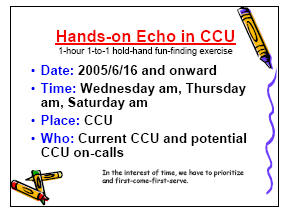
This is Fung Shui of this department that from time to time we need/want to do echo during CCU call. To practice transvenous pacing need a large amount of luck but echo does not. Teach one is better than do many ones and do one is better than see many ones. This is where this echo exercise comes from..
TTE actually comprises of two different studies - dimensional echo and doppler studies. A heart in asystole do not have doppler signal though you can still measure how big (dimension) it is.
Heart is a 3-D structure while echo is a 2-D tool. You really need to have a heart model to appreciate the topographic relationships of all those structures.
Doppler echo is a 4-D tool and time is the 4th 'dimension'.
Primary data are the raw data the echo machine gives us. The quality-limiting factor is on the hardware (echo machine, echogenicity of the patient). This is what we are practicing in CCU - try to get the best window using the echo machine we have from a wide variety of patients.
The clinical parameters are what we give (interpret) the primary data, after making certain geometric/haemodynamic assumptions. This is what echocardiogram/echocardiographer and echocardiography/echocardiologist differs. However, it is bookwork.
There are many books on echocardiography. All are very heavy (and painfully expensive). In contrast to medical statistics, there are not much free online resources. In order not to scare you away, I have made some notes (1) (2) at another site.
Finally, echo is a difficult subject that obviously need more than one hour to understand it. Put too much thing in one session is waste of time. On the other hand, the concentration span of an ordinary people seldom last longer than one hour. Wish everyone of you could take your many one-hour before I disappear.
