
The Last Battle, p. 82
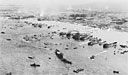
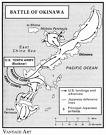
The land battle spanned a period of approximately 82 days, beginning on April 1, 1945. As the troops of the Tenth Army, led by Lt. Gen. Simon Bolivar Buckner, prepared for the attack, navy ships and aircrafts annihilated Okinawa's beaches, providing stellar support for the approaching troops. The troops were unsure of what to expect at Okinawa. The Japanese tactics were inconsistent throughout the Pacific conflict, but the U.S. felt that because Okinawa was so close to the Japanese mainland, they could encounter serious opposition. What they encountered was far from what they expected. Facing little opposition, 16,000 troops came ashore in the first hour, with the amount of troops totaling 60,000 by sundown. Accompanied by tanks, service troops and heavy artillery, the combat troops made their way inland, focusing their attack on two airfields, Yontan and Kadena. The airfields fell with great ease, and were under U.S. control by nightfall.
As the U.S. troops were spreading with ease through the interior of the island, the U.S. navy was fending off serious attacks by suicide bombers. Maj. Gen T.E. Watson's 2nd Marine Division found themselves in a similar position off the eastern coast of the island. Suicide planes attacked their boats forcing them to return to their transports. Watson and his troops never planned to move ashore, but the Japanese 32nd army claimed that they thwarted an invasion off the southeastern coast.
At the end of the first day on Okinawa, casualties were far fewer than the U.S. had anticipated. Although the troops met little resistance, they did not doubt that major battles lay ahead.
The second day of the conflict found American forces working their way through the interior of the island and eventually reaching the eastern coast. They effectively cut off the Japanese in the north from those in the south. Their rapid advance enabled marine troops to proceed with the taking of Motobu Peninsula, while the army troops struck in the south. On April 5, the first major resistance was met at a ridge that came to be known as the Pinnacle. The Japanese fortified this area with trenches, mined areas, and barbed wire. Savage fighting took place for two days before the U.S. forces were able to take the ridge with only 20 Japanese living to escape. The U.S. command discovered that the Japanese were extremely adept with frontal assaults, but lacked a cohesive plan when attacked on its flanks.
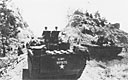
Elsewhere on Okinawa, the 96th division was moving southward meeting an increase in resistance. On April 6, following an air strike on Cactus Ridge, the 383rd Infantry charged with western side of the ridge gaining complete control for the Americans. The U.S. troops were approaching the perimeter of the Japanese fortified defense zone on the Kakazu area. Fighting would become increasingly savage with the 12th Independent Infantry Brigade commanded by Lt. General Ushijima and the numerous Okinawan Home Guards. The Northern Campaign simultaneously occurred during the first week on Okinawa. The 6th Marines moved through the foothills of Mount Yontan, the Hagushi beaches and the town of Nagahama. The Northern Campaign was well ahead of schedule, rapidly advancing on retreating Japanese troops. As the Marines pushed forward, to the rear, support troops repaired bridges and widened roads in anticipation of the arrival of U.S. artillery, tanks and supplies.
The first seven days of the Okinawan campaign were successful with rapid progress, securing numerous sites for the U.S. troops. The forces now found themselves pressing closer to the powerful defenses around Shuri. Future success would most certainly be at a higher cost of human life for the U.S. troops as the Japanese were becoming increasingly desperate and willing to fight a determined battle.
A crucial element to the successful campaign on Okinawa was the safety of the naval armada sitting off the island shores. The Imperial Japanese Navy decided to send its forces to Okinawa in hopes of destroying the Allied fleet. On April 6, radar picket ships were attacked by 900 Japanese planes, 355 of them the dreaded kamikazes. This increased use of Kamikazes indicated how important the Japanese viewed this battle. The U.S. lost three destroyers, 2 ammunition ships and one LST. Eight destroyers, a destroyer escort and a mine layer, all suffered extensive damage. Considering the massive amounts of Allied ships in the area, the casualties were considered light.

The Last Battle, p.78