The "Betsy Ross" flag.

Vermont and Kentucky joined the union in 1791 and 1792. This flag with 15 stars and 15 stripes, was adopted by a Congressional act of 1794. The flag became effective May 1, 1795.

By 1818, the union consisted of 20 states. A Congressional act mandated that the number of stripes be fixed at 13 and that one new star was to be added for each new state, the July 4 following its admission. However, nothing was written about what arrangement the stars should be in. This and the following two flags were all used simultaneously.

By 1861, the nation had 34 states. Even after the South seceded from the Union, President Lincoln would not allow any stars to be removed from the flag.

The United States flag today. The 50th star was added on July 4, 1960 for Hawaii, which entered the Union on August 21, 1959.

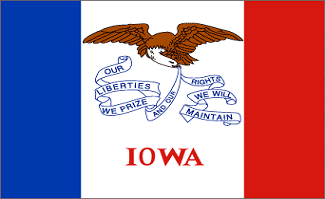
It was not until 1921, almost seventy-five years after the admission of Iowa into the Union, that a state banner was finally adopted by the Legislature. Designed by Mrs. Dixie Cornell Gebhadt, the banner consists of three vertical stripes of blue, white and red. Gebhadt explained the meaning of the colors. As well as a reference to the colors of the United States, the color blue stands for loyalty, justice and truth; the white stands for purity; and the red for courage. An eagle is displayed on the white center stripe of the flag. The eagle carries in its beak blue streamers with the state motto, "Our liberties we prize, and our rights we will maintain", inscribed on it in white letters. The state name "IOWA" is printed in red letters below the eagle.
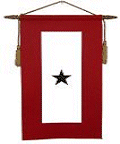
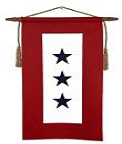
The Service flag was first displayed in the front windows of homes during World War I to signify a son or husband serving in the Armed Forces. The flag quickly became known as the "son in service flag" with each blue star indicating one family member.
The Service flag is authorized for display by Americans to honor their family members who are serving in the Armed Forces of the United States during ANY period of war or hostilities.
The blue star represents one family member serving in the Armed Forces. The blue star is covered or replaced with a gold star to indicate that the family member was killed or died during the war or period of hostilities. The blue star represents hope and pride, and the gold star represents sacrifice to the cause of liberty and freedom.
Each blue star indicates one family member serving in the Armed Forces of the United States. If multiple stars are shown, a gold star takes the place of honor nearest the staff