BEAR SCOUT BOOK
Bear Requirements
If this is a boy's first year in Cub Scouting, he must first earn the Bobcat Badge then
he may work on the Bear Trail. To earn the Bear Badge, a Cub Scout must complete
12 achievements out of a possible 24 that are offered in the book. The
achievements are grouped in 4 major areas: GOD, COUNTRY, FAMILY, and SELF.
Within each group, a required number of achievements must be completed, as
indicated below. Also, any achievements that they do not use to earn the Bear
Badge may be used to earn Arrow Points.
(Note: These
achievements are primarily done at home and signed off by an adult family member
after the boy has completed each one. The book is then shown to the Den Leader
who records the progress and also signs the boy's book.)
The Bear
Achievements are as follows:
GOD
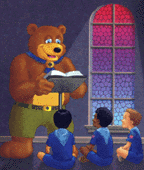
Do one of the
following
- WAYS WE WORSHIP
We are lucky. The
people who wrote and signed our Constitution were very wise. They understood
the need of Americans to worship God as they choose. A member of your family
will be able to talk with you about your duty to God. Remember, this
achievement is part of your Cub Scout Promise: "I promise to do my best to do
my duty to God and my country..."
Practice your religion as
you are taught in your home, church, synagogue, mosque, or other religious
community.
- EMBLEMS OF FAITH
Many signs
remind us of God. Among them are a six-pointed star, a cross, and a crescent.
There are many other religious symbols. One of them may appear on a special
emblem you may earn to wear on your uniform. Learn more about you faith from
your rabbi, minister, priest, imam, elder, or other religious
leader.
Earn the religious emblem of your faith.
COUNTRY
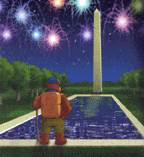
Do three of
the following
- WHAT MAKES AMERICA SPECIAL?
Americans believe everyone should be free and should control his or
her own life. We have the right to own property and to worship any way we
want. Our laws protect each of us equally. People did not always live this
way. How men and women got together and started our free way of life makes an
interesting story. The story is still being written. Probably your parents and
grandparents and even your great-grandparents are part of it. You can be part
of it, too. As a Cub Scout, you can be one of the reasons that America is
special. Help others. Be a good citizen. Take part in the life of your
country.
Do requirement "a" and three of the
following
- a.
- Write or tell what makes America special to you.
- b.
- With the help of your family or den leader, find out about two
Americans. Tell the things they did or are doing to improve our way of
life.
- c.
- Find out something about the old homes near the place where you live. Go
and see two of them.
- d.
- Find out where places of historical interest in or near your town are
located. Go and visit one of them with your family or den.
- e.
- Pick your favorite state or home state. Name the state bird, tree, and
flower. Describe its flag. Give the date it was admitted to the union.
- f.
- Be a member of the color guard in a flag ceremony for your den or pack.
- g.
- Display the U.S. flag in your home or fly it on three national
holidays.
- TALL TALES
A modern-day tall tale
might be a fisherman's story about "the big one that got away." What we mean
by "tall tales" in the Bear Book are stories, customs, songs, and sayings from
our American past. These were handed down by families or groups of people.
They tell us about the life and spirit of our forefathers. American folklore
is told in stories and songs, some true and some told to make the story
better. One thing you can count on about tall tales or folklore is they tell
about the happiness, fears, dreams, and hopes of early Americans. American
folklore is full of wonderful people and adventures.
Do ALL three requirements
- a.
- Tell in your own words what folklore is. List some folklore stories,
folksongs, or historical legends from your own state or part of the country.
Check this out to take a Folklore Quiz.
- b.
- Name at least five stories about American folklore. Point out on a
United States map where they took place.
- c.
- Read two folklore stories and tell your favorite one to your
den.
- SHARING YOUR WORLD WITH WILDLIFE
(This Achievement
is part of the Cub Scout World Conservation Award)
Every living creature has a place in this world, and
there is room for all of us. Birds, fish, and animals need clean water, food,
and air just as Cub Scouts do. You can help protect wildlife by following the
fishing and hunting laws. Keep wildlife areas beautiful. Pick up trash along
the trails, streams, and lakeshores. Put it in rubbish barrels where it
belongs.
Do four of the following
- a.
- Choose a bird or animal that you like and find out how it lives. Make a
poster showing what you have learned.
- b.
- Build or make a bird feeder or bird house.
- c.
- Explain what a wildlife conservation officer does.
- d.
- Visit one of the following: Zoo, Nature Center, Wildlife Refuge, Game
Preserve.
- e.
- Name one animal that has become extinct in the last 100 years. Tell why
animals become extinct.
- TAKE CARE OF YOUR PLANET
The
earth is your planet. That means you have to help take care of it. It's the
only planet we will ever have. Conserve energy. Save our resources. Plant
trees and flowers.
Do three of the following
- a.
- Save five pounds of glass or aluminum, or one month of newspapers, and
turn them in at a recycling center.
- b.
- Plant a tree in your yard or on the grounds of the group that operates
your Cub Scout Pack or in a park. Be sure to get permission first.
- c.
- Call city or county officials or your trash hauling company and find out
what happens to your trash after it is hauled away.
- d.
- Do a water usage survey in your home. Note the ways water is used. Look
for any dripping faucets.
- e.
- Discuss with one of your parents the ways your family uses energy.
- f.
- Find out more about your family's use of electricity.
- LAW ENFORCEMENT IS A BIG JOB
Police officers need our help as they work to protect us. We need
to understand ways of taking care of ourselves. Crime has always been a
problem everywhere. But we can do something about it. This achievement will
help you understand how the police and others fight crime. It will also show
you ways that you can help.
Do four of the following
- a.
- Make a set of your own fingerprints.
- b.
- Make a plaster cast of a shoeprint in the mud.
- c.
- Check the doors and windows of your home.
- d.
- Visit your local sheriff's office or police station.
- e.
- Be sure you know where to get help in your neighborhood.
- f.
- Be sure fire and police numbers are listed by the phone at your home.
- g.
- Know what you can do to help law enforcement.
FAMILY
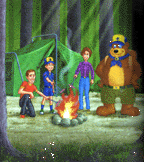
Do four of
the following
- THE PAST IS EXCITING AND IMPORTANT
Something that took place 100 years ago can seem as exciting and
interesting as something that took place yesterday. You learn about America's
past in school. Your family has history, too; so has your community, and your
Cub Scout Pack.
Do three of the following
- a.
- Visit your library or newspaper office. Ask to see back issues of
newspapers. (What were headlines on: Date you were born; July 21, 1969; Day
you were 5 years old?)
- b.
- Find someone who was a Cub Scout a long time ago. Talk with him about
what Cub Scouting was like then. (What did they do at den meetings, pack
meetings, what kind of uniform did they wear?)
- c.
- Start a pack scrapbook and give something to it.
- d.
- Trace your family back through your grandparents or great-grandparents;
or, talk to your grandparents about what it was like when they were younger.
- e.
- Find out some history about your community.
- f.
- Keep a diary for two weeks.
- WHAT'S COOKING?
We all like to
eat good things. Good things seem to taste even better when we make them
ourselves. In this achievement, you will want to work with someone who knows
how to cook. You and that person can cook up some great
food.
Do four of the following
- a.
- Bake cookies.
- b.
- Make snacks for a den meeting.
- c.
- Prepare one part of your breakfast, one part of your lunch, and one part
of your supper.
- d.
- Make a list of the "junk" foods you eat. Discuss "junk" food with your
parent or teacher.
- e.
- Make some healthful after-school snacks or some snacks for watching
television.
- f.
- Make a dessert for your family.
- FAMILY FUN
Families live together
and take care of each other. Get to know your family better by spending more
time with them. Plan a trip or a fun evening together. Talk about your plans.
A parent or guardian is like Baloo, a Cub Scout Leader, who can show you many
useful and interesting things.
Do BOTH of these requirements
- a.
- Go on a trip with members of your family.
- b.
- Have a "family-make-and-do-night".
- BE READY!
You expect fire
fighters, police, and paramedics to protect you in an emergency. Sometimes,
though, you have to take care of yourself or someone else until help arrives.
You should be ready to do the right thing if this happens. Fires and accidents
can be frightening, and it is natural to be scared. That is why we think about
what to do before an emergency happens. In a very serious case, there is
little time to stop and figure out what to do. That is why we must be ready.
If someone's clothes are on fire, or breathing has stopped, you must act at
once. In other cases there may be time to stop a few seconds and thing about
what to do. Your best way to handle most cases is to get help from an adult.
If you are not with an adult, go outside and try to stop a passing car. DO NOT
stand in the road or street. Most drivers will stop if you wave to them and
they see your Cub Scout Uniform. A good way to be ready is to carry enough
change for a pay telephone. In some places you can dial "911" for help. Find
out if you can do that where you live.
Do the first four (The last one is
recommended, but not required.)
- a.
- Tell what to do in case of accident in the home. Parent needs help.
Clothes catch on fire.
- b.
- Tell what to do in case of a water accident.
- c.
- Tell what to do in case of a school bus accident.
- d.
- Tell what to do in case of a car accident.
- e.
- Have a health checkup by a physician (optional).
- FAMILY OUTDOOR ADVENTURE
You may
live in a state with snow in winter, or you may live where it is warm all the
time. No matter where you live, being outside and doing things with your
family is great. You can have fun together and get to know one another
better.
Do three of the following
- a.
- Go camping with your family.
- b.
- Go on a hike with your family.
- c.
- Have a picnic with your family.
- d.
- Attend an outdoor event with your family.
- e.
- Plan your outdoor family day.
- SAVING WELL, SPENDING WELL
People
can do a lot of things with money. They can buy or build a house. Cars,
clothes, food--almost everything we need or use takes money. We can make some
things. We can raise or grow some foods. When we do that we save money. You
may have an allowance, or you may earn money for the things you need each
week. Money is going to be important to you all of your life. Now is a good
time to learn how to control it.
Do four of the following
- a.
- Go grocery shopping with a parent. Compare prices of different brands of
the same item. Check the prices at different stores. Read the ads in your
newspaper.
- b.
- Set up a savings account.
- c.
- Keep a record of how you spend money for two weeks.
- d.
- Make believe you are shopping for a car for your family.
- e.
- Discuss family finances with one of your parents.
- f.
- Play a board game with your family that involves the use of make-believe
money.
- g.
- Figure out how much it costs for each person in your home to eat one
meal.
SELF
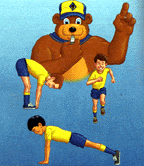
Do four of
the following
- RIDE RIGHT
Bicycle motorcross,
10-speeds, bike hikes--there are all kinds of bicycles and things to do with
them today. Boys and grils and grownups, too, are riding bikes more and more.
Bicycling is fun, it's good for you, and it's interesting. But bicycling can
be dangerous if you are not careful. Be sure you know the safety rules for
bicycling, and be sure and you and your mom or dad always keep your bike in
good shape.
Do requirement "a" and three
more.
- a.
- Know the rules for bike safety.
- b.
- Learn to ride a bike. Show that you can follow a winding course for 60
feet doing sharp left and right turns, a U-turn, and an emergency stop.
- c.
- Keep your bike in good shape. Identify the parts of a bike that should
be checked often.
- d.
- Change a tire on a bicycle.
- e.
- Protect your bike from theft. Use a bicycle lock.
- f.
- Ride a bike for one mile without rest, be sure to obey all traffic
rules.
- g.
- Plan and take a family bike hike.
- GAMES, GAMES, GAMES!
Let's play a
game! Everybody likes games, especially outdoor games. Here are some game
ideas. You may have played some of them, but you will probably find new ones.
Games are fun and they teach you how to think before you
act.
Do two of the following
- a.
- Set up the equipment and play any two of these outdoor games with your
family or friends.
Backyard golf - Kickball - Badminton - Tenpins -
Croquet - Tetherball - Sidewalk Shuffleboard - Volleyball
- b.
- Play two organized games with your den.
- c.
- Select a game your den has never played. Explain the rules. Tell them
how it is played, then play it with them.
- BUILDING MUSCLES
Games, stunts,
and contests with other Cub Scouts help you become physically fit and alert.
Den and Pack activities are aimed at keeping you healthy. This achievement
will develop your speed, balance, and reactions. The more you practice, the
stronger you will become. A strong body is important to you now, and it will
be even more important to you as you grow older.
Do ALL of the following
- a.
- Do physical fitness stretching exercises. Then do sit-ups, push-ups, the
standing long jump, and softball throw.
- b.
- With a friend, compete in at least six different two-person contests.
- c.
- Compete with your den or pack in the crab relay, gorilla relay, 30-yard
dash, and kangaroo relay.
- INFORMATION, PLEASE
Information
is a big word with a simple meaning. It means facts, and telling someone a
fact is communication. We can also get information from newspapers, books,
magazines, radio, TV, and computers. As you complete this achievement, you
might be surprised to find out all the ways we can give and get
information.
Do requirement "a" and three more of the
following
- a.
- With an adult in your family, select a TV show. Watch it together.
- b.
- Visit a newspaper office, TV or radio station and talk to a news
reporter.
- c.
- Play a game of charades at your den meeting or with your family at home.
- d.
- Visit a place where computers are used.
- e.
- Write a letter to a company that makes something you use.
- f.
- Talk with one of your parents or another family member about how getting
and giving facts fits into his or her job.
- JOT IT DOWN
Writing is one of the
most important things man has learned to do. Writing lets us send messages to
far away places, make a lasting record of things we want to remember, and read
what others have done or thought in the past. Being able to write clearly is a
useful and satisfying skill. Do this achievement to learn moare about
it.
Do five of the following
- a.
- Make a list of the things you want to do today. Check them off when you
have done them.
- b.
- Write two letters to relatives.
- c.
- Keep a daily record of your activities for two weeks.
- d.
- Write an invitation to someone.
- e.
- Write a story about something you have done with your family.
- f.
- Write a thank-you note.
- g.
- Write about the doings of your den.
- SHAVINGS AND CHIPS
Your Cub Scout
knife is an important tool. You can do many things with its four blades. The
cutting blade is the one you will use most of the time. With it you can make
shavings and chips and carve all kinds of things. You must be very careful and
think when you whittle or carve. Take good care of your knife. Always remember
that a knife is a tool, not a toy. Use it with care so that you don't hurt
yourself or spoil what you are carving.
Do ALL of the following
- a.
- Know the safety rules for handling a knife.
- b.
- Show that you know how to take care of and use a pocketknife.
- c.
- Make a carving with a pocketknife.
- d.
- Earn the Whittling Chip card.
- SAWDUST AND NAILS
When you can
cut wood to the right length and fasten it together with nails, you are a
handyman; but there are more tools than a hammer and saw. You will need
something to hold the wood in place while you work on it. Sometimes you will
need to make a curved cut or put a hole through the wood. A good way to learn
how to use tools is to watch someone using them. When you need to make
something with wood asky your parent or an adult to show you how to use the
tools safely.
Do ALL of the following
- a.
- Show how to use and take care of four tools.
- b.
- Build your own tool box.
- c.
- Use at least two tools to fix something.
- BUILD A MODEL
Model kits can be
fun to put together. You can be proud of your model when it is finished. Most
boys like to put together models. Did you know that you might still be putting
models together when you grow up? Many grownups like to build models as a
hobby. They build ships out of wood, or large model train layouts they call
"pikes." Models are also used by companies for serious purposes. Auto makers
build smal models of their new cars before they actually start making them.
Companies that build airplanes do the same thing. People who design and build
shopping centers or other kinds of buildings often build models to see whtat
the building will look like. Model buildings can be serious business for
grownups. As yo can see, model building can be more than just going to the
hobby shop and buying a kit.
Do three of the following
- a.
- Build a model from a kit.
- b.
- Build a display for one of your models.
- c.
- Make believe you are planning to change the furniture in one of the
rooms in your home.
- d.
- Make a model of a mountain, a meadow, a canyon, or river.
- e.
- Look at a model of a shopping center or new building that is on display
somewhere.
- f.
- Make a model of anything - a rocket, boat, car, or
plane.
- TYING IT ALL UP
Sailors, cowboys,
and mountain climbers all use good strong rope. Their lives depend on their
ropes and the knots that hold them in place.
Do five of the following
- a.
- Whip the ends of a rope.
- b.
- Tie a square know, bowline, sheet bend, two half hitches, and a slip
knot. Tell how each knot is used.
- c.
- Learn how to keep a rope from tangling.
- d.
- Coil a rope. Throw it, hitting a 2-foot square marker 20 feet away.
- e.
- Learn a magic rope trick.
- f.
- Make your own rope.
- SPORTS, SPORTS, SPORTS
Sports
make for great times. They help us stay healthy and in good shape. They are
fun to watch and fun to play.
Do ALL of the following
- a.
- Learn the rules and how to play three team sports.
- b.
- Learn the rules and how to play two sports in which only one person is
on each side.
- c.
- Take part in one team and one individual sport.
- d.
- Watch a sport on TV with a parent or some other member of your family.
- e.
- Attend a high school, college, or professional sporting event with your
family or your den.
- BE A LEADER
Leadership means more
than just elling others what to do. It means doing the right things. It also
means listening to everyone's ideas before going ahead. It's hard to be a
leader, but you feel good if you do your job well. Your community and country
need good leaders. In these requirements, you will find some ways to be a good
leader.
Do three of the following
- a.
- Help a boy join the Cub Scouts, or help a new Cub Scout through the
Bobcat trail.
- b.
- Serve as a denner or assistant denner.
- c.
- Plan and conduct a den activity with the approval of your den leader.
- d.
- Tell two people they have done a good job.
- e.
- Leadership means choosing a way even when your choice is not liked by
all.
BEAR ELECTIVES
AFTER a Bear Cub Scout earns his Bear Badge he may begin working on earning
Arrow Points in the Electives section of his book. He may work on his "Arrow
Point Trail" at any time, however, he cannot receive Arrow Points until after he
has earned the Bear Badge.
There is a big difference in the achievements for arrow points for Bear. In
this rank the Cub Scout can go back and do requirements from the achievements
section of the book and use them as requirements for arrow points, as long as
they do not count any requirements that they used to earn the Bear Badge.
The Achievement requirements and the Elective requirements can be freely
mixed to count toward earning arrow points. In the following descriptions, we
will use the term "Arrow Points" to refer to either type of requirement.
GOLD ARROW POINT - For the FIRST tem arrow
points completed, the Bear Cub earns his GOLD ARROW POINT.

SILVER ARROW POINTS - For EACH tem arrow points
completed (AFTER HE EARNS THE GOLD ARROW POINT) the Bear Cub earns a SILVER
ARROW POINT.
He may earn any number of SILVER ARROW POINTS, but he may only earn ONE GOLD
ARROW POINT for the first ten elective points that he completes.
The following is a list of the ELECTIVES for arrow points. To see what is
available in the Achievements section - see Bear Badge requirements above.
- SPACE
What do you see when you
look toward the sky? You might say, "In the daytime, I see the sun and the
clouds. At night, I see the moon and stars." That's true, of course. You also
are looking at man's newest frontier. Here's your chance to learn something
about space.
- a.
- Identify two constellations and the North Star.
- b.
- Make a pinhole planetarium and show three constellations.
- c.
- Visit a planetarium.
- d.
- Build a model of a rocket or space satellite.
- e.
- Read and talk about at least one man-made satellite and one natural one.
- f.
- Find a picture of another planet in our solar system. Explain how it is
different from Earth.
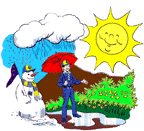
- WEATHER
(This Elective is part of the Cub Scout
World Conservation Award)
Everyone wants to know what the weather is and what it will be
tomorrow. Will it rain out my team's baseball game? Do I need a sweater? Those
are questions you have probably asked. In this Elective, you will learn how
weather forecasts are made, how to measure rain and snowfall, and how to
figure wind directions.
- a.
- Learn how to read a thermometer. Put a thermometer outdoors and read it
at the same time every day for two weeks. Keep a record of the weather for
each day.
- b.
- Build a weather vane, record wind direction for two weeks at the same
hour. Keep a record of the weather for each day.
- c.
- Make a rain gauge.
- d.
- Find out what a barometer is and how it works. Tell your den about it.
Tell what "relative humidity" means.
- e.
- Learn to identify three different kinds of clouds. Estimate their
height.
- f.
- Watch the weather forecast on television every day for two weeks.
Describe three different symbols used on weather maps. Keep a record of how
many times the weather forecast is correct.
- RADIO
You probably hear radioo
every day without things musch about it. Radio is just one of the things you
have grown up with. When radio first began, however, everyone thought it was
wonderful that music and words culd be sent all over the world without wires.
You can find out for yourself the excitement of the early days of radio, and
learn how it works by building a radio for yourself.
- 1.
- Build a crystal or diode radio.
- 2.
- Make and operate a battery powered radio following the directions with
the kit.
- ELECTRICITY
Wouldn't it be fun to
make an electric motor that really works? Well, you can. There are other
things like games and toys that run on electricity which you can also make. As
you build them, you will be learning about electricity, the power that runs so
many things around your house and school and around your
community.
- a.
- Wire a buzzer or doorbell.
- b.
- Make an electric buzzer game.
- c.
- Make a simple bar or horseshoe electromagnet.
- d.
- Use a simple electric motor.
- e.
- Make a crane with an electromagnetic lift.
- BOATS
Boating and sailing are
great sports. May you have already been sailing, but do you know how to rig a
sailboat? Make a raft? Repair a dock? Do you know the safety rules for
boaters? If your answers were no, find out now. Anchors
aweigh!
- a.
- Help your dad or any other adult rig and sail a real boat.
- b.
- Help your dad or any other adult repair a real boat or canoe.
- c.
- Know storm warning flag signals.
- d.
- Help an adult repair a boat dock.
- e.
- Know the rules of boat safety.
- f.
- With an adult, demonstrate forward strokes, turns, and backstrokes. Row
a boat around a 100-yard course involving two turns.
- AIRCRAFT
Cub Scouts are too young
to fly real airplanes, but they can learn a lot about them. They can fly model
airplanes. They can visit airports, talk to pilots, and be a passenger in an
airplane. There are lots of ways to have fun with airplanes, and to learn more
about them.
- a.
- Identify five different kinds of aircraft in flight, if possible, or
from models or photos.
- b.
- Ride in an airplane (commercial or private).
- c.
- Explain how a hot air balloon works.
- d.
- Build and fly a model airplane. (You can use a kit. Every time you do
this differently, it counts as a completed project.)
- e.
- Sketch and label an airplane showing the direction of forces acting on
it (lift, drag, and load).
- f.
- What are some of the things a helicopter can do that other kinds of
airplanes can't? Make a list. Draw or cut out a picture of a helicopter and
label the parts.
- g.
- Build and display a scale airplane model. You may use a kit or build it
from plans.
- THINGS THAT GO
May when you were
little, your folks got you a toy car to ride. It was lots of fun. Think how
much fun it would be now if you build it any way you like, and stop, go, or
steer as you please. Try building a Cubmobile and have fun! Cubmobiles are not
the only things that go. Have you ever seen a windmill or a water wheel and
wondered what they do? Make a windmill or waterwheel, after you've done
them--you may want to make an invention of your own that
goes.
- a.
- Make a scooter or a Cubmobile. Know safety rules.
- b.
- Make a windmill.
- c.
- Make a waterwheel.
- d.
- Make an invention of your own design that goes.
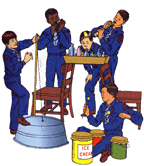
- CUB SCOUT BAND
Here comes the
band--the Cub Scout band! You can play music even if you have never had a
lesson. You can even make your own instrument. You can learn how in this
elective. Strike up the band!
- a.
- Make and play a homemade musical instrument - cigarbox banjo, washtub
bull fiddle, a drum or rhythm set, tambourine, etc.
- b.
- Learn to play two familiar tunes on an ocarina, harmonica, or tonette.
- c.
- Play in a den band using homemade or regular musical instruments. Play
at a pack meeting.
- d.
- Play two tunes on any recognized band or orchestra
instrument.
- ART
Art is not just pictures. The
artist's skill is used to make pictures and sculpture that tell a story and
are pleasant to look at. That is what art is about. Statues and stained glass
windows are made for the same reasons. Study the art around you, and try your
hand at making your own.
- a.
- Do an original art project and show it at a pack meeting. Every project
you do counts as one requirement. Some ideas for art projects are: Mobile -
Wire Sculpture - Collage - Silhouette - Mosaic - Acrylic Painting - Clay
Sculpture - Water Color - Silk Screen Picture.
- b.
- Visit an art museum or picture gallery with your den or
family.
- MASKS
Since time began, we have
been using masks to act out plays, games, and important religious ceremonies.
We wear masks to pretend we are something besides ourselves. This can be fun,
like Halloween.
- a.
- Make a simple papier-mâché mask.
- b.
- Make an animal mask.
- c.
- Make a clown mask.
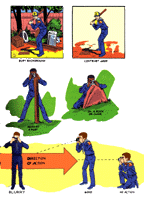
- PHOTOGRAPHY
Taking pictures is a
lot of fun, but it can be harder than you may think. You need to use a camera
to learn the secrets of making good pictures.
- a.
- Practice holding a camera still in one position. Learn to push the
shutter button without moving the camera. Do this without film in the camera
until you have learned how. Look through the viewfinder and see what your
picture will look like. Make sure that everything you want in your picture
is in the frame of your viewfinder.
- b.
- Take five pictures of the same subject in different kinds of light. (1)
Subject in direct sun with direct light. (2) Subject in direct sun with side
light. (3) Subject in direct sun with back light. (4) On a sunny day,
subject in shade. (5) Cloudy day.
- c.
- Put your pictures to use. (1) Mount a picture on cardboard for display.
(2) Mount on cardboard and give it to a friend. (3) Make three pictures that
show how something happened (tell a story) and write one sentence
explanation for each.
- d.
- Make a picture in your house. (1) With available light. (2) Using a
flash attachment or photo flood.
- NATURE CRAFTS
(This Elective is part of the Cub
Scout World Conservation Award)
When you go on a hike with a group in the woods, watch for animal
tracks. Look at the trees and see how many you can name. If you look
carefully, you will see that the rocks are many shapes, sizes, and colors.
Nature is a fun world to get to know.
- a.
- Make shadow prints or blueprints of three kinds of leaves.
- b.
- Make a display of eight different animal tracks with an eraser print.
- c.
- Collect, press, and label ten kinds of leaves.
- d.
- Collect, mount, and label ten kinds of insects.
- e.
- Collect eight kinds of plant seeds and label.
- f.
- Collect, mount, and label 10 kinds of rocks or minerals.
- g.
- Collect, mount, and label five kinds of shells.
- h.
- Make a spider web print; mount and display it.
- MAGIC
Now you see it--now you
don't! Magic is a world of surprises. You can have fun with magic
tricks.
- a.
- Learn and show three magic tricks.
- b.
- With your den, put on a magic show for your pack.
- c.
- Learn and show four puzzles.
- d.
- Learn and show three rope tricks.
- LANDSCAPING
Some of our most
useful plants are food plants. Other plants are grown for their beauty.
Deciding which plants to use and how they should be arranges is called
landscaping. Careful use of flowers, bushes, and trees can make our homes,
neighborhoods, and parks nicer places to live and visit.
- a.
- Help your parents take care of your lawn or help take care of the lawn
of a public building, school, or church. Seed bare spots. Get rid of weeds.
Pick up litter. Agree ahead of time on what you will do.
- b.
- Make a sketch of a landscape plan for the area right around your house
or for an apartment building. Talk it over with your parents or den leader.
Show what trees, shrubs and flowers you could plant to make the area look
better.
- c.
- Take part in a project with your family, den, or pack to make your
neighborhood or community more beautiful. These might be cleanup parties,
painting, planting, cleaning and painting trash barrels, and removing
ragweed. (Each time you do this differently, it counts as a completed
project.)
- d.
- Build a greenhouse and grow 20 plants from seed. You can use a package
of garden seeds, or use beans, pumpkin seeds, or watermelon
seeds.
- WATER AND SOIL CONSERVATION
(This Elective is part
of the Cub Scout World Conservation Award)
Every living things depends on clean water and rich earth. It is
important that we learn as soon as we can how to care for our water and
soil.
- a.
- Dig a hole or find an excavation project and describe the different
layers of soil you see and feel.
- b.
- Take three cans the same size and punch four holes in the bottom of each
with a hammer and nail. Put clay in the first can, soil in the second can,
and sand in the third can. Fill all three cans one half-full of soil. Pour
one-half can of water into each can, one at a time. Write down the time it
takes the water to run through (until dripping stops) each kind of earth.
- c.
- Visit a burned-out forest or prairie area, or a slide area, with your
den or your family. Talk to a member of the U.S. Forest Service about how
the area will be planted and cared for, to grow again the way it was before
the accident.
- d.
- Some people like to use live Christmas trees. After Christmas, plant the
tree in your yard, or at school, your Boy Scout council service center, or a
park. Find out all the things you need to know about how to take care of a
live Christmas tree in your home.
- e.
- What is wind erosion? Find out the kinds of grass, trees, or ground
cover you need to plant to stop wind erosion.
- f.
- As a den, visit a lake, stream, river, or ocean. Plan a den project to
help clean up this important source of water. Name four kinds of water
pollution.
- FARM ANIMALS
You can learn more
about farm animals even if you don't live on a farm or a ranch. If you do, it
is easier, but if not, you can find pictures of different farm animals in
magazines and learn how they are used. You can read a book about farm animals.
Then when you go for a ride in the country, you will know what kinds of
cattle, horses, pigs, and sheep you see.
- a.
- Take care of a farm animal.
- b.
- Name and describe six breeds of farm animals and tell their common uses.
- c.
- Read a book about a farm animal and tell your den about it.
- d.
- With your family or den, visit a livestock exhibit at a county or state
fair.
- REPAIRS
It seems as though there
is always something that needs fixing around the house. Who takes care of
these repairs where you live? Maybe you have already helped with repair work.
It not, ask before you try. Talk it over. Make sure you understand what to do
before you start. Electrical and plumbing jobs are not games. You have to know
what you are doing.
- a.
- With the help of an adult, fix an electric plug or an electric
appliance.
- b.
- Use glue or epoxy to repair something.
- c.
- Remove and clean a drain trap.
- d.
- Refinish or repaint something.
- e.
- Agree with your parent on some repair job to be done and do it. (Each
time you do this differently, it counts as a completed
project.)
- BACKYARD GYM
Have you ever
visited a gym or health club? Yo can build your own gym in your backyard. If
you don't have room, don't give up. Your den can build a gym set to use in a
pack outdoor fun day. Here are some ideas. You can find more in Boys'
Life magazine and the Cub Scout Leader How-To
Book.
- a.
- Build and use an outdoor gym with at least three items from this list.
(1) Balance Board (2) Trapeze (3) Tire Walk (4) Tire Swing (5) Tetherball
(6) Climbing Rope (7) Running Long Jump Area.
- b.
- Build three outdoor toss games.
- c.
- Plan an outdoor game or gym day with your den. Put your plans on paper.
- d.
- Hold an open house for your backyard gym.
- SWIMMING
Swimming is a lot of
fun! Whe you learn to swim, you have a skill you can enjoy all you life.
Whether you swim for fun or for sport, you can enjoy it winter or summer, and
share the fun with your friends. (Remember, NEVER SWIM
ALONE!>
- a.
- Jump feetfirst into water over your head, swim 25 feet, turn around, and
swim back.
- b.
- Swim on your back, using a resting stroke, for 30 feet.
- c.
- Rest by floating on your back, using as little motion as possible for at
least one minute.
- d.
- Tell what is meant by the buddy plan and the basic rules of safe
swimming and simple rescue.
- e.
- Do a racing dive from edge of pool and swim 60 feet, using a racing
stroke.
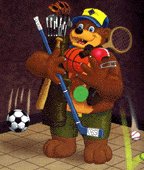
- SPORTS
If you like sports, you
aren't alone! Here are some more fun electives that will help you earn arrow
points while you learn new sports skills.
- a.
- In archery, know the safety rules. Know how to shoot correctly. Put six
arrows into a 4-foot target at a distance of 15 yards.
- b.
- In skiing, know the Skier's Safety Code. Demonstrate walking and kick
turn, climbing with sidestep or herringbone, snowplow stop, stem turn, four
linked snowplow or stem turns, and straight running in a downhill position,
or a cross-country position, and show how to recover from a fall.
- c.
- Ice skating, know the safety rules. From a standing start, skate forward
150 feet; come to a complete stop within 20 feet. Skate around a corner
clockwise and counterclockwise without coasting. Show a turn from forward to
backward. Skate backward 50 feet.
- d.
- In track, show how to make a sprint start. Run the 50-yard dash in 10
seconds or less. Show how to do the standing long jump, the running long
jump, or high jump. Land in a soft area.
- e.
- In roller skating, know the safety rules. From a standing start, skate
forward 150 feet; come to a complete stop within 20 feet. Skate around a
corner clockwise and counterclockwise without coasting and show a turn from
forward to backward. Skate backward 50 feet.
- SALES
The idea of selling
something goes back a long way. People were trading things even before money
was invented. When people traded, each one would give something for something
else he wanted more. In a sale, everyone should feel better off than he or she
was before the sale. Money is an easier way of keeping track of how much
things are worth.
- a.
- Take part in a pack-sponsored, money-earning sales program. Keep track
of the sales you make yourself. When the sale is over, add up the sales you
have sold.
- b.
- Help with a garage sale or rummage sale. This can be with your family, a
neighbor, or a church, school, or pack event.
- COLLECTING THINGS
Many people
like to collect things as a hobby. Some things that are collected are stamps,
coins, and emblems. Collections are just for fun, but you can't help but learn
something about other palces when you find a stamp, coin, or emblem from
somewhere a long way from where you live.
- a.
- Start a stamp collection. You can get information about stamp collecting
at any U.S. Post Office.
- b.
- Mount and display a collection of patches, coins, or other things to
show at a pack meeting. This can be any kind of collection. Every time you
show a different kind of collection, it counts as one requirement.
- c.
- Start your own library. Keep your own books and pamphlets in order by
subject. List the title and author of each on a piece of paper or a
card.
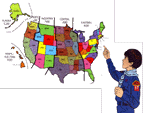
- MAPS
When explorers scout a new
land, they make maps to show others what they find. Maps mean adventure,
excitement, and imaginary trips. They are also useful for exploring your town
and state.
- a.
- Look up your state on a U.S. map. What other states touch its borders?
- b.
- Find your city or town on a map of your state. How far do you live from
the state capital?
- c.
- In which time zone do you live? How many time zones are there in the
U.S.?
- d.
- Make a map showing the way from your home to your school or den meeting
place.
- e.
- Mark a map showing the way to a place you would like to visit that is at
least 50 miles from your home.
- NATIVE AMERICAN LIFE
There were
already people in America when Columbus got here. They tell many stories abot
where they came from, but nobody knows for sure. They hunted for their food
and also grew plants that people in the rest of the world did not have. they
gave us corn, squash, and pumpkins. They lived close to nature and many still
have their own laws and religions. They were called Indians because Columbus
thought he was near India.
- a.
- Native Americans lived all over what is now the United States. Find the
name of the tribe who lived nearest where you live now. What is this tribe
best known for? Where do they live now?
- b.
- Learn, make equipment for, and play two Native American games with
members of your den. Be able to tell the rules, who won, and what the score
was.
- c.
- Make a model of an Native American
house.