What is the
best product to use?
There is no definite answer to this question. I would say what appearance are
you looking for? What does your budget dictate you can afford? Buying the most
expensive product does not at all mean it’s the best. Some window and door
manufactures spend millions of dollars a year in marketing their product. We as
the consumer are paying for this so by buying we make them the best. We have
fallen prey to their marketing schemes and pay that inflated price for the
product. There is a difference in product, but I will say your better product is
great when it comes to customer service, options, warranty and performance. You
truly do get what you pay for. Be a SMART CONSUMER!
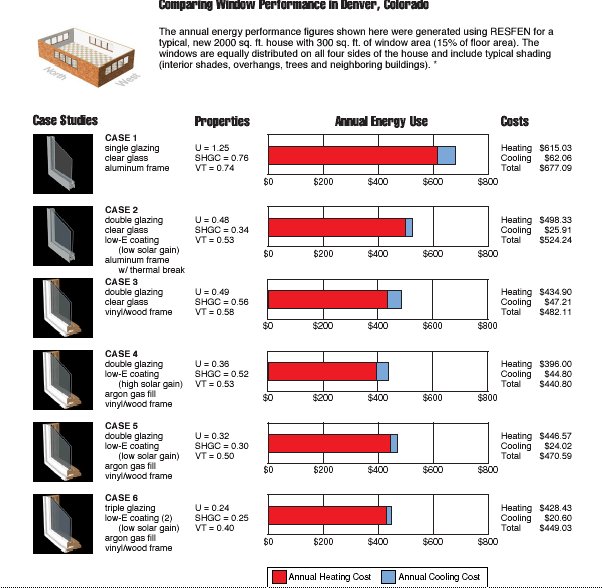
See an example of Energy Savings in Heating and Cooling (example is Denver area):
Weatherize Primary Window First
It is important to prevent moisture-laden room air from leaking past the primary
window. If not done, moisture will condense on the interior surface of the storm
window. This moisture can be trapped and cause the window framing to rot.
Caulk the interior window trim and weatherstrip the sashes. Make sure the window
latch pulls the sashes together tightly. Plan to spend an hour or more per
window to do the job properly. You may have to adjust the alignment of the
window sashes and trim for the unit to seal tightly.
Why windows "sweat" During winter, a window can get so cold that it causes "sweating" or condensation. The water can stain trim, peel paint and cause the framing to rot. This water can also cause harmful molds to grow inside your home.
Warm the Window to Reduce Condensation Increasing the temperature of the window reduces condensation. The easiest way to warm the surface is by installing a storm window. The storm window creates an insulating air space between itself and the primary window. It is this air space, not the storm unit, which cuts heat loss and warms the interior glass surface.
Condensation: on windows (between glass panels) may occur as the natural result of humidity within the house or building area and changes in interior / exterior temperatures, and does not indicate a defect in the window.
Here are the steps you should take to reduce condensation on your windows.
1. Put on good thermal windows, double or triple glazed.
2. Shut off furnace humidifier and any other humidifying devices in your home.
3. Be sure the louvers in attic or basement crawl spaces are open and that they
are large enough.
4. Run kitchen or other ventilating fans longer and more often than has been
your custom.
5. Open fireplace damper to allow easier escape for moisture.
6. Air out your house a few minutes each day. Air kitchen, laundry and bathrooms
during use or just following use.
7. If troublesome condensation persists, see your heating contractor about an
outside air intake for your furnace; about venting of gas-burning heaters and
appliances; or about installation of ventilating fans.
Normal Weathering: may cause any surface to oxidize, chalk or accumulate surface dirt or stains due to various exposure to sunlight, weather, and atmospheric conditions.
Insulated Glass: Technically, there are two or more panes of glass separated by insulation at the edges and air in the center to provide greater thermal efficiency to a window.
Argon gas-filled: Modern window technology permits an inert gas, usually argon, to be sealed between the panes of glass in a window instead of air. The gas is a far better insulator that just air, thus further increasing the thermal value of a window.
Low - E: filters long wave radiation. In the summer, Low-E reduces heat gain in your home keeping your home cooler. In the winter, Low-E lets warm solar rays into your home while blocking the heat in your home from getting out.
U-value and R-value rating: are reciprocal to one another. The term U-value is measured by the amount of heat that escapes a surface-a wall, ceiling, or window. R-Value is measured by insulation value. How many glass layers there are in a window to the type of gas that is between the panes of glass, are some of the basis of this measurement. The higher the R-value, the better insulated are walls and ceilings. The lower the U-value, the better job a window does in keeping out heat and cold.