


 |
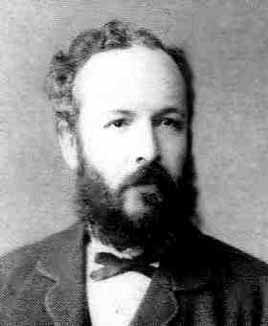
- Born: March 3, 1845 in St Petersburg, Russia
- Died: January 6, 1918 in Halle, Germany
- Full Name is:Georg Ferdinand Ludwig Philipp Cantor
- Georg was educated early in his life by private tutoring
- He went to primary school while in St. Petersburgh, Russia.
- In 1856 his family moved to Germany for a warmer climate, due to his father's poor health Cantor's father wanted him to be an Engineer, but Georg was interested in Mathematics
- In 1873 Cantor proved the rational numbers are countable,they can be put into a 1-1 correspondence with the natural numbers.
- He showed that the algebraic numbers, the numbers which are roots of polynomial equations with
integer coefficients, were countable.
- Cantor is famous for proving that the real numbers are not countable.
- A transcendental number is an irrational number that is not a root of any polynomial equation having integer coefficients.
- Cantor showed that almost all numbers are transcendental by proving the real numbers were not countable while proving that the algebraic numbers were countable.
|
| Picture and the information to the right came from this mathematics site |
|---|
| | The following taken from here |
|---|
Cantors basic definition of infinity was: a collection is infinite, if some of its parts are as big as the whole.
The Story of the Hotel Ad Infintum (as told by B. David Stacy)
The interval (0,1) is not countable Cantor's Diagonal Proof
Other 1-1 Correspondences
- The Counting numbers and the Even Counting numbers
- The Whole Numbers(0,1,2,3...) and the set of rational numbers
- But Cantor also proved there was no 1-1 correspondence between the whole numbers and the real numbers (Morris Kline-- Mathematics the loss of certainty, page 201)
- Cantor also showed that the set of all subsets of a given set is larger than the original set (Morris Kline-- Mathematics the loss of certainty, page 201)
|
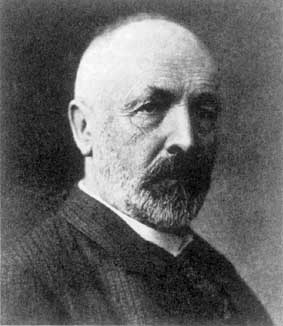 Another Picture of George Cantor Another Picture of George Cantor
|
| George Cantors' Law of Ignorance |
| "A false conclusion once arrived at and widely accepted is not easily dislodged and the less it is understood the more tenaciously it is held" (From Morris Klines' Mathematics The Loss of Certainty page 88, Copyright 1980). | | Cantor was talking about lack of acceptance of Hyperbolic Geometry as opposed to Euclidean Geometry.
|
| The Topology came from hereCantor introduced the concept of the first derived set, or set of limit points, of a set. He defined closed subsets of the real line as subsets containing their first derived set. Cantor introduced the idea of an open set, another fundamental concept in point set topology. |
| Cantor's doctoral thesis was titled "In mathematics the art of asking questions is more valuable than solving problems.What are numbers? |
Cantor Links
|
By Craig Breen |
|
