
PIG BREEDING FARM
| Research programme of the Project for the period under review |
 |
Breeding :
A breeding unit of indigenous pigs was established. Selection and pure breeding was conducted upto second generation of purebred indigenous pigs. Cross breeding was conducted between Large White Yorkshire males and indigenous females. Interse mating among the Crossbred Pigs were also done.
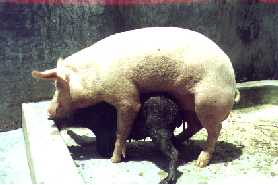 |
Two purebred generation of indigenous pigs were produced and a pilot study was conducted to study the feasibility of cross breeding between Large White Yorkshire and Desi pigs. The pilot study conducted in halfbreds to assess the success of producing 75% and 50% desi groups was also fruitful indicating the identical chromosome structure in both desi and LWY pigs. This was further confirmed by Karyotyping. Based on the results in the pilot study successful cross breeding has been conducted in reasonable number of animals and crossbred pigs were produced. Progenies from interse mating among Crossbred pigs were also produced . The production and reproduction traits of Desi pigs under farm conditions were assessed in the two generations.
Nutrition :
Nutritional experiments were conducted using the unconventional feed stuffs available in the locality and efforts were taken to develop economic rations.
The following unconventional feed stuffs were identified and tried in desi pigs.
1. Jackfruit ( Artocarpus heterophyllus)
2. Raintree fruit ( Enterolobium samman )
3. Prawn waste
4. Swill ( fresh and dried )
5. Banana Rhizome
6. Carcass meal
7. Dried blood - Rice polish mixture
8. Subabool leaves
9. Ground half riced paddy(a bye product from Modern Rice Mill, Kalady)
The nutritive value of feed stuffs identified were assessed and following low cost ration were evolved using appropriate combination of feed stuffs.
1. Rations incorporating 50% Jackfruit
2. Rations with swill alone
3. Prawn waste - Rice bran silage ration
4. Rations incorporated with Raintree fruit at 50 % level.
5. Ration incorporated with carcass meal
Management :
Management technologies were developed for achieving better labour efficiency, growth rate of animals, alleviation of summer stress of animals, effective cross breeding, better management of orphan piglets, effective watering , effective database management, detection of stress susceptibility in pigs and creating better micro environment in pig styes. A prophylactic autovaccine was developed against pneumonia.
The following managemental technologies were developed
a. Microsprinkler System
This was designed and installed in the open pig styes for alleviating summer stress in pigs. This was made locally with an out lay of Rs.40,000/- suited for 46 styes which can accommodate 250-300 adult pigs. This can be recommended to commercial farmers rearing more than 250 pigs in tropical areas where there are chances of heat stress. Wallowing can be avoided in this system there by saving water and labour. Desi animals maintained under sprinkler system had an ADG of 137.807g against 124.488g for those maintained without sprinklers. The FCE was also better under sprinkler system ( 7.971 ) against those without sprinklers ( 8.492 ).
b. Pressure Cleaning System
This was designed and installed in farrowing houses with 90 pens, with the technical assistance of Kerala Agro Industries Corporation (KAICO). The system helps for considerable labour and time saving in cleaning of sheds. It also ensures effective cleaning of pens. In this system cleaning of a pen can be done in 4-5 minutes time against 10-15 minutes in traditional system. Total financial outlay is Rs.45,000/- per 90 pens. This can be recommended for large commercial breeding farms rearing more than 200 nos. Of breeding stock. Labour can be saved up to 1/3rd of the normal requirement in commercial farms.
c. Automatic Feeder for Weaned Piglets..
This was fabricated locally using 200 lit. Oil drums measuring 94 cm height x 58 cm diameter. An outer guard and cone are fixed to it as in the case of hanging feeder for poultry with a gap of 17 cm between the drum and outer guard. Extensions (foot) are provided at the bottom for stability. About 20-25 weaned piglets can be fed with one feeder. The total cost involved is Rs.750/- per feeder. This can be recommended to medium and large scale farmers to alleviate weaning stress and post-weaning body weight loss in piglets by adopting adlibitum feeding. The average body weight of Desi pigs at 180
days of age was found to be 24.85 Kg. in animals reared on automatic feeder when compared to 21.69 Kg. In traditional feeding system.
d. Cross Breeding Trevis
This was designed locally using GI pipes and adjustable limbs. This system alleviate the difficulty in cross breeding between small Desi breeds and large exotic breeds of pigs (males). The female can be restrained in the trevis with suitable support and height of trevis can be adjusted to bear the weight of the boar. The total cost involved is Rs.450/-. This can be recommended to farms practicing cross breeding by natural mating.
e. Artificial Milk Feeder
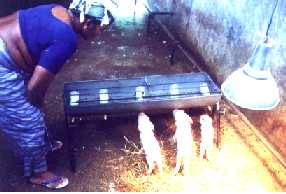
This was fabricated locally for feeding milk to orphan piglets when appropriate foster mothers are not available. Milk bottles are arranged on a convex structure which simulate sow udder. Ten piglets can be fed simultaneously using this device. Total cost of fabrication is Rs.475/-. This can be recommended to breeder farms to save orphan piglets.
 |
f. Brooding Device for Piglets.
This consists of an infrared lamp with a hood which can be hung over the farrowing pens to avoid piglet mortality due to chilling during winter and rainy season. It was fabricated locally with approximate cost of Rs.450/- per brooder.
g. Automatic Waterers.
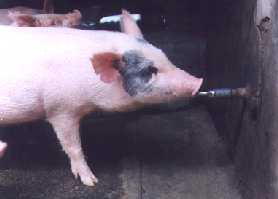 |
Designed and installed with technical assistance of KAICO. It ensures continuous drinking water availability to pigs. Cost of installation is approximately Rs.750/- per pen (Rs.350/- for waterers + Rs.400/- installation charges). It can be fitted at varying height from the floor for various categories of pigs (25 cm for weaners 65 cm for growers and 85-90 cm for sows and boars).
h. Management Information System(AMIS) for Pig Farms.
An advanced user friendly Animal Management information System (AMIS) has been developed by Mr.C.T.William. MBA.HRM working in the administrative wing of this Office. This innovated software is programmed in Visual Basic 6.0 and can be used in any animal farms. The implementation of this software ensures strict quality control in feeding, breeding and management practices of the farms. Further, this will increase the all over productivity of the farms.AMIS has been widlly applauded by the apex bodies of Kerala Agricultural University as well as the Indian Council of Agricultural Research, New Delhi.
i. Technology for detecting stress susceptibility in pigs.
Detection of halothane sensitivity in pigs is considered as a method of identifying stress susceptibility in pigs. A halothane screening procedure for detecting stress susceptibility in weaned piglets was standardised and used in association with Dept. Of Surgery, College of Veterinary and animal Sciences, Mannuthy as a part of the Ph.D. research programme. The overall findings in the study indicated that halothane positive animals are more suited for fattening purpose with respect to feed conversion efficiency and negatives for breeding purpose. If positive animals are reared for breeding environmental enrichments in the form of wallowing, water sprinkling and access to a shaded range will have better effect. Fattner pigs may be provided with an access to a shaded range rather than providing wallowing or water sprinkling facilities. Environmental enrichments (Wallowing/water sprinkling/access to shaded range) may be provided during growing and pre-partum stages of breeding stock for getting better mothering ability and litter performance. Suitable enrichments during later half of lactation may have beneficial effect on litter traits. The halothane screening procedure can be recommended for early detection of stress susceptibility in pigs. Suitable management combinations can be recommended based on the type and purpose of the stock reared.
j. Air Circulator
Installed in farrowing houses for alleviating summer stress and to effect constant air circulation avoiding foul smell. Cost involved is Rs.4900/- per house of 30 pens.
k. An autovaccine was developed and successfully used against pneumonia in pigs in collaboration with the Department of Microbiology, College of Veterinary & Animal Sciences , Mannuthy.