|
Scarcely an area of Catholic
life was left unchanged by Vatican II. Some transformations were
intended, such as the revised rites for all seven sacraments, the
introduction of vernacular languages into the liturgy, new fast
and abstinence rules for Fridays and Lent, the promotion of lay
ministries, the encouragement of dialogue with Protestants and Jews,
and so on. Many of these were controversial by themselves, but when
accompanied by other unintended changes — the decline in Mass
attendance, plummeting vocations, demonstrations of open dissent
— attitudes toward Vatican II became inevitably bound up with
judgments about its aftermath.
In my undergraduate course
on Vatican II at Catholic University in Washington, D.C., I have
the students interview older Catholics who remember the Church before
the council. The students ask the elders what it was like to be
a Catholic then, what they appreciate about the changes, what they
don’t like. The experience vividly shows the students how differently
people interpret Vatican II. Some regard it as the greatest thing
since Pentecost, while others, like the father of one of the students,
exclaim, “Those d––d liberals fixed what wasn’t
broken!”
Roughly speaking, Catholics
view the council in one of three ways. The progressives see it as
a long-overdue and much-needed accommodation to the modern world.
Pope John XXIII opened the windows, they say, and let the Spirit
blow back in. If there have been troubles since Vatican II, it’s
because the conservatives have blunted the sharp edge of conciliar
reform.
Traditionalists, meanwhile,
say the Church’s long-standing suspicion and even condemnation
of the modern world was appropriate. The Church had grown strong
and self-confident through this countercultural stance, they say,
as illustrated by the beauty of its liturgy, the popularity of its
devotions, the committed obedience of its members. The crises that
have followed Vatican II are the bitter fruit of the council’s
mistaken repudiation of centuries-old habits of mind and heart.
Finally, reformists reject
the sharp contrast posed by the first two groups. They insist on
the elements of continuity in the teachings of Vatican II, and look
realistically at the state of the Church before Vatican II. It was
not as irrelevant or archaic as the progressives say, nor was it
the ideal thing the traditionalists nostalgically describe. The
popes and bishops intended necessary reform, they argue, but not
revolution.
To shed light on the
debate, it may be helpful to step back and consider just what is
meant by Vatican II, anyway. In the first place, Vatican II is the
16 documents produced over four years of debate and compromise by
the popes and bishops of the council. The documents make up a relatively
small book, but are an obligatory reference point, especially when
extravagant claims are made about what the council said or endorsed.
Second, technically speaking,
Vatican II is what happened between January 25, 1959, when Pope
John XXIII announced his intention of convoking a council, and December
8, 1965, when Pope Paul VI brought it to a close. And it is from
this perspective that the drama of the council is best perceived.
The first session in 1962 is the setting for a number of particularly
dramatic events, starting with Pope John’s opening speech .
Here, the bishops showed that they were interested in significant
reform, and that they did not wish to issue documents that were
as defensive and condemnatory as the texts that had been prepared
for them. The result was that those who had been in charge of the
preparation of the council were suddenly revealed to be in the minority,
while those who had been marginal during the preparation were now
in charge.
During this time, many
bishops spoke of what a change of mind and heart the conciliar experience
had caused in them. And those fortunate enough to be in Rome followed
every day the ups and downs of the debates and voting. Indeed, Catholics
around the world read eagerly about the council on the front pages
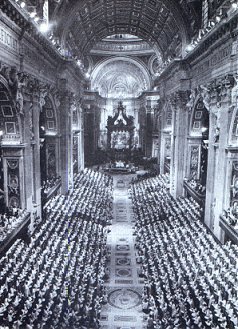
of their newspapers. They wondered at the sight of all the bishops
gathered together, at the magnitude of the debates carried out in
a spirit of charity and for the good of the Church. For almost everyone,
this was a completely new experience of the Church.
A third definition of
Vatican II considers the unintended consequences of the council.
While the popes and bishops of Vatican II may have meant to make
simple or straightforward decisions, they inspired some revolutionary
consequences. These aftereffects are another way of looking at Vatican
II.
Three of the council’s
basic decisions created strong, unintended consequences felt to
this day. The first was the very project of embarking upon serious
self-examination for the sake of self-renewal and reform. This is
what Pope John called aggiornamento, or updating. The goal was to
better discern Christ’s wishes for the Church and improve pastoral
effectiveness in the modern world. Yet Catholics were not very familiar
with the idea of self-criticism; in fact, they had been told more
than once by recent popes that the Church had no need of reform.
Soon it would seem that there was hardly a single aspect of Catholic
life — worship, preaching, catechesis, devotions, presence
in the world, relations with others — that would not be examined
and more or less altered.
Once the genies of reform
had been let out of the bottle — and by none other than the
Church’s supreme authority — Vatican II proved to be far
bigger and more difficult to control than the popes and bishops
had expected. People began extending aggiornamento into areas and
at levels that the council never anticipated.
A second decision that
prompted unintended consequences was the council’s validation
of local Churches, that is, its urging that the Church be genuinely
Asian in Asia, African in Africa, and so on. This went against the
Church’s tendency toward uniformity and the long-held assumption
that its Greco-Roman roots and its integral role in European history
compelled it to remain Eurocentric.
The council argued that
people of other cultures did not need to imitate Europeans to become
Christians, that the task of becoming genuinely at home in other
cultures can only be undertaken by members of that culture. It called
for greater self-responsibility for the local Churches, thereby
undermining the centralization of decision making in Rome that had
reached new heights in the 20th century.
Finally, the popes and
bishops of Vatican II adopted a far more nuanced attitude toward
the modern world than had been typical of the previous century and
a half. When Pope John in his opening speech criticized the “prophets
of doom,” he was referring to Church leaders who could see
nothing in the modern world but decline and degradation, apostasy
from Christ. He asked whether the modern world might not offer new
possibilities for the reign of Christ.
Vatican II responded
by calling for dialogue with the modern world, which meant listening
as well as speaking, learning as well as teaching. Catholics were
now encouraged to enter into respectful conversation with other
Christians, those of other religions, and nonbelievers.
This open attitude ran
counter to the logic that lay behind many Catholic movements and
organizations that had grown up in the previous century. Many of
these existed precisely in order to inoculate Catholics from the
world, to give them a powerful sense of identity, and to prepare
them for the combat that would win the world back to Christ. Now
the bishops were saying the world is not all bad, that we may have
some things to learn from it, that there is much that unites us
with Protestants and Jews.
Suddenly, Catholics had
to forge a new identity, one that could hold even if we didn’t
demonize other people. And that proved harder than many expected,
and more than a few Catholic organizations declined in membership
or disappeared entirely.
These are the three decisions
— to undergo self-examination, to increase local control, to
open the Church to the modern world — that had deeper consequences
than participants in the council had anticipated. Almost 40 years
later, we live the dynamism of these great decisions: We know our
permanent duty to review how we live our Christian lives; we feel
our responsibilities to undertake Christ’s work in our local
Churches; and we understand that we are the Church in the world,
a world that has much to praise and assimilate, a world that needs
Christ. If those three things remain clear in our consciousness
and strong in our conscience, then Vatican II is still alive. It
can still become the “new Pentecost” that Pope John hoped
it would be.
Taken
from http://www.catholicdigest.org/stories/200110060a.html
What
do you think of the article? Got something else to share? come to
the forums!
|